
By Thorsten Meyer
Netflix gave the idea its name. In No Rules Rules, Reed Hastings and Erin Meyer described “talent density” as the deliberate concentration of high performers — the observation that a team of a few exceptional people, with the mediocre ones removed rather than tolerated, doesn’t just perform a bit better; it operates in a different mode entirely. Fewer people, more trust, less process, faster decisions. The density itself becomes the asset.
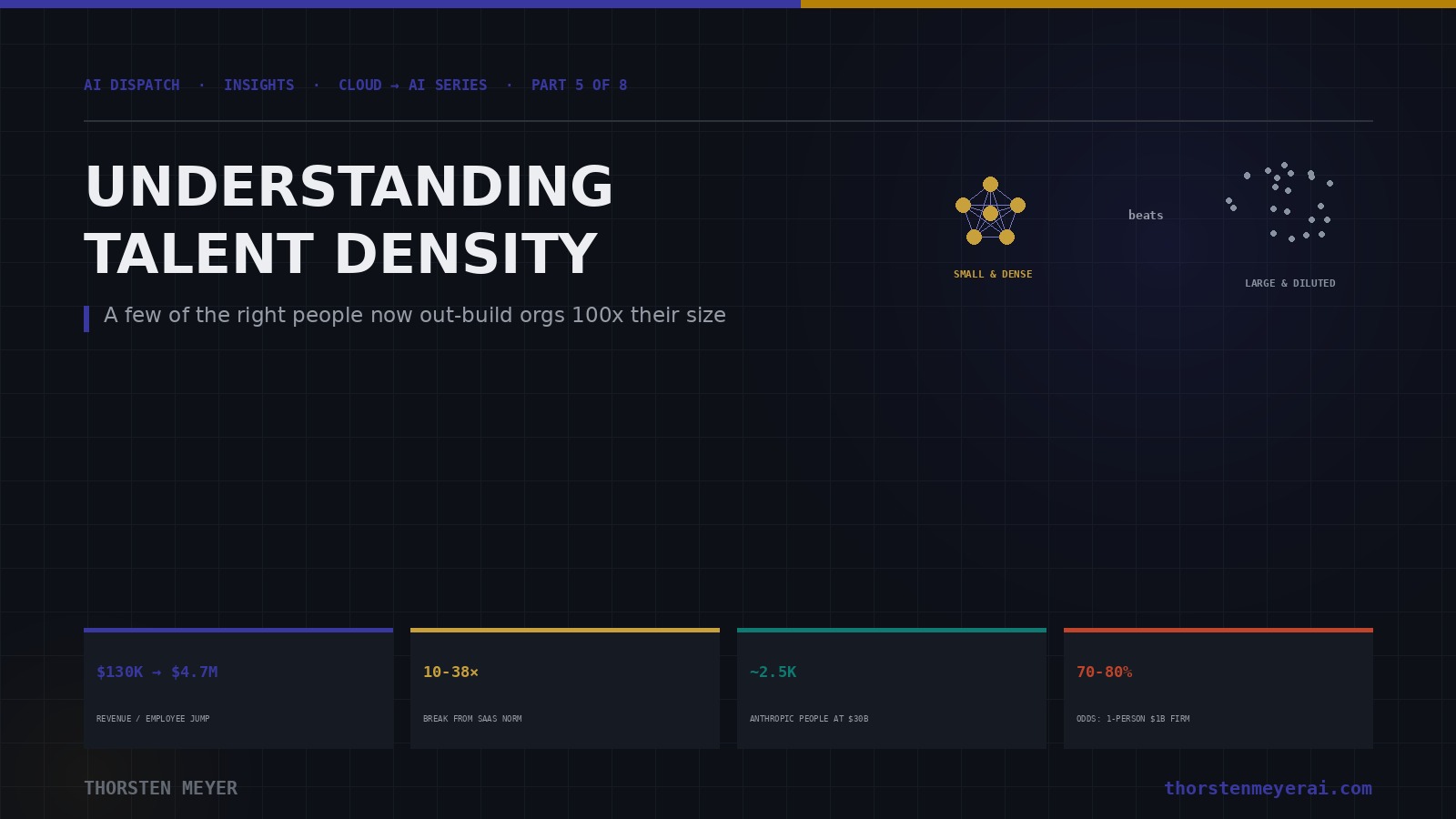
That was a management philosophy. In 2026 it has become an economic force, because AI took the multiplier on each dense, capable person and cranked it by an order of magnitude. This is the fifth piece in my cloud-to-AI series, and it’s the one that moves from markets and infrastructure to the thing underneath both: how a small number of the right people, armed with these tools, now out-build organizations a hundred times their size.
The number that broke the spreadsheet
Start with the metric, because it’s the most legible shock in the whole AI economy. For a decade, the productivity yardstick for software was revenue per employee, and the numbers were stable: the median private SaaS company generated about $130,000 per employee, and the best traditional software businesses were proud to reach $300–400K.
For a decade, revenue per employee was stable and boring. AI-native companies posted figures that don’t fit on the same chart — a 10-to-38× break.
Then the AI-native companies posted numbers that don't fit on the same chart. Midjourney generates roughly $500 million in revenue with about 100 people — near $4.7 million per employee — bootstrapped, no outside capital, profitable within two months of launch, no marketing budget, no sales team. Cursor crossed $2 billion in annualized revenue in early 2026 with a team in the low hundreds, landing around $3.3 million per head. Gamma reached $100M ARR with about 50 people and has been profitable for years. Lovable hit $100M ARR in eight months with 45.
The frontier labs make the point at scale. When Salesforce first reached $30 billion in revenue, it employed roughly 79,000 people; Google needed about 32,000 to get there. Anthropic crossed a $30 billion run rate in early 2026 with somewhere between 2,500 and 5,000. That is not a rounding error or a better quarter. It is a 10-to-38x break from the entire prior history of how software turns people into revenue. And it's why revenue per employee, a metric that sat quietly behind gross margin and the Rule of 40 for a decade, is suddenly the first thing investors ask about.
The vision at the end of this curve already has a number attached: Anthropic's CEO has put the odds of the first one-person billion-dollar company appearing in 2026 at 70–80%. Whether or not that specific milestone lands on schedule, the direction is the point.
high performance team management book
As an affiliate, we earn on qualifying purchases.
As an affiliate, we earn on qualifying purchases.
Why it works: the multiplier on density
Two things are happening, and it's worth separating them because they're often blurred.
The first is that AI absorbs entire categories of work into the product itself. Customer support, content creation, code generation, design iteration, first-line sales — functions that used to require whole departments get folded into the software. A company that would have hired a support team ships an agent instead. The headcount those functions represented never gets added, so the same revenue is spread across far fewer people. That's not the team being superhuman; it's the org chart being absorbed.
The second is the older Netflix insight, now supercharged. When work that used to need coordination across many people can be done by a few, the few matter enormously more — and the specific scarce skills change. It's not "engineers" or "PMs" as roles anymore. From what I can see across the companies pulling this off, it's three things: taste (knowing what's worth building), deep customer understanding (knowing what problem actually matters), and fluency with the jagged edge of AI capability (knowing what the models are brilliant and terrible at, which shifts every few weeks). A person holding all three, with AI leverage under them, does what a department used to. And critically, a small team of such people carries almost no coordination overhead — the tax that makes large organizations slow. Small and dense beats large and diluted, and now the gap is measured in multiples, not percentages.
productivity tools for high performers
As an affiliate, we earn on qualifying purchases.
As an affiliate, we earn on qualifying purchases.
What talent density actually is
Here's the distinction I most want to make, because "revenue per employee" understates it into a mere efficiency stat. Talent density is not "the same company with fewer people." It's a different operating mode that only becomes available above a certain concentration of capability.
Netflix named it: the deliberate concentration of high performers. Not "the same company with fewer people" — a different operating mode that only unlocks above a threshold.
- Overhead falls away
- Faster decisions, less process
- Whole problem held in a few heads
- Dense teams attract dense people
- Energy spent on management & alignment
- Process compensates for weak links
- Problem fragmented across many
- Coordination tax slows everything
Below the threshold, an organization spends its energy on management, alignment, and compensating for its weakest links — the process exists to make mediocre coordination safe. Above it, that overhead falls away: high-trust teams need less process, make decisions faster, and can hold the whole problem in a few heads instead of fragmenting it across many. AI raises the ceiling on what each dense node can accomplish, which means the threshold now unlocks something that used to be impossible — a handful of people running a business that genuinely serves millions. The density isn't a cost-saving. It's the capability. And it compounds: dense teams attract dense people, because the best want to work with the best and without the drag of the rest.
AI productivity software for teams
As an affiliate, we earn on qualifying purchases.
As an affiliate, we earn on qualifying purchases.
The honest bear case
I'd be doing exactly the hype-extrapolation this series keeps warning against if I handed you those revenue-per-employee numbers uncut. They are real, and they are also partly an artifact. Here's the other side, and it's substantial.
The revenue-per-employee numbers are real — and partly an artifact. Telling the real density from the accounting mirage is most of the work.
Much of the eye-watering math is run-rate annualization. A lot of AI-native figures are last-month revenue times twelve, not trailing-twelve-month GAAP revenue. When a company is doubling every few months, that convention dramatically inflates the per-employee number versus what an audited full year would show. Some of the "$40M per employee" headlines that circulated were simply wrong — built on stale headcounts and annualized spikes.
And the deeper problem: the metric hides where the labor went. This is the caveat that matters most, and it's devastating if you sit with it. When Cursor spends billions on API calls to Anthropic and OpenAI, it is, in effect, buying labor — the model does work a human used to do. But that spend shows up as cost of goods sold, not as headcount, so it never enters the revenue-per-employee denominator. The stunning ratio is real only if you believe API tokens are categorically different from human labor. They aren't; they're substitutes with different pricing. The tiny team didn't eliminate the work — it moved the work off the payroll and onto an inference bill. Midjourney is the clean exception precisely because it runs its own models on its own hardware and internalizes that cost, which is why it's the most honest proof point in the set — and also why its private, unverifiable financials can't fully settle the argument.
There's a temporal trap, too. Early-stage AI companies run negative gross margins on purpose, burning on inference to build a moat. Year-one revenue-per-employee tells you nothing about year-three margin structure, when the API bill either gets optimized away or eats the business. Comparing a two-year-old AI-native darling to a mature public SaaS company is comparing different points in a lifecycle, not different species.
And does it generalize? The dazzling cases are a handful of AI-native, product-led, viral-distribution companies. Whether talent density at these multiples extends to enterprise software with long sales cycles, regulated industries, or anything requiring large field operations is genuinely unproven. The base rate for "this handful of outliers is the new normal for everyone" is not good — as this whole series keeps insisting.
team collaboration tools for remote teams
As an affiliate, we earn on qualifying purchases.
As an affiliate, we earn on qualifying purchases.
The part that's mine to make
This is the piece of the series closest to how I actually work and think, so let me be direct about the lens. As a post-labor economist, I read the revenue-per-employee explosion as the leading edge of something bigger than a startup-metrics story: the decoupling of economic output from headcount. For most of industrial history, more output meant more workers, in a fairly stable ratio. That ratio is breaking, and talent density plus AI leverage is the mechanism breaking it.
That's genuinely thrilling if you're a small, capable team — it's the entire reason a local-first operation run by a handful of people can produce at a scale that used to require a company. It's why I build the way I do: the tools and the leverage mean density beats size. But intellectual honesty requires naming the other face of it. If a billion-dollar company can be built by one person, the implicit question is what happens to the several thousand people the old version of that company would have employed. "Talent density" is an inspiring phrase from inside the dense team and a much heavier one from outside it. The productivity is real; so is the displacement it implies, and pretending the first doesn't carry the second is the kind of comfortable half-analysis I try not to write.
Where I land
Talent density was always the quiet variable behind great teams. AI turned it into the loudest one, because it multiplied what each dense, capable person can do and let a few of them absorb work that used to need thousands. The revenue-per-employee numbers are a real signal of that — and also partly a mirage of run-rate accounting and off-balance-sheet inference labor, and I don't trust the ones that don't survive scrutiny.
The reframe I'd offer is this: stop reading revenue per employee as an efficiency score and start reading it as a map of where the work went. Sometimes it went into genuinely denser, more capable teams doing more with less — the real thing, and it's remarkable. Sometimes it just went off the payroll and onto an API bill. Telling those two apart is most of what it takes to understand this moment honestly, whether you're building a tiny team to punch far above its weight, or thinking hard about the world that a few very dense teams are quietly building for everyone else. Next in the series: what the earlier platform giants — the ones who lived through their own disruptions — can actually teach the AI incumbents.
Analysis and opinion from a builder, founder, and post-labor economist running a local-first inference operation. Figures verified at time of writing against multiple 2026 sources (Sacra, TechCrunch, Forbes, SaaStr, company disclosures) for revenue-per-employee at Midjourney, Cursor, Gamma, Anthropic and others, and against the widely reported "one-person billion-dollar company" prediction; note that many AI-native figures are annualized run-rate rather than audited GAAP revenue, and revenue-per-employee excludes inference (API) costs that substitute for labor. Interpretation and the post-labor framing are the author's own. This is analysis, not investment advice. Part 5 of an 8-part series. Point-in-time as of 15 August 2026.