Listen free for 30 days with Audible
Thousands of audiobooks and originals — cancel anytime.
Start your free trialAs an affiliate, we earn on qualifying purchases.
The citation.
When licensing turned out to be a large-publisher game, one route remained for everyone else: if you cannot get paid for the content and you cannot get the click, at least get named in the answer. Be the source the AI cites. The discipline that promises this has a name — generative engine optimization, GEO — and it is the fastest-growing thing in the publisher playbook.
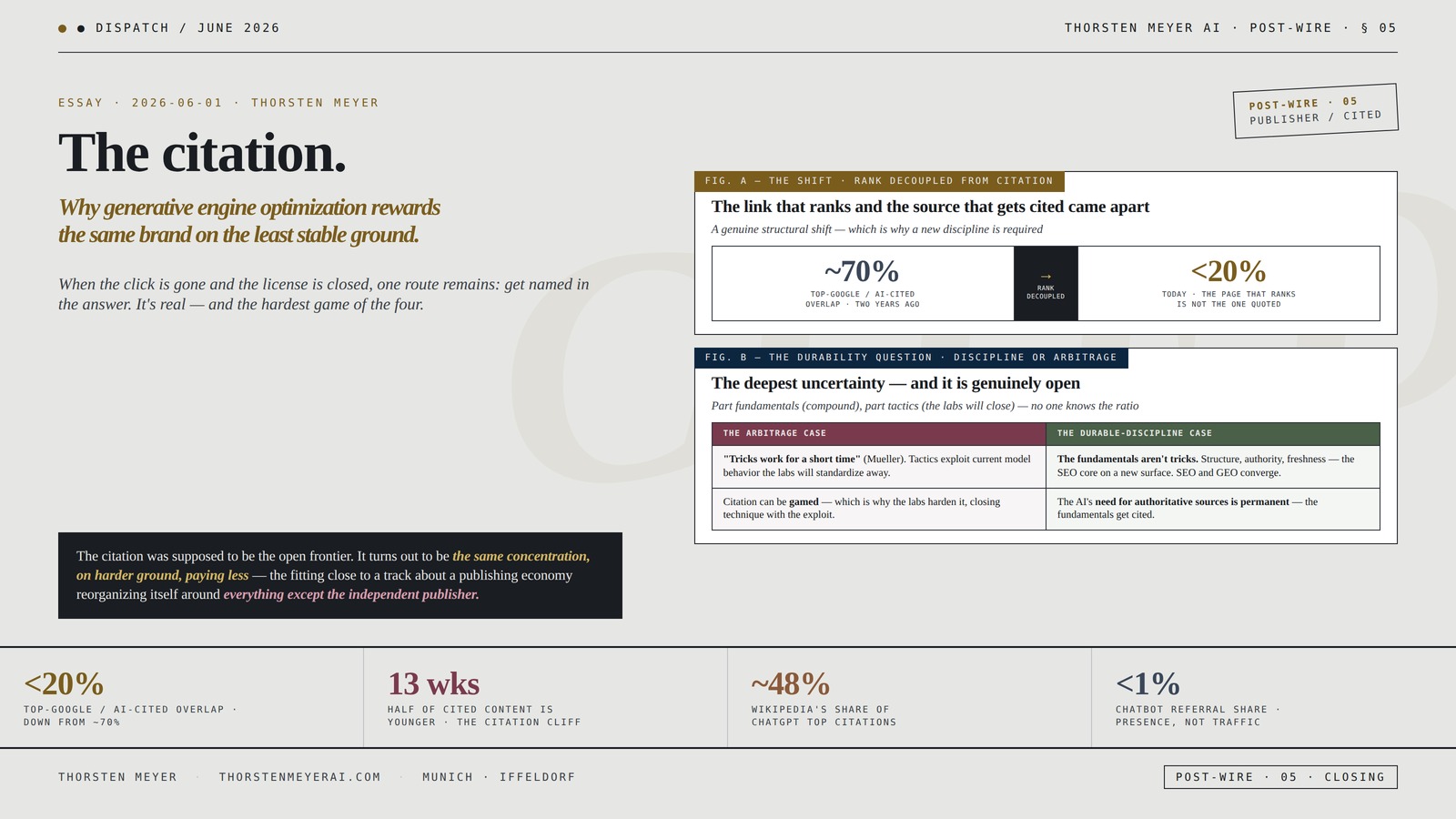
The promise is real, and the shift behind it is structural. Ranking on page one of Google no longer guarantees you appear in the AI answer, and appearing in the AI answer no longer requires ranking on page one. The overlap between the top Google links and the AI-cited sources has fallen from roughly 70% to under 20% in two years. A new layer has opened between the content and the reader, and GEO is the discipline of winning it.
But the layer has properties that make it a harder game than the one it replaces, not an easier one. AI citation decays fast — research finds 50% of content cited in AI answers is less than 13 weeks old, a “citation cliff” with no equivalent in classic SEO. Citations are unstable — 40-60% of cited sources change month to month. And there is no stable ranking system underneath: LLMs are probabilistic, not deterministic, so the same query can cite different sources on different days. The ground GEO is fought on does not hold still.
And the deciding factor is the one that keeps recurring across this track. The single strongest citation lever is entity authority — E-E-A-T, brand recognition, presence on the sources the AI trusts most. Wikipedia alone accounts for roughly 48% of ChatGPT’s top citations; Reddit and G2 dominate their categories. The AI cites the recognized entity, which means GEO rewards the same brand strength that survived the referral collapse and commanded the licensing fee.
The structural argument I want to make: GEO is a genuine successor discipline to SEO, but it inherits the asymmetry of the entire Post-Wire sequence — it rewards entity authority and brand recognition over the long tail, it decays faster than SEO ever did, it runs on a probabilistic black box with no stable ranking, and the citations it wins still convert to little or no traffic — which makes it less a new escape from the collapse than the same game, “be the recognized brand,” played on harder and less durable terrain. This is the fifth and closing piece in the Post-Wire sequence: the content commoditized, the channel severed, the license closed, and now the last route — the citation — turns out to favor the same incumbents and decay under everyone’s feet.
The headline integrative finding: The honest both-sides read is that GEO is neither a gimmick nor a salvation. It is real — AI-referred sessions are growing fast, the cited-brand premium is measurable, early movers do capture citation share while competition is low. But it is also unstable, largely unmeasurable, traffic-poor, and — per Google’s own search team — partly a set of “tricks” that “will work for a short time.” The durability question is the whole question: if GEO is a durable discipline, it is the long tail’s last legitimate craft; if it is a temporary arbitrage the labs will close as they standardize citation, it is a treadmill that rewards the brands that were already winning and exhausts everyone else. The answer is not yet known — which is itself the finding, because a discipline you cannot measure and cannot count on is a thin foundation for a business.
This essay walks the structural shift that opened the citation layer, the citation cliff that makes it decay, the entity-authority lever that favors the incumbent, the measurement black box, the traffic that still does not come, the durability-versus-arbitrage question, and the structural reading of the citation as the publisher track’s closing asymmetry.
The citation.
Why generative engine
optimization rewards the
same brand on the least
stable ground.
down from ~70% in two years
the citation cliff · SEO compounded
top citations · trust concentrates
citation is presence, not traffic
source overlap · two years ago
decoupled
from
citation
is not the page that’s quoted
The citation was supposed to be the open frontier. It turns out to be the same concentration, on harder ground, paying less — the fitting close to a track about a publishing economy reorganizing itself around everything except the independent publisher.Thorsten Meyer · The Citation · Post-Wire 05 · closing
By Thorsten Meyer — June 2026
This is the fifth and final dispatch in the Post-Wire track — the publisher-side forensics of AI intermediation. The first walked the death of the identical paragraph; the second continued the supply-side analysis; the third walked the death of the referral; the fourth walked the licensing asymmetry. This one walks the last route left when the click is gone and the license is closed: getting cited — and finds it the hardest game of the four, on the least stable ground, favoring the same publishers the prior three already favored.
The structural argument I want to make: the citation economy was supposed to be the open frontier — a new layer where the long tail could compete on craft rather than scale — and it is instead a continuation of the same concentration, because the AI cites what it trusts, and trust is a function of recognition, which is a function of the scale the long tail does not have. SEO had a long tail — obscure pages ranked for obscure queries because relevance was, at the margin, a fair fight. GEO has a much thinner tail, because citation is a trust decision, and trust concentrates.
The headline integrative finding: GEO is a real discipline with real techniques, and the publisher who ignores it cedes the citation layer entirely. But it is a discipline whose returns are uncertain, whose ground shifts monthly, whose measurement is a guess, and whose rewards flow disproportionately to entities that were already authoritative. For the small publisher, GEO is necessary and insufficient at the same time — necessary because the citation layer is where discovery now happens, insufficient because winning it requires the brand authority the small publisher lacks and produces traffic the small publisher needs but does not receive. The citation is the last route, and it leads to the same place the first four did.
This essay walks the structural shift (Section I), the citation cliff (Section II), the entity-authority lever (Section III), the measurement black box (Section IV), the traffic that does not come (Section V), the durability question (Section VI), and the structural reading (Section VII).
As an affiliate, we earn on qualifying purchases.
I · The shift · why a new layer opened between content and reader
The decoupling crystallization. GEO exists because something genuinely new happened: the link that ranks and the source that gets cited came apart. That decoupling is the structural fact the whole discipline is built on.
The rank-citation split
Ranking no longer determines citation: the overlap between the top Google links and the sources AI engines cite has fallen from roughly 70% to under 20% in two years (per Brandlight and industry analysis summarized by Search Engine Land). The page that ranks first is increasingly not the page the AI quotes — the two systems have developed different preferences for what to surface.
Two citation mechanisms, two games: AI engines find sources two ways. Retrieval engines (Perplexity, Google AI Overviews) fetch pages at query time and cite what they retrieve — closest to classic SEO, where indexing and authority still matter. Training-data engines (the base behavior of ChatGPT, Claude, Gemini) draw on what was in the model at training time — where being published, indexed, and recognized as authoritative before the training cutoff is what earns the citation. GEO is two games at once: win the real-time retrieval, and be authoritative enough to have been baked into the model.
Why the layer matters
The citation is where discovery now happens: with 58-83% of AI-influenced searches ending without a click (the referral dispatch), the citation inside the answer is, increasingly, the only presence a publisher gets. The reader sees the AI’s synthesis and the sources it names; if you are not named, you do not exist in that answer. The citation layer is the new shelf, and GEO is the discipline of getting on it.
The shift observation
A genuine new layer opened between content and reader: the AI answer, where the source that gets cited is decoupled from the page that ranks, and where presence means being named in the synthesis rather than ranked in a list. This is real and structural — not hype. The decoupling (70% to under 20% overlap) means classic SEO no longer delivers the citation, which means a new discipline is genuinely required. The frontier is real. The question the rest of this piece asks is who can actually win it — and whether winning it lasts.
As an affiliate, we earn on qualifying purchases.
II · The citation cliff · why GEO decays faster than SEO ever did
The decay crystallization. The first thing that distinguishes GEO from SEO is that its rewards rot. A top SEO ranking, once earned, could hold for years. A citation is a perishable good.
The cliff
Half of cited content is under 13 weeks old: research finds that roughly 50% of the content AI engines cite is less than 13 weeks old — a “citation cliff” with no equivalent in classic search. AI systems have a strong freshness bias: they prefer recent content, and citations decay as content ages out. A page that earns citations this quarter may lose them next quarter purely to age.
Monthly instability on top of the cliff: beyond the freshness decay, 40-60% of cited sources change month to month on both Google AI Mode and ChatGPT. The citation set is not just decaying with age; it is churning with model updates, retraining, and the probabilistic variance of the systems. The ground moves under you even when your content does not change.
Why this is harder than SEO
SEO compounded; GEO does not: a strong SEO position was an asset that appreciated — rankings, once earned, tended to hold and to compound through accumulated authority. A citation is a depreciating asset that must be continuously re-earned. The freshness bias means the work is never done; the moment you stop publishing and refreshing, the citations decay.
The treadmill problem: GEO requires a permanent update cadence — write, verify, measure, refresh, repeat — because without it, even strong content decays out of the citation set. For a resource-rich brand, that treadmill is a manageable cost. For a small publisher, a discipline that demands continuous re-earning of a perishable reward is a structural burden the click economy never imposed.
The cliff observation
GEO decays faster than SEO ever did: half of cited content is under 13 weeks old, 40-60% of citations churn monthly, and the reward must be continuously re-earned rather than accumulated. SEO was an appreciating asset; GEO is a depreciating one. This is the second way the citation layer is harder than the layer it replaces — not only must you win it, you must keep winning it, on a freshness treadmill that favors whoever can sustain the highest publishing-and-refresh cadence, which is, again, the resourced incumbent.
citation management tools for content creators
As an affiliate, we earn on qualifying purchases.
As an affiliate, we earn on qualifying purchases.
III · The entity-authority lever · why citation favors the recognized brand
The concentration crystallization. The single most important GEO factor is the one that determines who wins, and it is the same factor that determined who survived the referral collapse and who got the license: recognition. The AI cites what it trusts, and trust concentrates.
The deciding factor
Entity authority and E-E-A-T are the top lever: across the research (Princeton’s citation-factor study, the platform analyses), the strongest determinant of being cited is entity authority — how well-recognized the brand is across the web — and E-E-A-T (experience, expertise, authoritativeness, trustworthiness). AI engines are under intense pressure not to spread misinformation, so they have a strong prior toward sources they can verify — which means recognized, established, corroborated entities.
The most-cited sources prove it: Wikipedia accounts for roughly 48% of ChatGPT’s top citations (the 5W AI Platform Citation Source Index). Reddit and Wikipedia dominate across platforms; G2 dominates software reviews. The citation layer is anchored by a handful of high-authority aggregators and the recognized brands they reference — not by the long tail of independent publishers.
Why this concentrates
Trust is a function of recognition: a citation is a trust decision — the AI is vouching for the source by naming it. It vouches for what it can verify, and it can verify the recognized entity. A niche site has no entity authority for the AI to lean on, so it is not a safe citation; an established brand is. The same brand recognition that let the large publisher survive the referral collapse and command the licensing fee is what wins the citation.
The thin tail: SEO had a genuine long tail — obscure pages ranked for obscure queries because relevance was, at the margin, a fair fight on content. GEO’s tail is thinner, because citation is a trust decision and trust does not have a long tail the way relevance did. The cited-brand premium is real and measurable — cited brands get materially more clicks — but it accrues to brands, which is the point.
The entity-authority observation
The strongest GEO lever is entity authority, which means the AI cites the recognized brand — Wikipedia, Reddit, G2, and the established publishers they reference — because a citation is a trust decision and trust concentrates. This is the third and deepest way the citation layer reproduces the track’s asymmetry: GEO’s deciding factor is precisely the brand recognition the long tail lacks. The discipline that was supposed to be the open frontier where craft beats scale turns out to reward the same scale-derived authority that won every prior round. The frontier favors the incumbent.
As an affiliate, we earn on qualifying purchases.
IV · The measurement black box · why you cannot tell if it is working
The opacity crystallization. A discipline you cannot measure is a discipline you cannot manage. GEO’s returns are not just uncertain — they are, to a significant degree, unobservable, which compounds every other problem.
The black box
No stable ranking, no clear reporting: LLMs are probabilistic, not deterministic — there is no stable ranking system comparable to Google’s, and AI-generated summaries vary by prompt and model. How an LLM chooses when and how to cite a publisher “remains a black box.” You cannot check your citation rank the way you could check your search rank, because there is no rank to check.
The attribution fog: even when a citation does drive a visit, the referrer data is often stripped — ChatGPT visits frequently land as “Direct,” mobile apps strip headers — so the visible AI traffic in analytics is a fraction of the real activity. The standard workarounds (tracking utm_source=chatgpt.com, testing core prompts manually, third-party tools like Otterly, Semrush’s AI Toolkit, Ahrefs Brand Radar) are partial and inferential. You are measuring a shadow of a probabilistic process.
Why this compounds the problem
Unmeasurable plus unstable plus decaying: the measurement opacity sits on top of the citation cliff and the monthly churn. You are trying to optimize a perishable, churning reward through a discipline whose results you can only partially observe. For the resourced brand, that justifies a dedicated GEO team (write/verify/measure/refresh). For the small publisher, it means investing in a discipline whose payoff cannot be confirmed — the worst possible profile for a thin-margin operation.
The black-box observation
GEO is largely unmeasurable: there is no stable ranking, citation behavior is a probabilistic black box, and the referral attribution is fogged — so you cannot reliably tell whether your GEO investment is working. This is the fourth way the citation layer is harder than the click layer: SEO had clear, measurable signals (rank, clicks, conversions); GEO has inference and proxies. A discipline you cannot measure cannot be optimized with confidence — which means GEO asks the small publisher to invest scarce resources on faith, in a layer that already favors the brands with resources to spare.
V · The traffic that does not come · the citation pays even less than the referral
The conversion crystallization. Underneath everything is the question that the referral dispatch raised and this one must answer: even if you win the citation, what does it pay? And the answer is: still very little.
The traffic gap
Citation does not equal traffic: getting mentioned or cited in LLMs “does not translate into any notable amount of referral traffic — at least, not yet.” Chatbot referrals remain under 1% of total publisher referrals (the referral dispatch). You can win the citation and still get almost no visit — the citation is presence, not traffic.
The qualified-traffic counter, again: where the AI traffic does arrive, it converts far better (the higher-intent reader who already got a recommendation) — Vercel reports 10% of new signups now come from ChatGPT referrals, and AI-referred sessions are growing fast (a reported 527% year-over-year in early 2025). So the citation is worth more per visit — but only for the businesses where a visit converts to a signup or a sale, which is a product business, not an ad-supported content business.
Why this is the sharpest cut for the publisher
The content publisher monetizes visits, not conversions: for a product company, a high-converting trickle of AI referrals can justify GEO outright. For an ad-supported or affiliate publisher, value comes from volume of visits — and the citation delivers presence without volume. GEO’s best-case payoff (qualified, converting traffic) is structured for the product business; the content publisher gets the citation’s worst case: recognition without the visits its model runs on.
The traffic observation
The citation pays even less than the referral did: chatbot referrals are under 1% of the total, citation is presence not traffic, and the qualified-traffic upside accrues to product businesses that monetize conversions rather than content publishers that monetize visits. This is the fifth way the citation layer fails the small publisher specifically: GEO can work — for a SaaS company turning a cited mention into a high-intent signup. For the publisher whose business is ad impressions and affiliate clicks against volume, winning the citation is winning a prize denominated in the wrong currency.
VI · The durability question · discipline or arbitrage
The temporality crystallization. Everything above assumes GEO is at least a stable practice worth learning. The deepest uncertainty is whether it is — whether GEO is a durable discipline or a temporary arbitrage the labs will close. This is the open question, and it is genuinely open.
The arbitrage case
“Tricks that work for a short time”: Google’s John Mueller, at Google Search Live in December 2025, was blunt: “AI systems rely on search, and there is no such thing as GEO or AEO without doing SEO fundamentals. Tricks will come out and they will work for a short time; companies that want to be around for the long term should focus on something proven with long-term stability and not tricks.” The arbitrage view: most GEO-specific tactics are exploits of current model behavior that the labs will standardize away as citation matures.
The manipulation problem confirms it: the Guardian’s testing showed AI search can be manipulated via hidden instructions on webpages — prompt-injection-style citation gaming. The fact that citation can be gamed is exactly why the labs will harden it — and every hardening closes whatever arbitrage the gamers found, along with some legitimate GEO technique alongside it. The ground does not just move; the referee actively reshapes it.
The durable-discipline case
The fundamentals are not tricks: the other reading is that the durable core of GEO is not arbitrage at all — it is the same fundamentals SEO always rewarded (clear structure, factual density, entity authority, freshness, extractable self-contained passages), now pointed at a new surface. On this view GEO and SEO are converging, not diverging: AI uses live search, so SEO powers AI visibility, and the “discipline” is just good content engineering with new emphasis. The durable view: the tricks decay, but the fundamentals compound, and a publisher doing the fundamentals will be cited because the AI needs authoritative sources and that need is permanent.
Why the question stays open
Both are partly true, and the mix decides everything: GEO is clearly part fundamentals (durable) and part tactics (arbitrage), and no one yet knows the ratio. If it is mostly fundamentals, GEO is the long tail’s last legitimate craft. If it is mostly arbitrage, it is a treadmill that exhausts the small publisher chasing tactics the labs keep closing. The answer will only be known in retrospect — which means committing scarce resources to GEO today is a bet on an unresolved question, and the small publisher can least afford to bet wrong.
The durability observation
Whether GEO is a durable discipline or a temporary arbitrage is genuinely unresolved — it is demonstrably part fundamentals (which compound) and part tactics (which the labs will close), and no one knows the ratio. Mueller’s “tricks work for a short time” and the manipulation-and-hardening dynamic point to arbitrage; the SEO-GEO convergence and the permanent need for authoritative sources point to discipline. The honest position is that GEO is a bet on its own durability — and a discipline you must bet on, cannot measure, and watch decay monthly is a thin foundation, especially for the publisher with the least margin to absorb a wrong bet.
What this is not
It is not a claim that GEO should be ignored. The citation layer is where discovery now happens; ceding it entirely is not an option. The publisher must do GEO. The claim is that doing it is necessary and insufficient at once.
It is not a claim that GEO never works. It demonstrably works for some — product businesses converting qualified citations, early movers capturing share, brands with entity authority. The claim is about who it works for and how durably.
It is not a claim that the fundamentals are worthless. The durable core — structure, factual density, authority, freshness — is real and worth doing. The claim is that the durable core favors the resourced incumbent and the arbitrage layer is a treadmill.
The synthesis observation
GEO is a genuine successor discipline to SEO, but it inherits the entire Post-Wire asymmetry: it rewards entity authority over the long tail, decays on a 13-week cliff, runs on an unmeasurable probabilistic black box, pays even less traffic than the referral, and rests on an unresolved bet about its own durability. It is the last route left after the content was commoditized, the channel was severed, and the license was closed — and it leads to the same place: the recognized brand wins, the long tail does the work and gets the citation, and the citation does not pay.
There is no single answer. Anyone offering one is selling something. What is unambiguous is that GEO is necessary and insufficient for the small publisher at the same time — necessary because the citation layer is the new shelf, insufficient because winning it requires the brand authority the long tail lacks, the resources the thin margin denies, and a bet on a durability no one can yet confirm. The citation was supposed to be the open frontier. It turns out to be the same concentration, on harder ground, paying less — the fitting close to a track about a publishing economy reorganizing itself around everything except the independent publisher.
That is the structural editorial question the citation sits on top of. It is a real new layer that genuinely requires a new discipline. It is a discipline that rewards recognition, decays fast, resists measurement, and pays little. And it is a bet on its own durability that the publisher with the least margin can least afford to lose. And it is the layer where the Post-Wire story ends — not with a new escape, but with the recognition that across four reorganizations of the publishing economy, the asymmetry held: the brand that started with scale keeps the value, and the independent publisher keeps the work. What survives, here as in every prior dispatch, is the owned relationship the AI cannot intermediate — built directly, off the citation layer, with the reader the answer engine cannot stand between.
About the Author
Thorsten Meyer is a Munich-based futurist, post-labor economist, and recipient of OpenAI’s 10 Billion Token Award. He spent two decades managing €1B+ portfolios in enterprise ICT before deciding that writing about the transition was more useful than managing quarterly slides through it. He runs StrongMocha News Group, a network of more than 450 niche WordPress magazines built on the DojoClaw editorial engine. More at ThorstenMeyerAI.com.
Related Reading · the Post-Wire track
This dispatch
- This piece · The citation · the GEO forensic that closes the track — how generative engine optimization, the last route after the click and the license, rewards the same entity authority, decays on a citation cliff, and rests on an unresolved bet about its own durability · transition-bronze dominant, empirical-clay and labor-rose balance
The track · now complete
- The death of the identical paragraph · Post-Wire 01 · the content commoditized
- Post-Wire 02 · the continuing supply-side analysis
- The referral · Post-Wire 03 · the channel severed — the click economy becomes a citation economy
- The license · Post-Wire 04 · the escape closed — licensing pays the brand and strands the long tail
- The citation · Post-Wire 05 · the last route favors the recognized brand on the least stable ground — the track’s closing asymmetry
Adjacent tracks
- The runway · Enterprise Reorg 04 · the labs whose answer engines run the citation layer
- Forthcoming · The ownership question · Post-Labor 01 · the broader structural response to value migrating away from those who produce it · synthesis-deep register
Sources
The GEO discipline and the citation shift
- Frase · What is GEO / the GEO playbook — the definition (structuring content so AI engines cite it) · AI-referred sessions +527% YoY (early 2025, Previsible) · the citation cliff: 50% of cited content under 13 weeks old · G2 the most-cited software-review platform · specificity-over-vagueness, inline primary-source citation · frase.io
- LLMrefs · GEO 2026 guide — citation stability low: 40-60% of cited sources change month-to-month on Google AI Mode and ChatGPT · the rank-citation decoupling: top-Google-vs-AI-cited overlap dropped from 70% to under 20% (Brandlight) · Vercel: 10% of new signups from ChatGPT referrals · SEO and GEO converging · llmrefs.com
- Enrich Labs · GEO complete guide — the two citation mechanisms (real-time retrieval vs training-data) · AI Overviews in 30-40% of queries · “GEO optimizes for inclusion in an AI-generated answer” vs SEO’s ranked links · publishing now to build citation probability for future training · enrichlabs.ai
- COSEOM · GEO 2026 guide — the ranking factors (entity authority, content extractability, factual density, freshness, E-E-A-T, semantic completeness) · platform differences (ChatGPT favors domain reputation/readability; Perplexity citation-first; Gemini inherits Google ranking; Claude rewards multi-source balanced content) · Reddit and Wikipedia among the most-cited · measurement tools (Otterly, Semrush AI Toolkit, Ahrefs Brand Radar) · coseom.com
The entity-authority lever
- Heeya · GEO 2026 — the Princeton citation-factor research · E-E-A-T as “the deciding factor” · the verification prior (AI under pressure not to spread misinformation favors verifiable sources) · the named-author/LinkedIn-profile signal · heeya.fr
- TruPerformance · how to get cited by AI search — SEO/GEO overlap “fewer than 20% of winners, down from ~70%” · ChatGPT favors Wikipedia/encyclopedic sources (47.9% of top citations per the 5W AI Platform Citation Source Index 2026) · entity presence on Wikipedia/Wikidata/LinkedIn; allow GPTBot and OAI-SearchBot · truperformance.us
The black box and the durability question
- Digiday · GEO hype busted — “more SEO than new discipline” — “how LLMs cite remains a black box; AI summaries vary by prompt and model; LLMs are probabilistic, not deterministic; no stable ranking comparable to Google” · “getting cited does not translate into any notable referral traffic, at least not yet” · content chunking, YouTube/Reddit for citations · digiday.com
- ALM Corp · 12 data-backed AI-search strategies — Mueller (Google Search Live, Dec 2025): “no such thing as GEO or AEO without SEO fundamentals; tricks will work for a short time; focus on long-term stability not tricks” · the 15,847-AI-Overview analysis (semantic completeness correlation 0.87; 8.5/10+ pages see 340% higher inclusion) · high-authority publications cited within hours · almcorp.com
- Directive · B2B GEO strategy guide — the Guardian’s testing: AI search vulnerable to manipulation via hidden webpage instructions (the gaming-and-hardening dynamic) · Google’s spam-policy stance on AI-mass-produced low-value pages · “GEO should reduce content sprawl, not create more” · directiveconsulting.com
- Lumar · 4-pillar GEO framework — “stop chasing prompts and start tracking entity presence” · topic-entity connections, consistent schema, credible cross-channel signals · lumar.io
The Post-Wire track backbone
- The referral / The license / The death of the identical paragraph · Thorsten Meyer · Post-Wire 03 / 04 / 01 · the channel severed, the escape closed, the content commoditized — the citation is the fifth and closing asymmetry, where the last route favors the same recognized brand on the least stable ground
Key reference figures crystallized
- The shift: rank-citation overlap 70% → under 20% in two years · two citation mechanisms (real-time retrieval vs training-data) · the citation as the new shelf
- The citation cliff: 50% of cited content under 13 weeks old · 40-60% of citations churn month-to-month · GEO depreciates where SEO compounded
- The entity-authority lever: E-E-A-T / entity authority the top factor · Wikipedia ~48% of ChatGPT top citations · Reddit, G2 dominant · trust concentrates, so the tail is thin
- The black box: no stable ranking, probabilistic citation, fogged attribution (ChatGPT visits land as Direct) · partial tools (Otterly, Semrush AI Toolkit, Ahrefs Brand Radar)
- The traffic gap: chatbot referrals under 1% of total · citation is presence not traffic · qualified-traffic upside (Vercel 10% of signups, +527% YoY sessions) accrues to product businesses, not ad/affiliate publishers
- The durability question: Mueller “tricks work for a short time” + Guardian manipulation/hardening (arbitrage) vs SEO-GEO convergence + permanent need for authoritative sources (discipline) · the ratio unknown · GEO as a bet on its own durability
NFL season / tailgating Picks
team gear
As an affiliate, we earn on qualifying purchases.