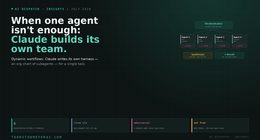

A soldier opens a browser tab on an ordinary phone and sees the war.
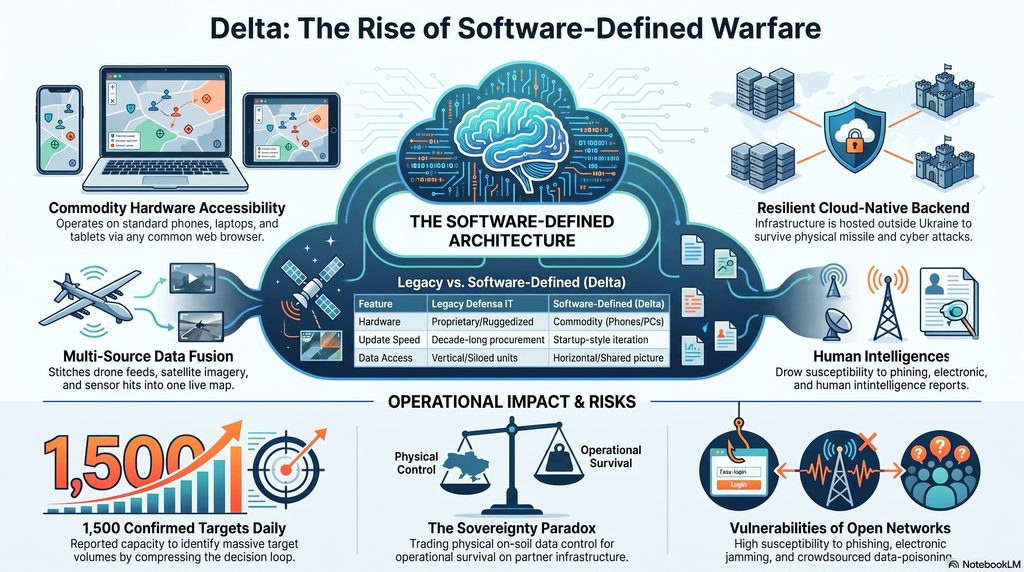
Not a fragment of it — the fused picture: enemy vehicles geolocated on a live map, drone feeds, satellite imagery, sensor hits, and reports from other units, all stitched together in real time. The backend is a cloud environment deliberately hosted outside the country, so a missile or a cyberattack on Ukrainian soil can’t take it down. The client is whatever hardware happens to be in the soldier’s hand.
That system is called Delta, and it is the clearest working example yet of what analysts have started calling software-defined warfare. Its lessons — about fusion, commodity hardware, sovereignty, and resilience — reach well beyond Ukraine, and they rhyme directly with the last briefing in this series.
Software-defined warfare: how Ukraine’s Delta turned the battlefield into a shared, real-time map
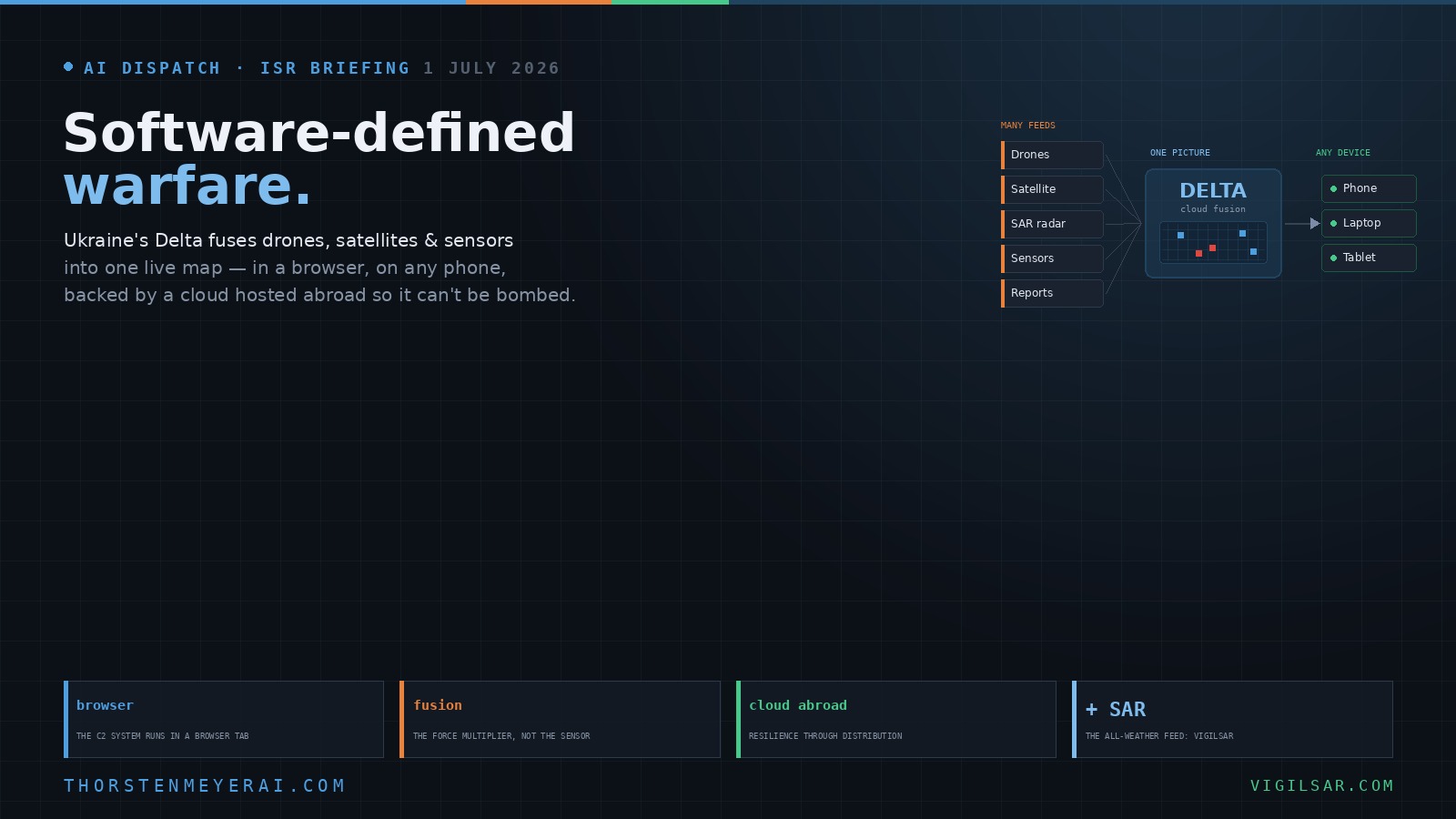
A soldier opens a browser and sees the fused war — drones, satellites, sensors and vetted reports on one live map. The backend is a cloud deliberately hosted abroad so a missile can’t take it down. The clearest case yet of treating warfare as software.
Optical sensors go blind in cloud & dark; an all-weather SAR radar layer — the kind VigilSAR produces — slots into a picture like this as one resilient, sovereign input. vigilsar.com · And note the paradox: to survive missiles & cyberattack, Ukraine hosted its crown-jewel cloud outside its own borders — trading physical sovereignty for operational survivability. Resilience through distribution.
Delta’s lasting lesson isn’t a piece of software — it’s a model of how to build: commodity clients, cloud backend, open standards, relentless iteration, fusion over hardware, and resilience through distribution. It’s why a wartime NGO out-shipped procurement bureaucracies on a fraction of the budget. The platform mattered less than the picture — and the picture is software. Own the fusion layer, own the sovereign feeds into it, and get it to the edge.
What Delta actually is
Delta is a situational-awareness and battlefield-management system built by Ukraine’s military — an unusual coalition of the NGO Aerorozvidka, the Defense Ministry’s defense-technology innovation center, and the Ministry of Digital Transformation under Mykhailo Fedorov. Its job is to fuse inputs from a deliberately diverse set of participants — reconnaissance units, civilian officials, allied intelligence services, and even vetted bystanders — and to draw on commercial and military drones, sensor networks, satellite imagery, and partner-country intelligence. All of it is geolocated and mapped in real time, with imagery of enemy assets attached.
On top of that picture, Delta handles the practical work of command: planning operations, coordinating between units, and securely sharing where enemy forces are. It is, in effect, a common operating picture — one shared view of the battlefield — turned into a live web application.
Kyocera Duraxe E4830 Epic AT&T Flip Smart Phone 16GB Rugged PTT Wi-Fi LTE Black (Renewed)
This Certified refurbished Kyocera Duraxe E4830 Epic AT&T Flip Smart Phone is tested and certified to look and…
As an affiliate, we earn on qualifying purchases.
As an affiliate, we earn on qualifying purchases.
The radical part: it runs on a browser
Here’s the detail that made professional militaries sit up. Delta’s backend is cloud-native, and its client runs on regular PCs, laptops, tablets, and phones. There is no exotic proprietary terminal, no ruggedized single-purpose console, no hardware you can only buy through a decade-long procurement program. If you can open a browser, you can use it.
That sounds mundane and is anything but. Legacy defense IT is famously bespoke, hardware-locked, siloed by vendor and by unit, and slow to change. Delta inverted all of it — and the result was that Ukraine, by several accounts, pushed a shared situational picture down to more of its frontline troops than richer, “more modern” militaries had managed with far larger budgets. The commodity-client, cloud-backend pattern is what bought that reach and that speed.

Drone with Camera for Adults, 2K HD FPV Drones with Upgrade Altitude Hold, One-Key Take Off/Landing, Speed Adjustment, Headless Mode, 2 Batteries, Toys Gifts for Teen Boys Girls, Beginner
【2K Ultra HD Camera】Loiley drone features a high-quality 2K HD camera with a 90° remote adjustable angle, allowing…
As an affiliate, we earn on qualifying purchases.
As an affiliate, we earn on qualifying purchases.
Software-defined warfare, defined
The phrase software-defined warfare — the framing of a 2024 CSIS analysis of Delta — captures the shift: advantage moves away from platforms and hardware toward data, software, and how fast you can iterate on both. Delta’s roots make the point. It traces to a 2017 NATO initiative aimed at breaking the old habit of hoarding information vertically within a unit rather than sharing it horizontally across the force — a deliberate move away from Soviet-inherited siloing toward NATO-standard interoperability.
The organizational model is as instructive as the software. A volunteer NGO, a digital-transformation ministry, and a defense innovation cell shipped, iterated, and fielded military software at something closer to startup tempo than defense-procurement tempo. That operating model — not any single feature — is what other militaries are actually studying.

LOCADENCE Digital Satellite Finder, LCD Screen Handheld Satellite Meter Detection Device Built in Battery Supports Loop Search, Constellatory Analysis
MULTIPLE FUNCTIONS: The satellite finder supports loop search, constellatory analysis, spectrum analysis, and automatic calculation of AZ and…
As an affiliate, we earn on qualifying purchases.
As an affiliate, we earn on qualifying purchases.
Fusion is the force multiplier — the same lesson as last time
Regular readers will recognize the through-line. The previous briefing on Wide-Area Motion Imagery argued that the scarce resource in modern ISR was never the sensor — it was the exploitation and fusion layer, the thing that turns many raw feeds into one trustworthy, actionable picture and gets it to the people who need it. Delta is that argument made operational. The drones, the satellites, the optical and radar sensors are inputs; Delta is the layer that makes them mean something together.
Which is exactly why a system like this is where a sovereign, all-weather radar feed belongs. Optical sensors go blind in cloud and darkness; a synthetic-aperture-radar layer of the kind VigilSAR produces keeps seeing through both, and slots into a common operating picture as one more resilient input. The doctrine Delta proves and the sensor sovereignty VigilSAR is built for are two halves of the same idea: own the picture, and own the feeds into it.

ETLKJVBL for iPhone 15 Pro Max Case Wallet with Card Holder, Armed Soldier in Battlefield Stylish PU Leather Phone Case with Kickstand – Secure RFID Blocking & Magnetic Flip Cover
【Compatible for iPad Pro 12.9 Inch Tablet Case】This protective stand case specifically designed for iPad Pro 12.9 Inch…
As an affiliate, we earn on qualifying purchases.
As an affiliate, we earn on qualifying purchases.
It compressed the loop
At the doctrinal level, Delta’s significance is that it shortens the distance from observing something to acting on it. By linking reconnaissance, identification, prioritization, and coordinated response into one fast cycle across dispersed units, it compresses what military theorists call the decision loop. Ukraine’s Defense Ministry has credited Delta, during the early counteroffensive against the Russian convoy near Kyiv, with helping identify on the order of 1,500 confirmed enemy targets a day — a striking figure, though one worth treating with appropriate caution, since it is a self-reported wartime claim that can’t be independently verified.
Fedorov has framed the endgame as 10,000 drones flying continuously along the front, broadcasting the fight without interruption. A swarm that size is meaningless without a digital coordination fabric underneath it — and that fabric is the actual product. The precise integration between Delta and drone operations is, for obvious operational-security reasons, undisclosed.
The sovereignty paradox: they moved the cloud out to survive
The most quietly radical decision came in February 2023, when Ukraine approved full deployment of Delta and — in the same breath — permitted hosting its cloud components outside the country specifically to protect them from missile and cyber attack.
Sit with that. To keep its most sensitive command system alive, Ukraine chose not to keep it on home soil. You cannot bomb a data center that isn’t where your front line is, and distributing the backend across foreign infrastructure makes it far harder to destroy in one strike. It’s resilience through distribution — the same principle that runs through everything from portable AI stacks to layered ISR: survivability comes from not being a single, co-located target.
It is also a genuine paradox for anyone who prizes sovereignty. Ukraine traded a measure of physical, on-soil control for operational survival, putting crown-jewel data on partner infrastructure because the alternative was losing it to a cruise missile. There’s no clean answer there — only an honest tension between sovereignty and survivability that every nation building such a system will have to weigh.
The honest risks
A networked, cloud-based command system is powerful and also a large, soft target, and the balanced view has to name the downsides. Delta was hit by an info-stealing phishing campaign in December 2022 — a reminder that the attack surface of a browser-accessible C2 system is enormous. It depends on connectivity, so jamming and outages degrade it. It fuses crowdsourced and “vetted bystander” inputs, which invites deception and data-poisoning — a fused picture is only ever as trustworthy as its least trustworthy trusted source. Its inner workings are opaque by necessity, so self-reported effectiveness numbers deserve skepticism. And compressing the loop from sensing to striking carries real ethical and escalatory weight: speed is an advantage that cuts both ways, and “faster targeting” is not a neutral good.
None of this negates the value — coordination, survivability, and the breaking of information silos are real gains. It just means the capability and its hazards travel together.
The take
Delta’s lasting lesson isn’t a specific piece of Ukrainian software; it’s a model of how to build. Treat warfare as software: commodity clients, a cloud backend, open standards, relentless iteration, fusion over hardware, and resilience through distribution rather than through fortification. That model is why a wartime NGO out-shipped procurement bureaucracies with a fraction of the budget — and why defense establishments (and the vendors still selling decade-long hardware programs) are studying it nervously.
For anyone building in ISR, the message is the same one the last briefing landed on, now proven under fire: the platform matters less than the picture, and the picture is software. Own the fusion layer, own the sovereign feeds that flow into it, keep both resilient — and get the result to the edge, on whatever device is already in someone’s hand.
Sources: Wikipedia — Delta (situational awareness system); CSIS — Kateryna Bondar, “Ukraine’s Delta: Lessons for Software-Defined Warfare” (Dec 2024); The New York Times — “For Western Weapons, the Ukraine War Is a Beta Test” (Nov 2022); The Washington Post — “Russia and Ukraine are fighting the first full-scale drone war” (Dec 2022); Militarnyi; BleepingComputer and Ukrainska Pravda on the cyber targeting and full deployment. The ~1,500-targets-a-day figure is a Ukrainian MoD claim and is not independently verified. Analysis and framing are the author’s. Related: VigilSAR — sovereign, all-weather SAR ISR.