AI productivity software continues to transform how we work, offering tools that automate tasks, optimize workflows, and enhance collaboration. The best options balance advanced AI features with ease of use, but they vary widely in scope, price, and complexity. Microsoft Copilot stands out as the overall top pick for its broad integration, while Claude AI offers powerful prompt engineering for professionals. Many products face tradeoffs between sophistication and accessibility, or between cost and feature depth. Continue reading for a detailed breakdown of the top choices and what makes each unique.
Open a free Amazon Business account
Business pricing, bulk buying and tax-exempt orders.
Create a free accountAs an affiliate, we earn on qualifying purchases.
Key Takeaways
- The top picks differentiate primarily on ease of use versus advanced customization capabilities.
- Integration with existing tools, especially Microsoft 365, is a common factor among the most effective options.
- Pricing varies widely, with some best suited for enterprise use and others ideal for individual professionals or beginners.
- Prompt engineering and automation features are key drivers of productivity gains in this category.
- Many solutions excel for specific needs like ADHD management or beginner learning, highlighting the importance of matching software to user goals.




More Details on Our Top Picks
AI Prompts for Productivity and Time Management: 500 Powerful Prompts to Work Smarter, Save Time, Stay Organized, and Achieve More with Artificial Intelligence
This book stands out for offering a vast collection of 500 AI prompts aimed at boosting productivity and organization. Unlike more practical guides like AI Productivity Made Simple, which focus on workflows and automation, this resource provides a broad array of prompts that users can adapt for various tasks, making it ideal for those who want a rich prompt library rather than technical instructions. The major tradeoff is that it lacks detailed guidance on how to implement these prompts effectively within specific AI tools. While it’s perfect for writers, strategists, or prompt engineers, it doesn’t delve into technical setups or integrations, which might disappoint advanced users looking for in-depth tutorials.
Pros:- Offers a comprehensive collection of 500 prompts for diverse productivity tasks
- Helps users work smarter and stay organized without technical barriers
- Flexible prompts can be adapted across different AI platforms
Cons:- Lacks specific details on how to implement prompts within particular AI tools
- No user reviews or ratings available, making effectiveness harder to gauge
Best for: Prompt creators, writers, and productivity enthusiasts who want a large, ready-to-use prompt library
Not ideal for: Tech-savvy users seeking step-by-step automation workflows or technical setup instructions
- Number of prompts:500
- Focus:Productivity and Time Management
- Format:Text prompts
- Intended audience:Prompt creators, writers
Our verdict“Best suited for prompt enthusiasts who want a large, versatile prompt bank to enhance productivity without technical complexity.”
AI Productivity Made Simple: How to Use ChatGPT, Automation Tools, Prompts, and Smart Workflows to Save Time, Work Faster, and Get More Done
This book excels at translating AI tools into actionable productivity strategies, making it a strong choice for individuals who want to implement automation and workflows quickly. Compared with AI Prompts for Productivity, which offers a broad prompt library, this guide is more about how to integrate those prompts into real work scenarios using tools like ChatGPT and automation platforms. Its main tradeoff is that it doesn’t provide detailed technical instructions, which could leave advanced users wanting more depth. It’s ideal for busy professionals who prefer practical, straightforward advice over technical jargon but may not satisfy experienced AI users seeking in-depth customization.
Pros:- Provides clear strategies for using ChatGPT and automation tools
- Focuses on real-world workflows to save time and increase output
- Suitable for beginners and intermediate users looking for practical guidance
Cons:- No detailed technical instructions for advanced automation setup
- Content may be too simple for highly experienced AI users
Best for: Professionals seeking practical, step-by-step methods to automate and streamline their workflow
Not ideal for: Tech experts or users wanting detailed technical instructions for AI setup
- Focus:Automation and workflows
- Tools covered:ChatGPT, automation platforms
- Practicality:High
- Difficulty level:Beginner to intermediate
Our verdict“Ideal for busy professionals who need straightforward, actionable strategies to automate and boost productivity.”
AI Tools for Productivity: Microsoft Copilot at Work for Beginners
This guide is tailored for newcomers to Microsoft Copilot, making it a great starting point for those unfamiliar with AI integration in Office apps. Unlike Microsoft Copilot: A Practical Guide, which covers multiple applications comprehensively, this book zeroes in on beginners, providing simple prompts, templates, and workflows across Word, Excel, PowerPoint, and Teams. The main limitation is its focus on novices; advanced users seeking in-depth technical insights or customization options may find it too basic. Still, for organizations or individuals just starting with AI in Microsoft 365, this makes a practical introduction.
Pros:- Provides a clear, beginner-friendly introduction to Microsoft Copilot
- Includes practical prompts, templates, and workflows
- Enhances productivity across multiple Office applications
Cons:- Limited to beginners; not suitable for advanced users
- Lacks detailed technical specifications or customization options
Best for: New users of Microsoft Copilot or organizations implementing AI in Office for the first time
Not ideal for: Experienced users seeking advanced features, customization, or technical details
- Applications covered:Word, Excel, PowerPoint, Teams
- Target audience:Beginners in AI for Microsoft Office
- Content focus:Practical prompts and workflows
- Technical depth:Basic
Our verdict“Designed for newcomers to Microsoft AI tools, offering straightforward guidance to get started quickly.”
Microsoft Copilot: A Practical Guide to Using AI in Word, Excel, PowerPoint, and Outlook (2026 Edition)
This book offers a thorough overview suitable for those new to Microsoft Copilot, with detailed step-by-step instructions and practical tips across major Office applications. Compared with AI Tools for Productivity: Microsoft Copilot at Work for Beginners, this edition aims to cover a broader scope with more comprehensive guidance. Its main drawback is that it doesn’t explore advanced AI features, and as software updates occur, some content may quickly become outdated. Nevertheless, it remains a solid resource for beginners eager to learn the basics and improve their productivity with clear instructions and practical advice.
Pros:- Thorough, step-by-step instructions for multiple Office apps
- Practical tips to enhance daily productivity
- Covers a broad range of AI features in Microsoft 365
Cons:- Lacks coverage of advanced AI capabilities
- Content may require updates as software evolves
Best for: Beginners seeking a detailed, all-in-one guide to Microsoft Copilot and AI features
Not ideal for: Advanced users or those looking for technical deep-dives into AI customization
- Applications covered:Word, Excel, PowerPoint, Outlook
- Content scope:Basic to intermediate
- Guide style:Step-by-step
- Edition year:2026
Our verdict“Perfect for new users wanting a comprehensive, easy-to-follow guide to Microsoft Copilot in Office apps.”
How To Master Generative AI: Master AI Tools, Write Better Prompts, Boost Productivity, and Future-Proof Your Career
This comprehensive guide tackles the broader landscape of generative AI, making it ideal for those aiming to future-proof their careers. Unlike the more platform-specific Microsoft Copilot guides, this book covers a wide range of tools, prompt engineering, and strategic use of AI to enhance productivity. It’s particularly useful for professionals wanting to develop a deep understanding of AI’s potential beyond simple applications, though it doesn’t provide detailed technical instructions for advanced users seeking in-depth customization. For those looking to stay ahead in AI careers, it offers practical advice and a broad perspective, but may feel broad and less technical for seasoned AI practitioners.
Pros:- Covers a wide range of generative AI tools and techniques
- Provides practical advice for prompt writing and productivity improvement
- Focuses on career resilience in an evolving AI landscape
Cons:- Lacks detailed technical or coding instructions
- Content may be too broad for those seeking in-depth technical mastery
Best for: Professionals, students, or entrepreneurs wanting to master AI tools and future-proof their careers
Not ideal for: Advanced AI developers seeking granular technical or coding instructions
- Focus:Generative AI tools and prompts
- Content scope:Broad and strategic
- Target audience:Professionals and students
- Technical depth:Introductory to intermediate
Our verdict“Best suited for career-oriented learners aiming to grasp the strategic use of AI and future-proof their skills.”
Claude AI for Microsoft 365 for Beginners: Practical Guide to Mastering Productivity with Connectors, Copilot, Prompts & Automation
This guide stands out for providing a clear, step-by-step introduction to integrating Claude AI within Microsoft 365, making complex features accessible to newcomers. Compared with more comprehensive books like ‘Master AI for Beginners,’ it focuses specifically on practical productivity tools like connectors and Copilot, which are vital for immediate workflow enhancement. The lack of detailed technical specs means it’s less suited for users seeking deep customization or advanced automation. Its emphasis on practical application makes it ideal for users starting their AI journey in a corporate environment.
Pros:- Comprehensive introduction for beginners
- Focuses on practical productivity tools
- Includes step-by-step guidance
Cons:- Lacks detailed technical specifications
- No user reviews or ratings available
Best for: Beginner users who want a straightforward, practical introduction to AI features in Microsoft 365
Not ideal for: Advanced users or developers seeking in-depth technical specifications and customization options
- Focus Area:Microsoft 365 integration
- Skill Level:Beginner
- Content Type:Practical guide
- Features Covered:Connectors, Copilot, Prompts, Automation
- Guidance Style:Step-by-step
- Technical Depth:Basic
Our verdict“This guide is perfect for newcomers who need a clear, practical starting point for using Claude AI within Microsoft 365.”
AI Tools for Everyone: Your Guide to Artificial Intelligence
This book excels at providing an accessible, broad overview of AI tools, making it suitable for those just starting to explore AI applications—much like ‘Mastering Claude AI,’ but with a wider focus on various tools rather than specific platforms. While it offers valuable insights into AI applications, it does not include hands-on exercises or technical depth, which limits its usefulness for users who want to develop practical skills. Its approachable style makes it ideal for enthusiasts wanting to grasp AI’s role in everyday tasks.
Pros:- Accessible and beginner-friendly
- Provides a comprehensive overview of AI tools
- Offers practical tips for implementation
Cons:- Lacks detailed technical depth
- No included hands-on exercises
Best for: Beginners and enthusiasts seeking a broad understanding of AI tools and practical implementation ideas
Not ideal for: Advanced users or developers looking for technical detail or hands-on experience
- Focus Area:AI overview and tools
- Skill Level:Beginner
- Content Type:Guide with tips
- Applications Covered:Various AI tools
- Hands-on:No
- Technical Depth:Basic
Our verdict“This book serves as a solid starting point for those new to AI who want a broad overview without technical complexity.”
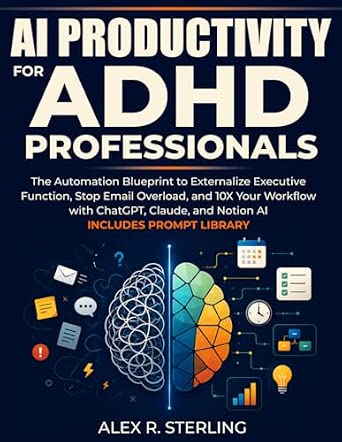
AI Productivity for ADHD Professionals: Automation Blueprint to Externalize Executive Function, Stop Email Overload, and 10X Your Workflow with ChatGPT, Claude & Notion AI. Includes Prompt Library
This guide makes a focused case for automation strategies tailored to ADHD professionals, emphasizing practical techniques to manage email overload and boost workflow efficiency, similar to the approach in ‘AI-Powered Productivity & Prompt Engineering,’ but specifically targeting challenges faced by ADHD users. While it offers a robust prompt library and clear strategies, it falls short on detailed technical instructions and assumes some familiarity with AI tools, which might be a barrier for complete beginners. It’s a practical choice for professionals wanting targeted productivity solutions rather than deep technical mastery.
Pros:- Provides practical automation strategies
- Includes a comprehensive prompt library
- Focuses on managing email overload and workflow
Cons:- Lacks detailed technical instructions
- May require prior familiarity with AI tools
Best for: ADHD professionals seeking tailored automation and workflow management strategies
Not ideal for: Users unfamiliar with AI tools or seeking comprehensive technical tutorials
- Focus Area:Automation for ADHD
- Content Type:Strategy guide
- Includes:Prompt library
- Tools Covered:ChatGPT, Claude, Notion AI
- Technical Detail:Basic
- Target User:ADHD professionals
Our verdict“This blueprint is best for ADHD professionals who want actionable automation strategies to improve productivity quickly.”
Master AI for Beginners: Develop Artificial Intelligence Basics, Understand Machine Learning, and Unlock the Power of Automation for Business Productivity
This book offers a comprehensive introduction to AI fundamentals and automation, similar in scope to ‘AI Tools for Everyone,’ but with a stronger emphasis on business applications and machine learning. It’s ideal for beginners who want to understand core concepts without being overwhelmed by technical details, though it doesn’t delve into advanced topics or provide practical exercises for hands-on learning. The focus on practical insights makes it suitable for professionals looking to leverage AI for productivity gains in a business context.
Pros:- Clear introduction to AI and machine learning
- Focuses on practical business automation
- Suitable for beginners
Cons:- Lacks detailed technical depth
- No customer reviews available
Best for: Business newcomers interested in understanding AI concepts and automation potential
Not ideal for: Advanced practitioners seeking detailed technical or programming guidance
- Focus Area:AI basics and automation
- Skill Level:Beginner
- Content Type:Introductory guide
- Applications:Business productivity
- Technical Depth:Basic
- Includes:Concepts and insights
Our verdict“This book suits business beginners aiming to grasp AI fundamentals and automation opportunities without technical complexity.”
AI-Powered Productivity & Prompt Engineering: A Practical System to Work Smarter, Save Time, and Get More Done with AI
This book emphasizes practical strategies for leveraging AI through prompt engineering to enhance efficiency, similar to ‘AI Tools for Everyone,’ but with a sharper focus on crafting effective prompts for productivity. While it offers actionable techniques and tools for working smarter, it omits detailed technical instructions and specific product features, which could limit those seeking in-depth technical mastery. It makes a good choice for users who want immediate, applicable methods to improve workflow using AI-driven prompts.
Pros:- Provides practical AI productivity strategies
- Helps improve work efficiency through prompts
- Focuses on working smarter and faster
Cons:- Lacks detailed technical instructions
- No specific product features or specifications
Best for: Professionals interested in mastering prompt engineering to boost productivity
Not ideal for: Those seeking technical deep-dives or detailed product specifications
- Focus Area:Prompt engineering
- Content Type:Practical system
- Tools Covered:AI for productivity
- Technical Detail:Limited
- Target Audience:Productivity-focused users
Our verdict“This book is well-suited for users who want quick, effective techniques to harness AI prompts for productivity gains.”
Mastering Claude AI: The Complete Practical Guide to Prompt Engineering, Projects, Artifacts, Claude Code, MCP, Automation, API Integration & Claude AI Mastery Series for Professionals
This guide stands out for its comprehensive coverage of complex Claude AI topics, making it ideal for experienced users who want to deepen their mastery beyond basic prompt engineering, unlike simpler resources like ‘AI Prompts for Productivity and Time Management.’ Its focus on projects, automation, and API integration provides practical skills for real-world application, though the dense technical content may overwhelm newcomers. Compared with beginner-friendly guides like ‘Claude AI for Microsoft 365 for Beginners,’ this volume offers depth at the expense of accessibility. The absence of pricing info and user ratings means I rely on its detailed scope as a sign of value, but its technical nature is a clear tradeoff for those new to AI tools.Pros:- Extensive coverage of advanced Claude AI topics and techniques
- Practical insights into automation and API integration for real-world use
- Includes detailed projects and artifacts for hands-on learning
Cons:- Lacks pricing and user ratings, limiting quick assessment of value
- Content may be too technical for users new to AI or programming
- No beginner-friendly explanations or simplified workflows
Best for: AI professionals and developers looking to master Claude AI through in-depth projects and automation techniques.
Not ideal for: Beginners or casual users seeking straightforward, easy-to-understand guidance on Claude AI, as the content may be too technical.
- Coverage:Prompt engineering, projects, artifacts, Claude code, MCP, automation, API integration
- Intended Audience:Professionals, developers, AI practitioners
- Content Depth:Advanced, technical
- Format:Practical guide, project-based
- Price Info:Not specified
- Customer Ratings:Not provided
Our verdict“This guide makes the most sense for seasoned AI professionals seeking deep, technical mastery of Claude AI, not for newcomers or casual users.”

How We Picked
I evaluated these AI productivity software options based on several critical factors: the breadth and depth of AI features, ease of integration with popular tools like Microsoft 365, user interface and learning curve, flexibility of automation and customization, and overall value for different user types. Products were also assessed for how well they support specific use cases, such as time management, prompt engineering, or niche needs like ADHD support. The ranking reflects a balance between sophistication and accessibility, prioritizing tools that deliver meaningful productivity improvements without excessive complexity or cost.Factors to Consider When Choosing AI Productivity Software
Choosing the right AI productivity software depends on your specific work style, technical comfort, and budget. Understanding key factors can help you avoid common pitfalls and select a tool that truly enhances your workflow rather than adding complexity. Here are the main considerations to keep in mind.Integration with Existing Tools
Most AI productivity tools perform best when seamlessly integrated into your current workflow. For many users, compatibility with Microsoft 365 apps like Word, Excel, and Outlook is a major advantage, enabling automation and AI assistance directly within familiar environments. Conversely, some tools excel as standalone solutions but may require additional setup or learning curves. Prioritize software that aligns with your daily tools to maximize efficiency and minimize disruption.
Ease of Use vs. Advanced Customization
Some products prioritize user-friendly interfaces suitable for beginners, offering guided prompts and simple automation. Others provide extensive customization options, allowing power users to craft complex workflows and prompts. The right choice depends on your comfort with technology and the depth of automation you need. Overly complex tools can be overwhelming if you’re new, while simpler options might limit your productivity gains if you’re experienced.
Cost and Value
Pricing ranges from free or low-cost plans to premium enterprise solutions. Consider whether the features justify the expense, especially if you’re an individual professional or small team. Free or affordable tools may provide basic automation, but investing in a more capable product can yield significant time savings and efficiency for larger or more complex workflows. Evaluate your budget alongside your productivity needs to avoid overpaying or underinvesting.
Support and Learning Resources
Effective AI tools come with robust support, tutorials, and community resources that facilitate quick onboarding and troubleshooting. If you’re new to AI-driven productivity, look for solutions with comprehensive guides and active user communities. For advanced users, developer support or API access can open additional automation possibilities. Well-supported products tend to reduce frustration and help you realize benefits faster.
Specific Use Cases and Niche Needs
Consider whether your primary goal is general productivity, managing specific workflows like email overload, or supporting particular needs such as ADHD. Some tools are tailored for niche applications, offering specialized prompts, automation, and integrations. Matching the software to your unique requirements ensures you get the most relevant features without paying for unnecessary extras. Clarifying your main priorities can streamline your decision process.
Frequently Asked Questions
How do I choose between an all-in-one AI productivity platform and specialized tools?
Deciding between comprehensive platforms and specialized tools depends on your workflow complexity and specific needs. All-in-one solutions, like Microsoft Copilot, provide broad functionality within familiar environments, making them ideal for users seeking simplicity and integration. Specialized tools, such as those focused on prompt engineering or niche productivity like ADHD management, offer deeper features tailored to particular tasks. For most users, starting with an integrated platform and adding niche tools as needed can provide a balanced approach.
Are free AI productivity tools sufficient for professional use?
Many free AI productivity options can handle basic automation and prompt generation, making them suitable for casual or low-stakes tasks. However, professional environments often demand reliability, advanced features, and dedicated support, which typically come with paid plans. Investing in premium versions can unlock deeper integrations, higher limits, and priority support, ultimately delivering greater value for demanding workflows.
What should I prioritize if I’m new to AI productivity tools?
Beginners should focus on ease of use and strong onboarding resources. Look for tools with intuitive interfaces, guided prompts, and ample tutorials. Compatibility with your existing work environment is also vital to reduce learning curves. Starting with simple automation features allows you to build confidence, gradually exploring more advanced capabilities as your familiarity grows. Avoid overly complex solutions until you’re comfortable with basic functionalities.
How important is prompt engineering in AI productivity software?
Prompt engineering is increasingly central to maximizing AI productivity tools, especially for professional or complex workflows. Well-crafted prompts can unlock more accurate, relevant, and useful AI responses, saving time and reducing frustration. Some software offers dedicated prompt libraries and engineering guides, which can significantly boost your efficiency. Investing time in learning prompt techniques is worthwhile if you want to leverage AI at a higher level.
Should I prioritize AI tools with automation capabilities or those focused on prompts?
Both automation and prompt engineering play vital roles in productivity. Automation handles repetitive tasks, freeing your time, while prompts enhance AI responsiveness and quality. The right choice depends on your workflow. If you deal with high-volume repetitive tasks, automation-focused tools may be more beneficial. If you seek creative or complex problem-solving, investing in prompt engineering capabilities can provide more nuanced control over AI outputs.
Conclusion
For general users seeking a reliable, all-around AI productivity solution, Microsoft Copilot offers a comprehensive approach with excellent integration. Those on a budget or just starting out may find AI Prompts for Productivity or beginner-friendly tools more suitable. Professionals requiring deep customization or niche support, like ADHD management, should consider products like Claude AI or specialized automation solutions. Understanding your work style and priorities will guide you to the best fit, ensuring AI tools truly enhance your productivity rather than complicate it.
NFL season / tailgating Picks
team gear
As an affiliate, we earn on qualifying purchases.