By Thorsten Meyer | November 12, 2026 | ThorstenMeyerAI.com

Get business pricing on tech for your team
- Business-only prices and quantity discounts
- Tax-exempt purchasing
- Multiple users, one account, clear invoices
Key takeaways
- What changed: On November 11, 2026, United Airlines said it is restricting access for “unauthorized, third-party personal AI agents or assistants”, on its own website and app and “indirectly via travel agencies and aggregators”. Its revised contract of carriage now lists “the use of AI Agents to make, modify or service a Ticket” as a prohibited practice, according to the travel blogs that first published the text.
- The surprising part: The ban applies “whether or not Passenger or another individual supervises or approves” what the software does. A human in the loop does not make an agent booking acceptable.
- What still works: An AI assistant may still search for United flights and show you fares, according to The Wall Street Journal as cited by View from the Wing. You just have to buy the ticket yourself.
- The reasons: United cites account security, unintended purchases and FAA and DOT rules. Its CEO, Scott Kirby, added a commercial one at an event in Chicago, according to the Journal: “To be honest, I don’t want to create another middleman.”
- The bigger picture: United is the first US airline to say this explicitly, according to Skift. Amazon and JPMorgan Chase have already shut outside agents out; Southwest and Expedia are working with ChatGPT. And for now, almost nobody buys through agents: Uber counted four agent-booked rides in a week of about 320 million trips and orders.
Products Worth Considering

Bose Lifestyle Ultra Soundbar and Ultra Subwoofer Bundle

DJI Mini 4 Pro Fly More Combo with DJI RC 2

Bose QuietComfort True Wireless Earbuds with Active Noise Cancellation, Bluetooth 5.3, USB-C Charging, and IPX4 Water Resistance
As an affiliate, we earn on qualifying purchases.
The first airline to lock the agents out
The pitch for personal AI agents goes like this: tell your assistant where you want to fly, your budget and your seat preference, and it finds the flight, books it and checks you in. Travel is the showcase use case. Meta’s CEO Mark Zuckerberg called travel a “top use case” for its Muse agent, according to Skift.
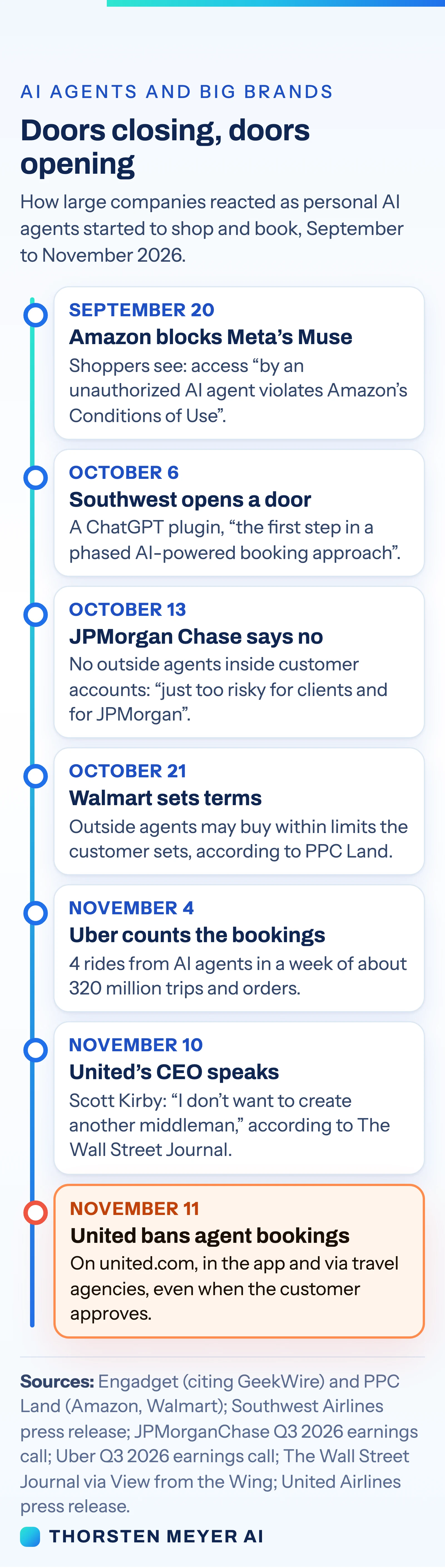
On Wednesday, United Airlines told those agents to stop at the checkout.
The airline’s press release is short. “United is taking steps to restrict access – directly within our digital platforms and indirectly via travel agencies and aggregators – to prohibit use by unauthorized, third-party personal AI agents or assistants,” it says. “This work includes updates to our booking, ticketing and distribution policies.”
The legal text sits in United’s contract of carriage, the terms every passenger accepts by buying a ticket. I could not load united.com from my research setup, so the contract wording below is quoted as published by View from the Wing, One Mile at a Time and PPC Land, which reproduced it on November 11. Where their quotes overlap, they match.

What the new rule actually says
The contract, headed “revised November 11, 2026”, adds AI agents to a list of “Prohibited Practices” that until now dealt with fare tricks such as hidden-city and throwaway ticketing. Rule 6.J.6 bans “the use of AI Agents to make, modify or service a Ticket, and/or to purchase any service or product.”
The definition is broad. According to One Mile at a Time, it reads: “AI Agent means any software or service, including but not limited to an AI assistant, AI agent or AI-enabled browser that takes autonomous or semi-autonomous action, whether or not Passenger or another individual supervises or approves its actions, to discover, search for, book, purchase, ticket, service or manage any product or service offered by or through United, including flights, seats, upgrades, ancillary products and partner products.”
It names three kinds of agents: “(i) AI assistants built into social media, messaging, search or other consumer platforms; (ii) AI-enabled browsers and standalone AI agents; and (iii) any third-party AI assistant that accesses United through a tool, application or connection provided by a travel agency or other intermediary.” It does not name a single product, as PPC Land points out. Reporters filled in the blanks: CBS News named Meta’s Muse and OpenAI’s dots as examples of the agents consumers use.
Three details matter most:
- Cancellation: Rule 5.H lets United cancel “reservations made, modified or serviced by AI Agents” without notice. Rule 5.F says United “is not liable for any consequential, compensatory, or other damages” when it cancels under that rule, according to PPC Land.
- Penalties: The remedies clause, Rule 6.K, includes invalidating tickets, charging “the full value of a Ticket”, deleting miles and ending MileagePlus membership. PPC Land notes that the contract does not say whether United intends to use these against agent bookings.
- Old tickets: Rule 3.E applies the contract “in effect on the date on which the Ticket is issued”, PPC Land reports. On its reading, tickets issued before November 11 fall under the earlier text.
The reasons United gives, and the one its CEO gave
United’s press release lists three concerns. “Sharing account credentials with personal, third-party, AI assistants can expose sensitive information, and actions taken by these tools may result in unintended purchases, account changes, or use of MileagePlus miles,” it says. And: “these automated AI actions have the potential to violate FAA and DOT regulations – as an example, flight check-in requires human acknowledgment that bags do not contain banned substances like explosives.”
That second point is worth checking. The federal rule, 49 CFR 175.25, requires airlines to inform passengers about forbidden hazardous materials at ticket purchase and at check-in. Where a passenger completes the purchase or check-in “without the involvement of another person”, the passenger must acknowledge “that they have been presented with the information”. Gary Leff of View from the Wing calls United’s safety argument “weak”: the rule “doesn’t require the customer to manually complete every other step of a booking”, and an assistant “can stop and ask the passenger” to confirm. United’s definition covers that supervised agent anyway.
Then there is the commercial reason. United CEO Scott Kirby said at an event in Chicago on Tuesday, according to The Wall Street Journal as quoted by several outlets: “To be honest, I don’t want to create another middleman.”
Henry Harteveldt, an aviation analyst at Atmosphere Research Group, read it the same way. “United is saying they don’t want to add yet another, and potentially even more powerful, intermediary than they already face in terms of Google search, price-comparison metasearch sites and online travel agencies,” he told CBS News. “Flight searches cost airlines money, and undoubtedly United wants to avoid the expense associated with the surge of AI bot flight searches.”
Thrifty Traveler suggests another motive. Since United dropped most change fees, travellers can rebook when a fare falls and keep the difference as travel credit. Few do it, because it means checking prices for weeks. “But AI can check your fare every hour until the day you fly and rebook the second it drops,” the site writes.
Not the first door to close, and not every door is closing
United said that “corporate leaders in the banking and retail industries have taken similar actions regarding AI agents”. The record shows companies choosing very different levers.
Closed, or closed without permission:
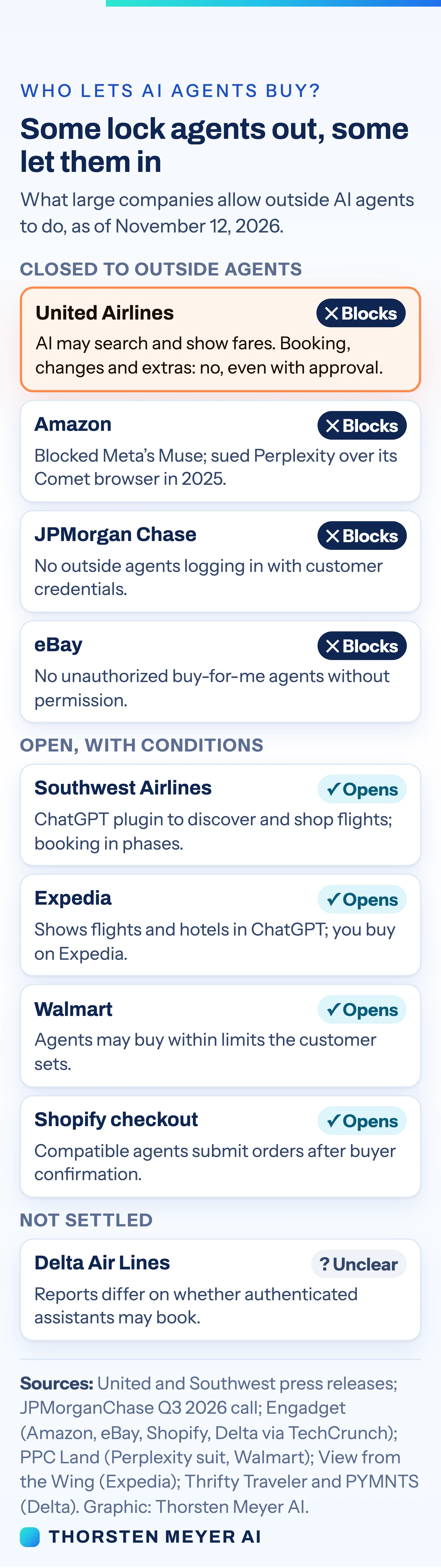
- Amazon blocked Meta’s Muse from shopping on its site in September. Shoppers saw the message “Continued access by an unauthorized AI agent violates Amazon’s Conditions of Use, to which our customers have agreed,” according to Engadget, citing GeekWire. Amazon also sued Perplexity over its Comet browser in November 2025, according to PPC Land.
- JPMorgan Chase does not let outside agents into customer accounts. “we’re not going to allow just any outside agents to come in inside the company, because it’s just too risky for clients and for JPMorgan,” CEO Jamie Dimon said on the bank’s earnings call on October 13. CFO Jeremy Barnum added that if customers “give up their credentials to the agent and the agent does something that they don’t want, that’s going to be on them.”
- eBay’s user agreement prohibits unauthorized buy-for-me agents unless the company grants permission, according to Engadget.
Open, under conditions:
- Southwest launched what it calls a “first-of-its-kind U.S. airline plugin in ChatGPT” on October 6, 2026, built with OpenAI and Amazon Web Services. It describes the plugin as “the first step in a phased AI-powered booking approach”.
- Expedia has a ChatGPT integration that shows flights and hotels with prices, but sends the customer to Expedia to buy, according to View from the Wing.
- Shopify’s checkout tools let compatible browser agents submit orders “after buyer confirmation”, according to Engadget. Walmart set terms on October 21 that let outside agents buy within limits the customer sets, according to PPC Land.
Delta sits in between. Delta told TechCrunch in October that it has no integration allowing third-party agents to book through its website, Engadget reported. Thrifty Traveler and PYMNTS now report that Delta lets authenticated AI assistants complete bookings, with extra safeguards for “sensitive transactions”. Skift quotes Delta CEO Ed Bastian as “cautious”. I could not find a Delta statement that settles it.
Almost nobody books through agents yet
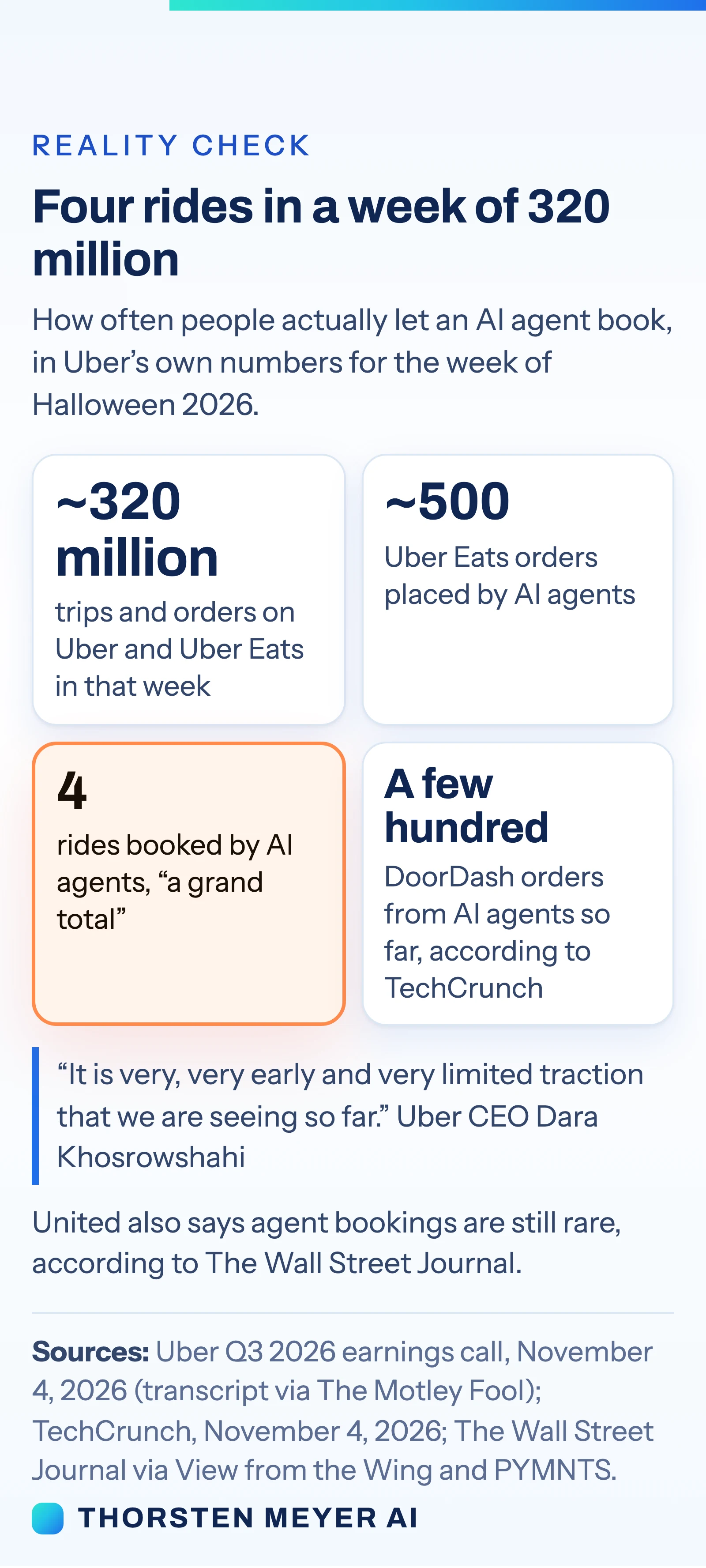
Here is the number that puts all of this in proportion. On Uber’s third-quarter earnings call on November 4, CFO Balaji Krishnamurthy said the company did “just around 320 million trips on Uber and Uber Eats” in the week of Halloween. “The volumes coming from AI agents for Uber Eats were around 500. 500 orders total. And for our Rides business, it was a grand total of 4 trips that we have fulfilled from agents.”
DoorDash said it has received only a few hundred orders from AI agents so far, according to TechCrunch. United itself says agent bookings are still rare, according to View from the Wing and PYMNTS, which cite the Journal.
That is why the timing makes sense from United’s side. As Thrifty Traveler puts it, this is “the cheapest moment to shut the door”. The interest is real, though: Meta says Muse has more than 10 million users, according to TechCrunch, and the agent startup Instinct raised money at a $10 billion valuation.
What this means for businesses
If you build agents: The open web is not an open checkout. United, Amazon and JPMorgan all use terms of use as the first line of defence, and United goes further by putting the ban in the contract the passenger signs. An agent that books anyway puts your user’s booking, miles and status at risk, not just your product’s access. The routes that work are sanctioned ones: partner plugins like Southwest’s, hand-offs to the seller’s page like Expedia’s, and checkout tools that expect agents, like Shopify’s. Visa is developing ways for merchants to recognise approved agents, its Trusted Agent Protocol, according to View from the Wing and PPC Land.
If you sell online and are deciding whether to allow agents: United shows the trade-off clearly. Blocking protects the direct customer relationship, the data and the upsell. It also means an agent shopping for “the cheapest nonstop to Denver” may book a rival that lets it finish, as Thrifty Traveler notes. Decide which actions you want to allow (search, hold, buy, change, cancel), write that into your terms, and give approved agents a way to identify themselves.
Liability is the open wound. Barnum’s warning, that a bad agent action is “going to be on” the customer, and United’s Rule 5.F, which excludes damages when it cancels, point in the same direction: the risk sits with the person who handed over the login. Anyone offering an agent to consumers should expect that question from regulators and customers.
Fare rules and fraud are the next fight. Agents that watch prices around the clock can use rules that only worked because most people do not bother, such as rebooking for credit. At scale, they could also hold seats or request changes far faster than any person. Expect more companies to separate “look” from “act” the way United did.
What this means for travellers
- Research with AI, buy yourself. Comparing United flights in an assistant is still fine. Complete the purchase on united.com, in the United app or with a human travel agent.
- Do not hand your MileagePlus password to an agent. That is United’s main argument, and it holds for any account with stored payment details or points.
- Check recent bookings. United’s Digital Trust Center is meant to explain the new rules and “where to get help if an agent takes an unintended action”. If an agent booked or changed a United trip for you after November 11, check that the ticket is in order.
- Your favourite fare tools still work. United fares remain bookable through aggregators such as Kayak, Hopper and Google Flights, Harteveldt told CBS News. “But by blocking the AI bots, United won’t make it any easier to find its fares, either,” he said.
What is not known
- How United will detect agents. The contract does not say. View from the Wing points out that an agent buying on Expedia would look like an ordinary Expedia booking: “A contractual ban isn’t a technical one.”
- What “service a Ticket” covers. The term is not defined, PPC Land notes. It is unclear whether an agent changing a seat, filing a refund request or checking you in counts.
- Whether search tools are next. The definition includes software that can “discover” or “search for” United products. Only booking, changing and buying are prohibited. One Mile at a Time asks whether award-search tools could be affected if United chooses to enforce broadly.
- How travel agencies must comply. United says the restrictions also apply “indirectly via travel agencies and aggregators”. The distribution rules behind that are not public in the sources I could check.
- Whether approved agents will come. United says it “will continue to evaluate how these tools interact with our services”. Its Digital Trust Center page for third-party AI agents did not load from my setup, so I could not check it.
- Delta’s exact policy, and whether other US airlines follow United or court the bookings it turns away.
The bottom line
United did not ban AI. It banned other companies’ AI from closing the sale. That is partly a business decision, as its CEO admitted, wrapped in a security argument, and the security argument is not empty: credential sharing really is risky, and nobody has settled who pays when an agent books the wrong flight. For now the cost to United is small, because hardly anyone books through agents. The interesting question is what happens when that changes, and the first airline whose agent bookings work well starts to win customers who never open an airline app again.
For background, read how OpenAI is moving into travel with Odessia and what IBM and Microsoft’s agent platform leaves open.
I’m Thorsten Meyer. The full sources are below, and more reality checks are at thorstenmeyerai.com.
Sources
- United Airlines: “United Restricts Access for Third-Party AI Agents”, press release, November 11, 2026, united.mediaroom.com
- United Airlines contract of carriage, “revised November 11, 2026”, as quoted by View from the Wing, One Mile at a Time and PPC Land (united.com did not load from our research setup)
- View from the Wing, Gary Leff: “United Airlines CEO Scott Kirby Bans AI Agents From Booking Tickets, Doesn’t Want ‘Another Middleman'”, November 11, 2026 (cites The Wall Street Journal)
- One Mile at a Time: “United Airlines Bans ‘AI Agents,’ Claims It’s To ‘Protect Customers'”, November 11, 2026
- PPC Land, Luís Rijo: “United bans AI agents from buying its tickets, seats and upgrades”, November 11, 2026
- InsideFlyer: “United bars AI agents from completing flight bookings”, November 11, 2026
- CBS News: “United Airlines bans AI agents from booking flights on behalf of travelers”, November 11, 2026
- Skift, Meghna Maharishi: “United Airlines Moves to Block Personal AI Agents From Booking Flights”, November 11, 2026
- Thrifty Traveler, Jackson Newman: “United Blocks Personal AI Agents from Booking Flights, Will Other Airlines Follow?”, November 11, 2026
- Engadget: “United is restricting AI agents from booking flights”, November 11, 2026; “Amazon bars Meta’s Muse AI from shopping on its site”, September 2026; report on websites blocking AI agents
- PYMNTS: “United Airlines Blocks AI Bots From Booking Flights”, November 11, 2026 (cites The Wall Street Journal)
- Reuters via CNA: “United Airlines moves to block AI agents from its platform over security concerns”, November 11, 2026
- US Code of Federal Regulations: 49 CFR 175.25, “Passenger notification system”, ecfr.gov
- Southwest Airlines: “Southwest Airlines Launches First-of-Its-Kind U.S. Airline Plugin in ChatGPT”, press release, October 6, 2026
- JPMorganChase: third-quarter 2026 earnings call transcript, October 13, 2026; CNBC: “JPMorgan Chase blocks outside AI agents like Muse, Instinct from directly accessing accounts”, October 13, 2026
- Uber Technologies: third-quarter 2026 earnings call, November 4, 2026 (transcript via The Motley Fool); TechCrunch: “Almost no one uses AI agents to book their Uber, company says”, November 4, 2026
Researched and drafted with AI assistance, including Anthropic’s Claude. Anthropic and OpenAI both offer AI agents of the kind discussed here. No company named in this article reviewed or sponsored it, and it contains no affiliate links. This article is for information only. It is not legal advice. Statements as published by United and the sources above as of November 12, 2026; United may update its contract and its Digital Trust Center. Images: AI-generated illustration (Runware) and graphics by Thorsten Meyer AI; no real people or logos are shown.