

By Thorsten Meyer | November 17, 2026 | ThorstenMeyerAI.com

Get business pricing on tech for your team
- Business-only prices and quantity discounts
- Tax-exempt purchasing
- Multiple users, one account, clear invoices
The world’s largest contract chipmaker says the leak did not come out of its own systems. TSMC, which makes chips for companies such as Apple and Nvidia according to BleepingComputer, confirmed on November 12 that data on some of its current and former employees had been put on an external website without authorization. The data, TSMC says, matches what a cloud service provider stored for it. It has not said which one. Meanwhile, a seller on a hacker forum claims to hold 46,000 employee records and has tried to auction them. The gap between what the company confirms and what the seller claims is one half of this story. The other half is the route: not through TSMC’s front door, but through a supplier.
Key takeaways
- What TSMC confirms: in a statement on the Taiwan Stock Exchange’s disclosure system dated November 12, 2026, TSMC says “some of our current and former employee data was made available on an external website without authorization.” So far, it has “found no evidence that TSMC’s systems have been compromised.”
- The cloud link: the leaked information “has been verified to match data stored in the system services of a cloud service provider”. TSMC does not name the provider, and none of the outlets we checked does either.
- What is not affected, per TSMC: the data is “unrelated to the company’s operations or customer-related data.”
- What the seller claims, not confirmed: a forum post on November 8 offered a 6.9GB dataset with 46,000 employee records, including national ID numbers, addresses, contact details and banking information, according to BleepingComputer. TSMC has confirmed neither the number nor the types of data.
- What TSMC is doing: informing affected staff, providing support, and working with the cloud vendor, investigating authorities and an outside cybersecurity agency.
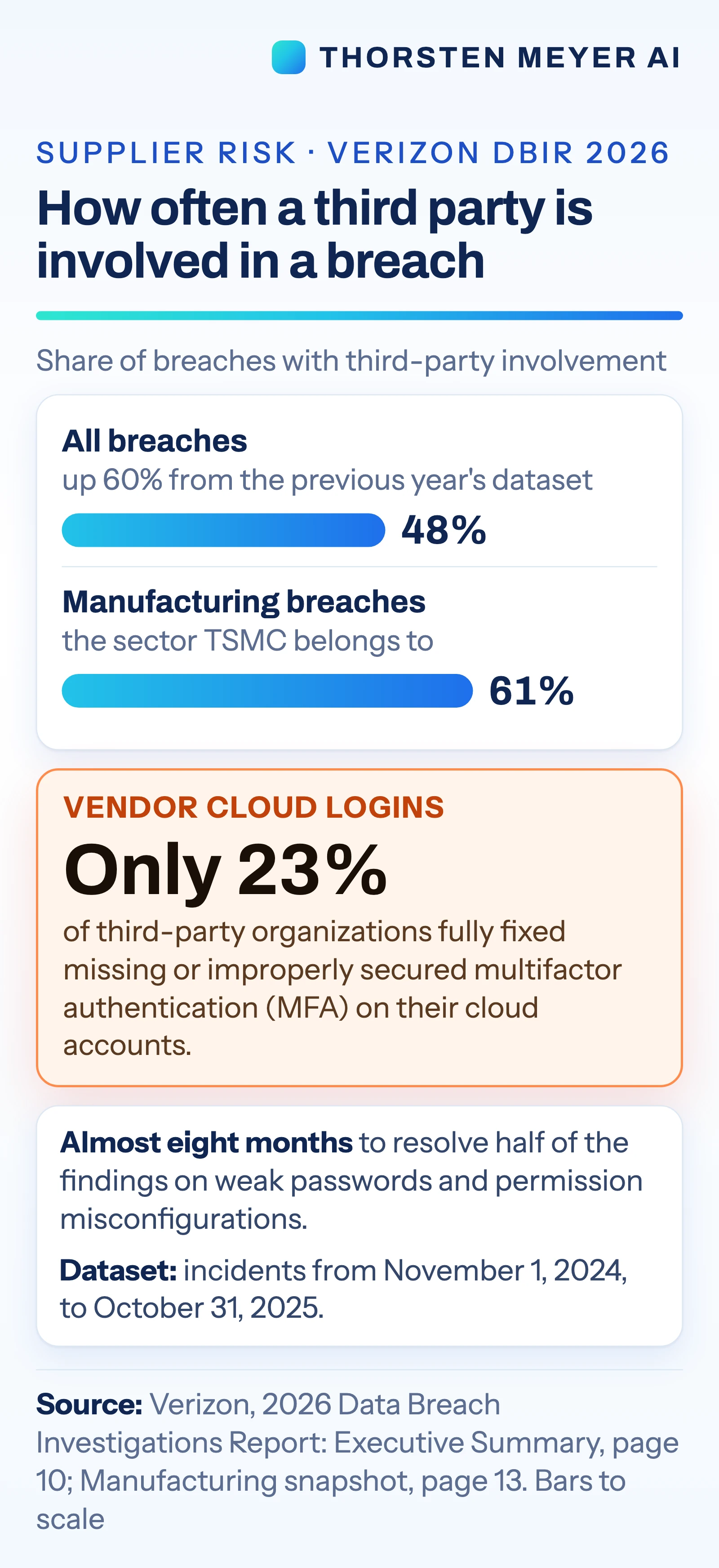
- The bigger pattern: Verizon’s 2026 Data Breach Investigations Report finds third-party involvement in 48% of breaches, and in 61% of breaches in manufacturing.
TSMC employee data · Nov 8 – Nov 16, 2026
How TSMC links the leak to a cloud provider
What TSMC confirms and what the seller claims, step by step.
Where the data was (schematic)
Solid tag: confirmed by TSMC. Dashed tag: the seller’s claim.
What happened
- Nov 8A seller posts a 499-row sample and claims 46,000 employee records, 6.9GBclaim, per BleepingComputer
- Nov 12TSMC: current and former employee data was put on an external website without authorization
- Nov 12TSMC: the data matches what a cloud service provider stored; the provider is not named
- Nov 12TSMC: no evidence so far that its own systems were compromised
- Nov 12TSMC informs affected staff and works with the vendor, investigators and outside experts; Form 6-K filed with the SEC
- Nov 15The seller’s deadline for a free leakclaim, per BleepingComputer
- Nov 16Deadline passed; no confirmed report that the full dataset was released
Sources: TSMC statement on the Taiwan Stock Exchange (MOPS), November 12, 2026; SEC EDGAR filing index; BleepingComputer, Nov 15, 2026; TechRadar, Nov 16, 2026. The chain is a schematic; the seller’s figures are not confirmed by TSMC.
Graphic: Powered by Thorsten Meyer AI
Products Worth Considering

Apple Watch SE 3 GPS 40mm Smartwatch

Bose QuietComfort Headphones (2nd Gen), Wireless Noise-Cancelling Over-Ear Headphones, White Smoke

Logitech MX Master 4 Ergonomic Wireless Mouse with Haptics – Graphite
As an affiliate, we earn on qualifying purchases.
What TSMC actually said
TSMC published its statement on November 12 as material information on the Taiwan Stock Exchange’s Market Observation Post System, in Chinese and English, in the evening Taiwan time. Its subject line reads “Statement Regarding the Unauthorized Access of Employee Personal Data”. The filing lists the company’s senior vice president and chief financial officer as spokesperson; The Record and TechRadar name him as Wendell Huang. According to the SEC’s filing index, TSMC filed a Form 6-K with the US Securities and Exchange Commission the same day. The text that The Record and BleepingComputer quote from that filing matches the exchange statement word for word; we could not retrieve the 6-K document itself.
The statement is six sentences long, and each one is worded with care:
- Where the data turned up: “TSMC has found that some of our current and former employee data was made available on an external website without authorization.” Note “former”: the data covers people who no longer work there.
- TSMC’s own systems: “Currently, we have found no evidence that TSMC’s systems have been compromised.” That is a finding for now, not a final result.
- The cloud provider: the information “has been verified to match data stored in the system services of a cloud service provider”. TSMC links the leak to the provider by matching the data. It does not say how the data left the provider, or whether the provider itself has confirmed a breach.
- What is out of scope: the data is “unrelated to the company’s operations or customer-related data.” The Chinese version is a little more specific. It says the data is unrelated to the company’s production or customer-related data (our translation of “與公司生產或客戶相關資料無關”).
- The response: “We have been informing impacted personnel and are providing them with necessary support.” TSMC “has engaged with both the cloud service vendor, the relevant investigating authorities, and a third-party cybersecurity agency to jointly ascertain the facts and take necessary actions.”
Some headlines went further than that. TechRadar’s reads “TSMC confirms cyberattack and data breach”. TSMC’s own words confirm unauthorized access to employee data and a match with a cloud provider’s data, and say there is no evidence so far of a compromise of TSMC’s own systems.
What the seller claims
The claims come from the forum post, not from TSMC. According to BleepingComputer, on November 8 a forum user “leaked on a hacker forum a text file containing 499 rows of information allegedly stolen from TSMC.” The seller called the file a sample of a 6.9GB dataset “containing 46,000 employee records”. According to the post, the data includes “national ID numbers, addresses, contact details, and banking information.”
The seller put the data up for auction, with bidding starting at 3 bitcoin, and warned that it would be leaked for free if nobody bought it, “setting the first deadline to November 15.” On November 16, TechRadar wrote that this deadline “has now expired”. We found no report that confirms the full dataset has since been published or sold.
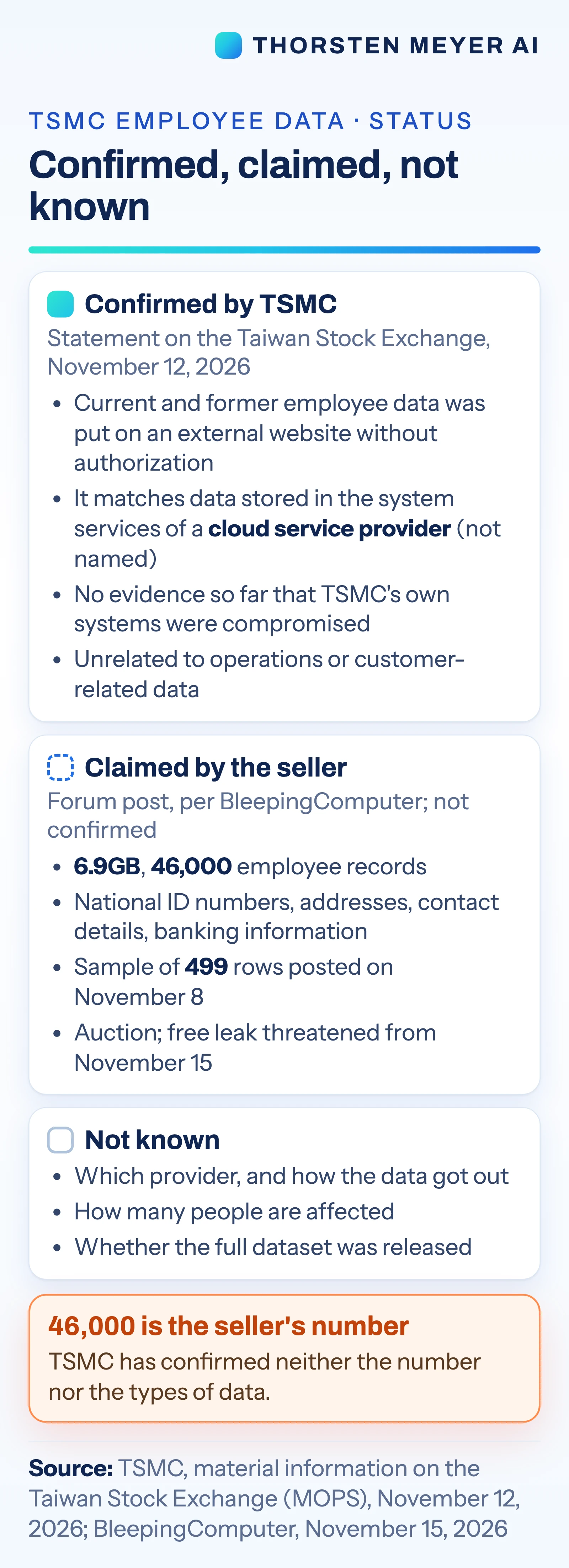
Two cautions about the numbers. First, 46,000 is the seller’s figure. TSMC has not given a number. Second, as TechRadar points out, “46,000 employee records doesn’t necessarily mean 46,000 people”. And TSMC has not said which data types were involved.
The company is saying little beyond its statement. The Record writes that “TSMC did not respond to requests for comment on the specifics of the post.” BleepingComputer asked whether TSMC had engaged with the seller or planned to pay; “A spokesperson declined to comment at this stage.”
Why the supplier is the weak point
TSMC has been here before, from a different angle. According to The Record, the company “dealt with a ransomware attack in 2023 involving one of its IT hardware suppliers.”
The last few weeks show the same pattern at other companies. On November 10, BleepingComputer reported that AI platform Fireworks said “A third-party cloud provider that hosted Fireworks R&D machines experienced a security incident on October 23”. We covered how the Fireworks breach widened and how it reached Uber drivers. A day later, BleepingComputer reported that accounting firm Baker Tilly is notifying clients after data “stored on a platform operated by a third-party service provider” was exposed. Baker Tilly says it has “no evidence of unauthorized activity on its own network”. That is very close to TSMC’s line.
The numbers behind the pattern come from Verizon’s 2026 Data Breach Investigations Report, which covers incidents from November 1, 2024, to October 31, 2025:
- Third parties are now in almost half of all breaches. “breaches with third-party involvement have increased by 60% from last year’s dataset, reaching 48% of total breaches.”
- Manufacturing is higher still. In the report’s manufacturing snapshot, third-party involvement stands at 61% of breaches.
- Vendor cloud accounts stay weak for a long time. Looking at third-party cloud exposure, “only 23% of third-party organizations fully remediated missing or improperly secured multifactor authentication (MFA) on their cloud accounts”. For weak passwords and permission errors, resolving half of the findings took “almost eight months”.
Our reading: a company can secure its own network well and still lose its people’s data, because that data also sits with the outside services it uses. TSMC has not said what service this cloud provider ran for it. But the lesson does not depend on that detail. Saying that your own systems were not compromised is not the same as saying that your employees’ data is safe.
What it means for businesses
This is not legal advice. The NIST Cybersecurity Framework 2.0 has a whole category for supply chain risk (GV.SC), and several of its outcomes read like a checklist for this case:
- Know who holds your people’s data. GV.SC-04: “Suppliers are known and prioritized by criticality”. Our reading: list every outside service that stores employee data, not only the obvious IT vendors.
- Put it in the contract. GV.SC-05 says security requirements should be “integrated into contracts and other types of agreements with suppliers”. Our reading: that includes how fast a vendor must tell you about an incident, multifactor login on every account that can reach your data, and logs you can see.
- Keep watching after signing. GV.SC-07 says supplier risks should be “monitored over the course of the relationship”. Given Verizon’s finding on missing MFA, checking a vendor’s login settings once at onboarding is not enough.
- Plan for the exit, and for former staff. GV.SC-10 calls for provisions “for activities that occur after the conclusion of a partnership or service agreement”. TSMC’s statement covers former employees too. Our reading: ask how long each vendor keeps data on people who have left, and get proof of deletion.
- Bring vendors into incident response. GV.SC-08: “Relevant suppliers and other third parties are included in incident planning, response, and recovery activities”. TSMC says it is working with its cloud vendor on the investigation; that only works fast if the roles are agreed before something happens.
- Warn staff before the scam calls start. Verizon reports that in phishing simulations, the median click rate for attacks by voice call and text message is 40% higher than via email. When employee data leaks, a short warning to staff is part of the response.
What affected employees should watch for
TSMC says it is informing the people affected. If the seller’s description of the data is accurate, the main risk is targeted fraud: messages or calls that use real names, addresses and bank details to look trustworthy. Guidance from the US cybersecurity agency CISA (an archived 2021 page, still useful) covers the basics:
- Verify the sender yourself. “If an unknown individual claims to be from a legitimate organization, try to verify his or her identity directly with the company.”
- Use contact details you already have. “Do not use contact information provided on a website connected to the request”.
- Do not trust caller ID. CISA warns that internet phone services make it easy: “VoIP easily allows caller identity (ID) to be spoofed”.
- Talk to your bank early. “If you believe your financial accounts may be compromised, contact your financial institution immediately”.

Our advice on top: treat any message about the leak with suspicion, especially one that offers to remove your data or asks you to confirm details. Information about the incident should come from TSMC through channels you already know.
What is not known
- Which cloud provider. TSMC does not name it, and neither do The Record, BleepingComputer or TechRadar. TSMC has not said what service it ran.
- How the data got out. TSMC’s statement links the data to the provider. It does not describe a break-in, a misconfiguration or anything else.
- How many people, and which data. TSMC gives no number. 46,000 records is the seller’s claim, and records are not necessarily people.
- What happened after November 15. Whether the full dataset was released, sold or withdrawn is not confirmed.
- Other customers. Whether the same provider holds affected data from other companies is not known, as TechRadar also notes.
- Contact with the seller. TSMC declined to tell BleepingComputer whether it engaged with the seller or planned to pay.
- Which authorities. TSMC mentions “the relevant investigating authorities” without naming them.
The bottom line
TSMC’s statement is short and careful: employee data leaked, its own systems show no sign of compromise so far, and the trail leads to a cloud provider it does not name. Everything else, from the 46,000 records to the bank details, is still the seller’s claim. For every other company, the lesson is clear. Your attack surface includes every supplier that holds your people’s data, including the data of people who left years ago. If you cannot list those suppliers today, start there.
I’m Thorsten Meyer. The full sources are below, and more reality checks are at thorstenmeyerai.com.
Sources
- TSMC: “Statement Regarding the Unauthorized Access of Employee Personal Data”, material information on the Taiwan Stock Exchange Market Observation Post System, English and Chinese versions, announced 2026/11/12 (retrieved November 16, 2026)
- US Securities and Exchange Commission, EDGAR filing index for Taiwan Semiconductor Manufacturing Co Ltd: Form 6-K filed 2026-11-12 (index retrieved November 16, 2026; the document itself could not be retrieved)
- The Record (Recorded Future News), Jonathan Greig: “TSMC confirms employee data breach tied to cloud service provider”, November 13, 2026
- BleepingComputer, Bill Toulas: “TSMC employee data breach linked to cloud provider”, November 15, 2026
- TechRadar: “TSMC confirms cyberattack and data breach — chip giant says personal employee data has been leaked online”, November 16, 2026
- BleepingComputer, Sergiu Gatlan: “Fireworks AI discloses new breach after cloud provider hack”, November 10, 2026
- BleepingComputer, Bill Toulas: “Baker Tilly notifies clients of data breach at third-party provider”, November 11, 2026
- Verizon: “2026 Data Breach Investigations Report”, Executive Summary (pages 10 and 11) and Manufacturing snapshot (page 13)
- NIST: “The NIST Cybersecurity Framework (CSF) 2.0”, NIST CSWP 29, February 26, 2024, category GV.SC (PDF pages 22 and 23)
- CISA: “Avoiding Social Engineering and Phishing Attacks”, released February 1, 2021 (archived content)
Researched and drafted with AI assistance, including Anthropic’s Claude. No company named here reviewed or sponsored this article. Our own text and graphics contain no affiliate links; offer and product boxes added by the site may contain Amazon affiliate links. This article is for information only. It is not legal or security-consulting advice. The translation from Chinese marked as ours is my own. Statements as published by TSMC and as reported by the outlets above, as of 20:00 UTC on November 16, 2026; check TSMC’s filings for updates. Images: AI-generated illustration (Runware) and graphics by Thorsten Meyer AI; no real people or logos are shown in our images. Boxes added by the site may show product photos or people.