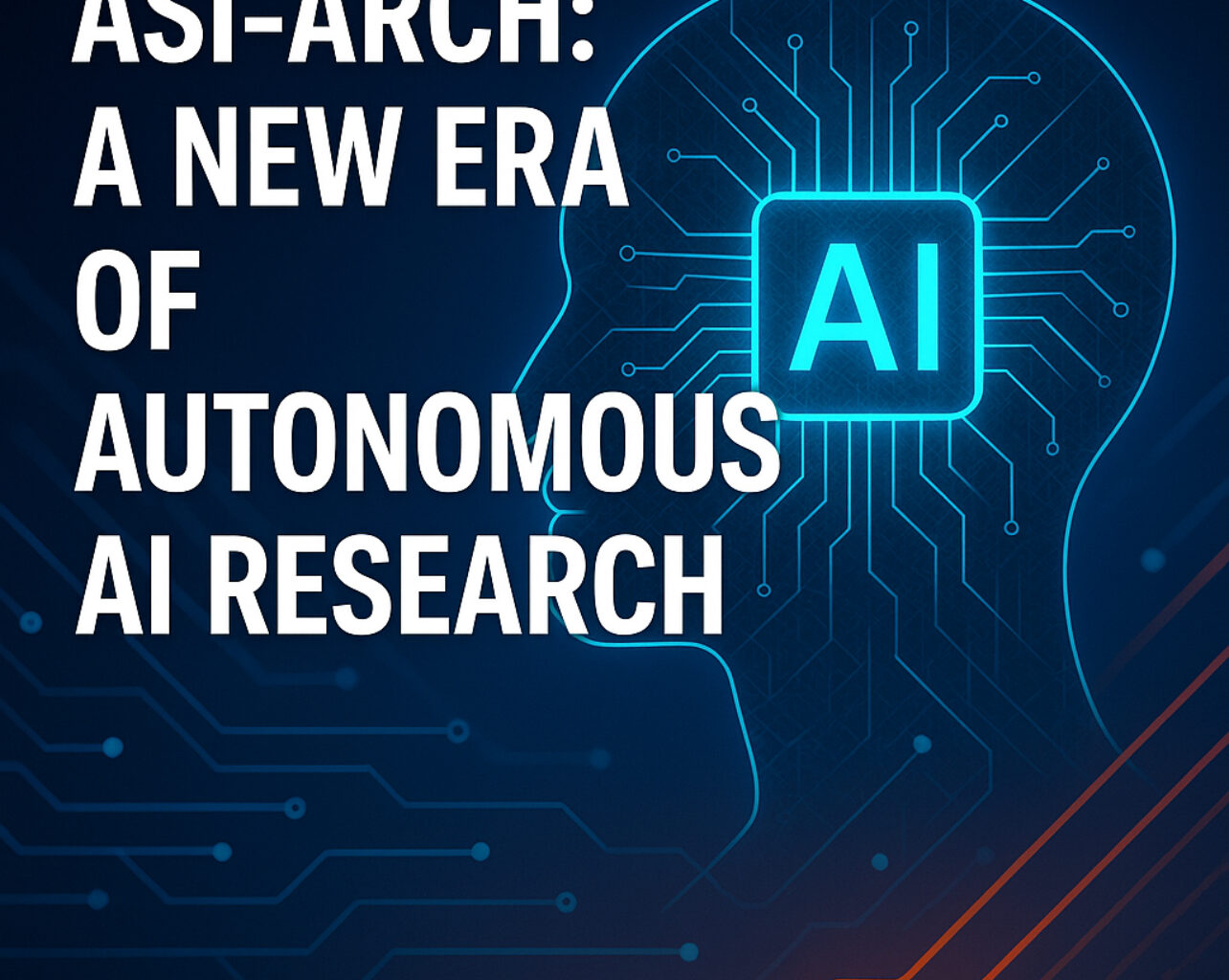

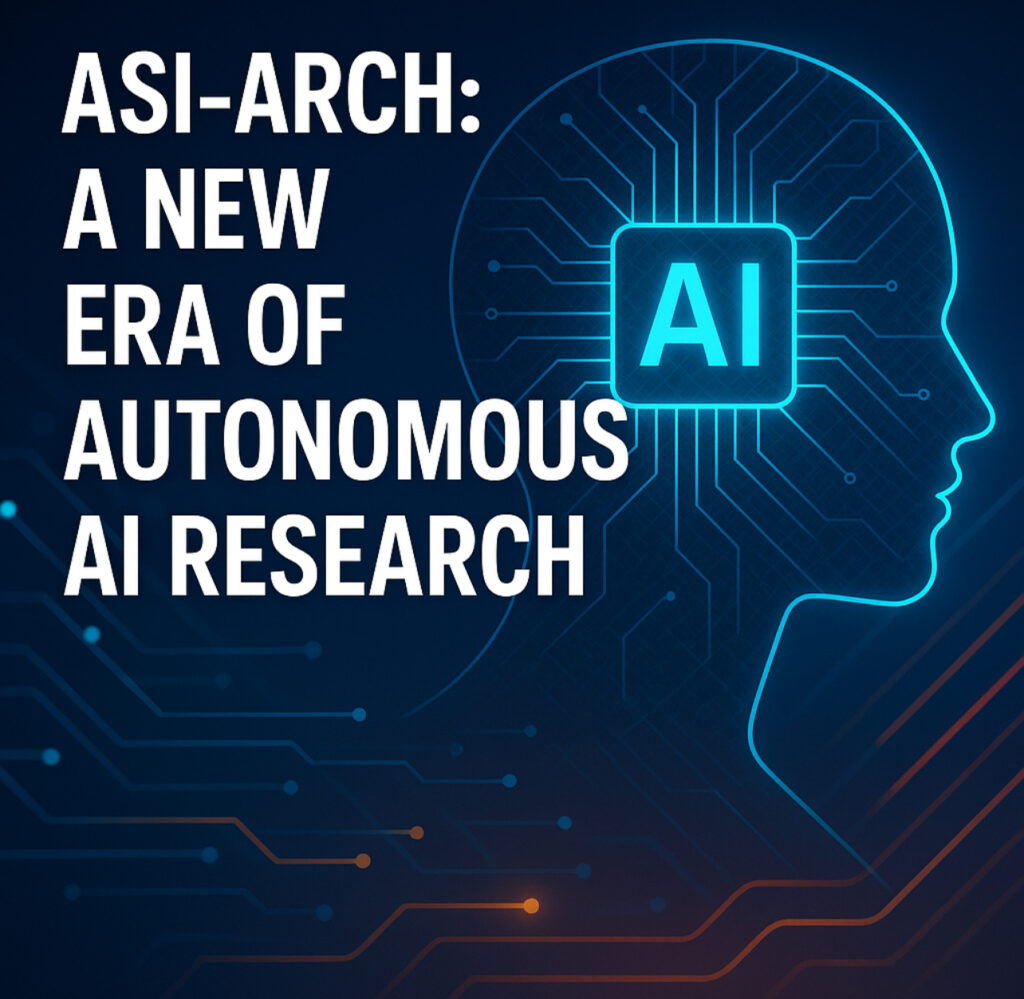
The AI research landscape is witnessing a transformative breakthrough with ASI-ARCH, an autonomous multi-agent system capable of independently designing novel AI model architectures. This system heralds an “AlphaGo moment” for AI research, shifting the paradigm from human-limited architectural innovation to a fully autonomous, computation-scalable process.
A Multi-Agent Closed-Loop Innovation Engine
ASI-ARCH is built around three specialized large language model (LLM)-based agents functioning in a closed-loop research cycle:
• Researcher: This creative engine proposes new architectural concepts by querying a vast database containing historical experiments and foundational knowledge from nearly 100 seminal papers on linear attention mechanisms. It writes detailed rationales and implements designs as PyTorch code, the standard framework for AI model development.
• Engineer: Acting as the experimentalist, this agent trains the proposed architectures rigorously. A robust self-debugging mechanism enables it to automatically detect, analyze, and fix errors in code or training, preventing promising models from being discarded due to simple bugs.
• Analyst: After each training run, this synthesizer studies performance metrics and experimental data. It compares new architectures to baselines and related designs, conducts quasi-ablation analyses to understand component importance, and generates concise reports that feed back into the system’s knowledge repository.
This autonomous cycle—generate, train, analyze, and learn—runs continuously, enabling rapid parallel experimentation and accelerating architectural innovation without any human intervention.
Staggering Autonomous Discoveries
Over the course of 1,773 experiments consuming more than 20,000 GPU hours (equivalent to about $60,000 in cloud compute costs), ASI-ARCH discovered 106 novel linear attention architectures. These designs consistently outperform human-engineered state-of-the-art models on various common-sense reasoning benchmarks. Notably, ASI-ARCH achieves these results through genuine architectural innovation rather than merely increasing model size, maintaining disciplined parameter counts mostly in the 400-600 million range.
Among the top architectures are models with evocative names like PathGateFusionNet and ContentSharpRouter, embodying emergent design principles unseen in human-designed baselines. This achievement demonstrates that architectural breakthroughs can emerge from automated invention, not just parameter tuning.
Scaling Scientific Discovery Beyond Human Limits
The ASI-ARCH team has established the first empirical scaling law for scientific discovery itself, showing that progress in AI architecture development no longer depends linearly on human cognitive capacity but can instead be scaled directly with available computational resources. This fundamentally alters the research process—turning it into a compute-bound endeavor where discoveries accelerate as more computational power is devoted.
Democratizing AI Research
In a significant move to accelerate global AI innovation, ASI-ARCH’s entire framework and all discovered architectures are open-sourced under the Apache 2.0 license. This availability enables smaller research groups and academic institutions worldwide to leverage autonomous architecture discovery, potentially decentralizing innovation from well-resourced tech giants to a broader research ecosystem.
Looking Ahead
ASI-ARCH exemplifies a future where AI systems are not only tools but autonomous researchers driving scientific progress. By mimicking and automating the scientific method at scale, it opens the door to self-improving, self-accelerating AI research — a breakthrough poised to fast-track many subsequent advances in machine learning and beyond.
This article highlights ASI-ARCH’s architecture, methodology, results, and profound implications for the future of AI research and innovation.

PyTorch: A Comprehensive Guide : A Practical Approach to Deep Learning, NLP, and Reinforcement Learning
As an affiliate, we earn on qualifying purchases.
As an affiliate, we earn on qualifying purchases.

Local AI on Linux in Practice: Build Private LLM Servers, GPU Workstations, Ollama Apps, Dockerized AI Services, and Self-Hosted AI Infrastructure with CUDA, ROCm, vLLM, and Open WebUI
As an affiliate, we earn on qualifying purchases.
As an affiliate, we earn on qualifying purchases.

Architecture in the Age of Artificial Intelligence: An Introduction to AI for Architects
As an affiliate, we earn on qualifying purchases.
As an affiliate, we earn on qualifying purchases.

Agentic AI for Market Research: Building Autonomous Intelligence Systems for Consumer Insights and Strategic Decision-Making (AI-Enhanced Market Research)
As an affiliate, we earn on qualifying purchases.
As an affiliate, we earn on qualifying purchases.