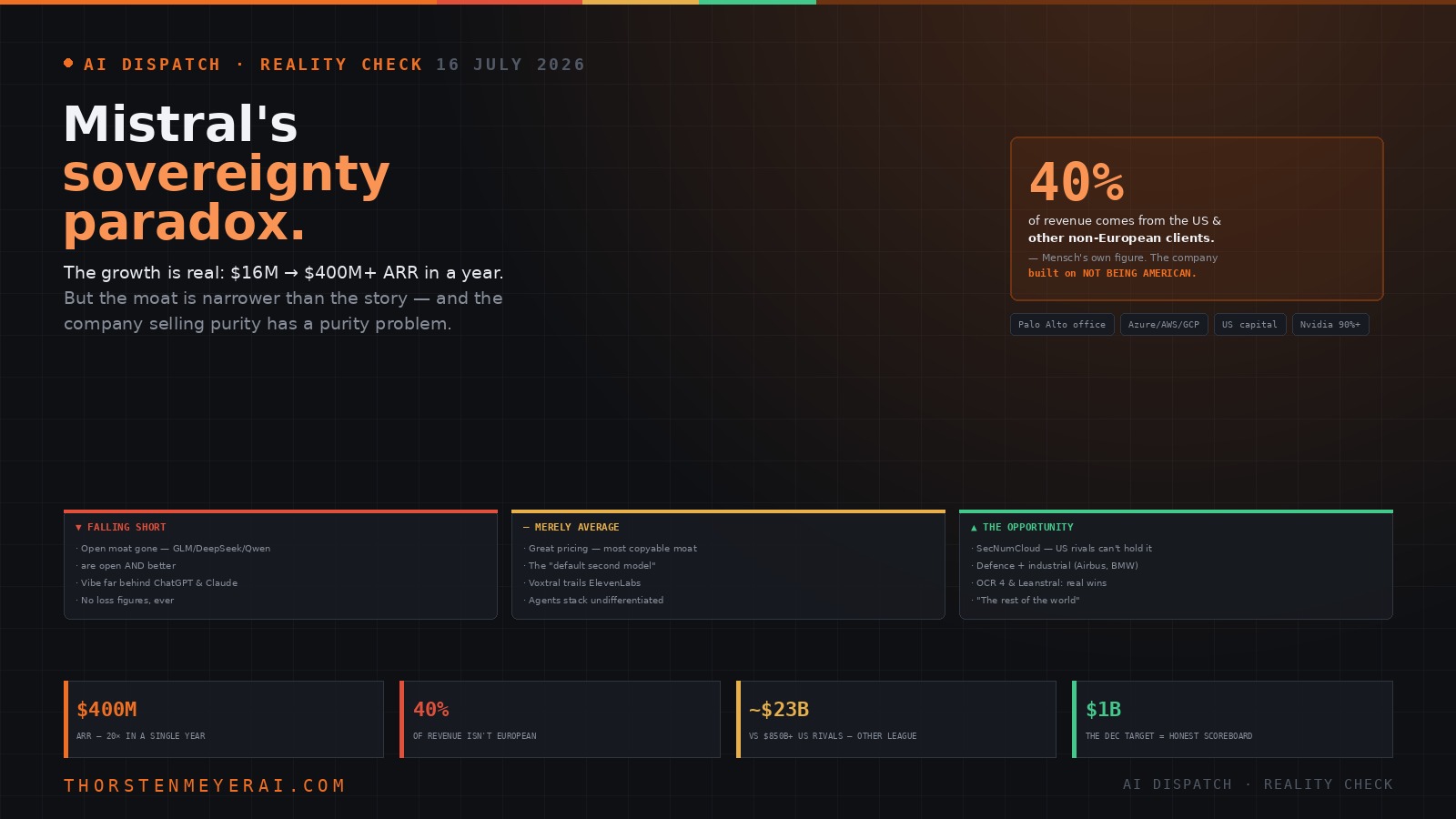
Here is a number that should be quoted more often than it is. Arthur Mensch told Forbes that roughly 40% of Mistral’s revenue comes from the United States and other non-European clients.

Get business pricing on tech for your team
- Business-only prices and quantity discounts
- Tax-exempt purchasing
- Multiple users, one account, clear invoices
Sit with that. The company that built a €11.7-billion-plus valuation on not being American — whose entire brand is that European data should stay under European law — earns nearly half its money outside Europe, runs an office in Palo Alto where a good share of its US-educated researchers sit, distributes its models through Azure, AWS, and Google Cloud, trains partly on American infrastructure, buys its silicon from Nvidia, and took capital from a16z, General Catalyst, Lightspeed, Cisco, IBM, Salesforce, and Nvidia itself.
None of that makes Mistral a fraud. It makes it a company, doing what companies do. But when your product is purity, every impurity costs more than it would for anyone else — and that asymmetry is the central strategic risk in Mistral’s business, more than any benchmark.
This is the critical read: what’s genuinely working, where Mistral is merely average, where it’s falling behind badly, what the sprawling product line is actually for, and whether the sovereignty story survives contact with the company’s own commercial reality.
Mistral’s sovereignty paradox: a critical look at Europe’s AI champion
The growth is real and rare — $16M → $400M+ ARR in a year. But the moat is narrower than the story, the open-weight advantage is gone, and the company selling purity has a purity problem. When your product is sovereignty, every impurity costs more than it would for anyone else.
- The open moat is gone — GLM-5.2, DeepSeek V4, Qwen, Kimi are open and better; now Inkling too
- Large 3 below median on AA index for peer open models; ~38 tok/s
- Vibe/Le Chat badly behind ChatGPT & Claude — even at Station F, Paris
- No loss figures ever disclosed; ~$3–5.5B raised vs $400M ARR
- Own-chip ambition = distraction at this scale
- Great API pricing — but price is the most copyable moat
- The “default second model” in multi-provider stacks = commodity position
- Voxtral trails ElevenLabs; Devstral behind coding agents
- Studio / Workflows / Agents undifferentiated vs Foundry, Bedrock, LangChain
- Ministral fine at the edge
- SecNumCloud — US hyperscalers structurally cannot hold it
- Defence: French armed forces framework deal; Helsing
- Industrial/physical AI — Emmi, Airbus, BMW: Europe’s real home turf
- Non-compute-bound wins: OCR 4 (170 langs, self-host), Leanstral (SOTA, ~1/75th cost)
- “The rest of the world” — states wanting neither DC nor Beijing
It looks like chaos — 18+ products for 350 people. Two things are true: it’s consolidating (Small 4 merged Magistral+Pixtral+Devstral; Le Chat → Vibe), and the real plan is vertical integration of the whole sovereign stack. Mensch at VivaTech: moving “from an AI company doing software to a cloud company.”
Mistral is the most important test running on whether European AI sovereignty is a business or a subsidy. The demand is real, the legal wedge is durable in 3–4 verticals, the growth is extraordinary. But the open-weight moat is gone, the vertical integration is being attempted from behind on six fronts, and April’s Cohere–Aleph Alpha merger killed the “only credible European option” claim. Stop trying to be Europe’s OpenAI. Finish being Europe’s Palantir. Own the narrowness — it’s a better business than the one being marketed. And watch the $1B ARR number in December: that’s the honest scoreboard.
The numbers, honestly
Credit first, because the growth is real and rare. Annual recurring revenue went from roughly $16–20M at the start of 2025 to over $400M by January 2026 — about a twentyfold increase in a year. More than 100 major enterprise clients: ASML, HSBC, TotalEnergies, BMW, Airbus, Stellantis, CMA CGM, the European Patent Office, the French armed forces. A €1.7B Series C led by ASML at €11.7B (Sept 2025), reportedly followed by a raise around $3.5B at roughly $20–23B in mid-2026 — treat that last figure with caution, as reports conflict on whether it closed. Roughly 350 employees. Around 60% of revenue from Europe.
Now the discipline. ARR is not audited revenue — it’s a run-rate extrapolation from the CEO’s public framing, not a financial statement. And Mistral has raised somewhere between $3B and $5.5B while never disclosing a loss figure. That silence is legal, private-market-normal, and informative: profitable companies tend to say so. Against confirmed billion-euro infrastructure commitments, 350 salaries in a talent war, and frontier training runs, cumulative losses are almost certainly substantial. One analysis flagged that at $30M revenue against $3B raised in 2024, Mistral had one of the highest capital-to-revenue ratios in generative AI.
Then there’s the target Mensch set himself: over $1B by end of 2026. From $400M in early 2026, that’s roughly 2.5× growth in ten months. It’s the clearest self-imposed accountability benchmark any AI company has published — and it is aggressive. Watch it. Miss it, and the sovereignty premium in that valuation gets repriced.
Finally, scale perspective: Mistral at ~$23B against OpenAI and Anthropic north of $850B. Mistral is not a peer of the US frontier labs. It’s a challenger in a different weight class, and the strategy only makes sense once you accept that.
European AI model training infrastructure
As an affiliate, we earn on qualifying purchases.
As an affiliate, we earn on qualifying purchases.
Where Mistral is falling short — the hard part
The model gap is the existential one, and it isn’t against America. Mensch himself says it plainly: we do not yet own the best language models. Third-party evaluation backs him. On the Artificial Analysis intelligence index, Large 3 scores below the median for comparable open-weight non-reasoning models, and it generates around 38 tokens/second — slow, a direct consequence of a 675B-parameter memory-bandwidth appetite. Forbes reported the sharper version: Mistral’s best model would lose a head-to-head against a competitor’s model released nine months earlier.
But the dangerous comparison isn’t with the closed US labs — it’s with the open ones. Mistral’s differentiation was supposed to be open weights. Today GLM-5.2, DeepSeek V4, Qwen 3.6, and Kimi K2.6 are open, permissively licensed, and better than Mistral’s flagship on most of the benchmarks that matter — and now Thinking Machines has shipped Inkling under Apache 2.0 as well. Mistral’s moat was “open + European.” The Chinese labs took “open” and the Americans are taking it back. What’s left is “European” — which is a legal argument, not a technical one. That’s a much narrower moat than the story implies.
The consumer product is a distant also-ran. Vibe (formerly Le Chat) has a fraction of ChatGPT’s brand recognition, a web interface that reviewers call bare-bones next to ChatGPT or Claude, a smaller integration ecosystem, and reports of sluggishness during European business hours. The detail that should sting most: TechCrunch notes that Claude is more popular than Mistral’s models among founders at Station F — Paris’s own startup campus. If you cannot win the developers in your home city on merit, “European alternative” is not a product strategy; it’s a procurement argument.
The financial opacity is a governance risk. It holds in private markets. It ends at an IPO, or the moment a debt covenant demands numbers. Mistral now has $830M of debt against a data centre.
And the chip ambition is, at this scale, a distraction. Mensch said in May 2026 that Mistral is exploring designing its own AI chips. At $400M ARR, competing with Nvidia’s silicon roadmap is not a strategy — it’s a press release with a multi-year capital hole behind it. SiPearl, France’s own effort, won’t ship until 2027–28. It may be right eventually. It is not right now.
As an affiliate, we earn on qualifying purchases.
Where Mistral is merely average
Most of the product line is competent, competitively priced, and rarely category-leading.
The API pricing is genuinely good — Small 4 at ~$0.20/M tokens, Medium 3.5 at $1.5/$7.5 — and that’s the honest core of the value proposition. But price is the most copyable moat in software. DeepSeek resets the floor whenever it wants.
The verdict that recurs in reviews is telling: Mistral has become the “default second model” for teams running multi-provider stacks. That’s a real position — and a commodity one. Second models get routed to when the first is expensive or down. They don’t command pricing power.
Voxtral TTS is competent but trails ElevenLabs on expressiveness. Studio, Workflows, and the Agents API are solid but undifferentiated against Azure AI Foundry, Bedrock, and LangChain. Devstral and Codestral are behind the leading coding agents. Ministral is fine at the edge.
Where Mistral is actually strong is where Mensch says it is — and this is the smartest thing in the company’s public positioning: the less compute-bound domains. Voice, vision, document processing. OCR 4 — 170 languages, bounding boxes, block classification, single-container self-hosting — is a genuinely excellent product and arguably a category win against Google Document AI or AWS Textract for anyone who needs it on-premises. Leanstral 1.5 hit state-of-the-art on formal-proof benchmarks at ~$4 per problem against $300+ for a rival. These are niches where a $400M company can beat an $850B one, because compute isn’t what decides.
That’s the honest shape of Mistral’s product portfolio: losing at the frontier, winning at the edges, average in the middle.
European data sovereignty software
As an affiliate, we earn on qualifying purchases.
As an affiliate, we earn on qualifying purchases.
The product sprawl — and the strategy underneath it
Look at the surface and it reads as chaos: Large 3, Medium 3.5, Small 4, Ministral 3, Devstral, Codestral, Voxtral TTS, OCR 4, Leanstral, Vibe, La Plateforme, Studio, Workflows, Connectors, Agents API, Forge, Mistral Compute, AI for Citizens — plus acquisitions (Koyeb for cloud, Emmi for physics AI) and a €4B data-centre programme. For 350 people, that’s an absurd surface area.
Two things are actually going on, and both deserve credit before the criticism.
First, it’s consolidating. Small 4 merged the previously separate Magistral (reasoning), Pixtral (vision), and Devstral (coding) lines into one Apache-2.0 model with a configurable reasoning_effort parameter. Medium 3.5 is explicitly a “flagship merged” release. Le Chat became Vibe, one agent across work and code modes. The zoo is being tidied.
Second — and this is the real answer to “what’s the strategy?” — Mistral is vertically integrating the entire sovereign stack. Mensch said it at VivaTech: the company is expanding from an AI company doing software to a cloud company. Chips (exploring), data centres (€4B, France and Sweden — Bruyères-le-Châtel’s 44MW/13,800 GB300s, EcoDataCenter’s hydropower site in Borlänge), cloud (Koyeb), models (open and closed), tuning (Forge), agents (Vibe, Workflows), applications, and forward-deployed engineers on the customer’s floor.
The logic is coherent and, in its own terms, correct. If you are selling sovereignty, you must own every layer — because a dependency anywhere is a sovereignty hole. You cannot credibly promise a French bank that its data never leaves French jurisdiction while renting the compute from Virginia. The vertical integration isn’t empire-building; it’s the product requirement. Sovereignty, as one French analyst put it, cannot be partial — it must be total, or it is an illusion.
And that’s also how it could die. Every layer is a fight against a better-capitalized incumbent: Nvidia on chips, AWS/Azure/GCP on cloud, OpenAI/Anthropic/Google on frontier models, ElevenLabs on voice, Palantir on forward-deployed enterprise, and now Cohere+Aleph Alpha on European sovereignty itself. Mistral is fighting on six fronts with 350 people and 3% of a US lab’s capital. Vertical integration is what you do when you have more resources than your rivals, not fewer. Doing it from behind is either the boldest bet in European tech or the reason the company runs out of road.
One more structural note that reviewers miss: this is not a clean SaaS business. The model is the Palantir playbook — forward-deployed engineers, embedded in the customer. CMA CGM signed roughly €100M over five years with six Mistral staff embedded in its Marseille HQ. That wins deals US labs can’t. It also means revenue that’s services-heavy, headcount-linked, and structurally lower-margin than the multiple implies. Nobody has seen those gross margins.
AI model deployment cloud services
As an affiliate, we earn on qualifying purchases.
As an affiliate, we earn on qualifying purchases.
Mistral USA: where the story gets uncomfortable
Now the part you asked about, and it deserves precision rather than a cheap gotcha.
The legal reality first. The CLOUD Act’s test is jurisdictional: is the vendor US-incorporated, or does a US-incorporated parent hold operational access to customer data? Mistral’s parent is Mistral AI SAS, French. A Palo Alto subsidiary doing research and sales does not, by itself, expose EU customer data held in France to a US warrant the way an AWS or Microsoft subsidiary does — because the controlling entity isn’t American. On the narrow legal question, Mistral’s position holds today, and it’s the reason SecNumCloud is achievable for them and structurally impossible for US hyperscalers in native form. (I’m not a lawyer; any buyer relying on this should get a jurisdictional opinion, because the question turns on who has “possession, custody, or control” of specific data — not on where the office is.)
So the US office is not primarily a legal problem. It’s four other problems.
A narrative problem. Mistral’s brand is not American. A Palo Alto office — where, by one analysis, most of its US-educated researchers work, including the lead author of its first reasoning paper — is legible to any competitor’s sales team as a talking point. Fair or not, a company that made purity the product gets held to a purity standard SAP or Siemens never face, because they never claimed it.
An incentive problem, and this is the serious one. If 40% of revenue is already non-European and the US business grows faster than the European one, the roadmap follows the money. Whoever pays the bills eventually sets the priorities. A sovereignty story is easy to hold when 100% of your customers demand it; it gets negotiable at 50/50. Nothing in Mistral’s public communication addresses what happens when American revenue outgrows the mission.
A future-structure problem. Everything above depends on the parent staying French and the US entity staying peripheral. That changes if Mistral ever pursues US federal contracts (which typically want US structures), a US listing, or a US holding company for tax or capital reasons. Investors pushing for an IPO have a habit of pushing for that structure. The sovereignty claim is one reorganization away from being materially weaker — and it’s the kind of decision that gets made for financial reasons and discovered by customers later.
A dependency problem, which is the biggest of all. The US office is a rounding error next to the fact that Mistral distributes through Azure, AWS, and Google Cloud while campaigning against exactly that dependency, has trained on Azure, took a €15M investment from Microsoft that came bundled with Azure distribution, and buys from Nvidia, which holds 90%+ of the AI GPU market. If Washington restricted AI chip access tomorrow — not unthinkable, given this year’s export-control whiplash — Mistral would be in serious trouble within months, French incorporation notwithstanding.
The steelman, which is strong: as Raconteur put it, that contradiction isn’t hypocrisy — it’s the operating reality of a company trying to bootstrap a sovereign AI business while depending on the incumbents it wants to displace. You cannot build the escape route without using the existing roads. And the €4B data-centre buildout is precisely the attempt to close the gap. Note the tell in the debt syndicate: BNP Paribas, Crédit Agricole, Bpifrance, La Banque Postale, Natixis, HSBC Continental Europe, and MUFG — six European banks and one Japanese. No US bank. That’s not an accident; it’s a structural signal about who’s underwriting European AI.
The honest verdict: the Palo Alto office isn’t the hypocrisy people think it is. The cloud and silicon dependencies are — and Mistral knows it, which is why it’s spending billions it doesn’t obviously have to fix them.
Where the real opportunity is
Now the constructive half, because the bear case isn’t the whole case.
Regulated verticals where sovereignty is legally decisive, not merely preferred. Gartner’s read is that Mistral’s argument is strongest in exactly three: financial services (DORA), healthcare (GDPR plus national health-data law), and public sector/defence. That’s narrow — and Mistral should own the narrowness strategically instead of marketing past it. But it’s not small: CISPE found ~72% of European enterprise IT decision-makers cite data sovereignty as a primary or secondary factor in vendor selection, and European sovereign-cloud IaaS spending is running at $12.6B for 2026, up 83%.
SecNumCloud is a genuine, legally-grounded moat. France’s certification covers both operational security and legal sovereignty — and US hyperscalers cannot hold it in native form. Contrast Germany’s BSI C5, which certifies security practices but says nothing about CLOUD Act exposure; AWS’s European Sovereign Cloud holds C5 and retains full CLOUD Act exposure through its US parent. That distinction is worth real money in French public procurement, and it is not contestable by Mistral’s largest rivals at any price.
Defence is the deepest moat. The French armed forces signed a framework agreement in January 2026 to deploy Mistral on national infrastructure — one of Europe’s first major sovereign AI procurements. Add the Helsing partnership. No US vendor can win that business at any benchmark score. It’s the one market where “European” is not a tiebreaker but a gate.
Industrial and physical AI may be the biggest prize. The Emmi AI acquisition, plus contracts with Airbus and BMW, point at Europe’s actual home-field advantage: it still has a world-class industrial base whose engineering data is too sensitive and too specialized to send to a US API. Manufacturing, simulation, automotive, aerospace, energy — high willingness to pay, early adoption, structurally European. If Mistral wins here, it doesn’t need to win chat.
Sector-specific wedges where regulation blocks the Americans outright. Mistral is reportedly building a cybersecurity model for European banks, targeting security workflows currently inaccessible to EU financial institutions because of US-provider restrictions. That’s the template: find the places where the incumbent is legally barred, not merely disliked.
And the underrated one: “the rest of the world.” Mensch’s pitch in New Delhi wasn’t to Europe — it was that the rest of the world should control its own AI destiny rather than rent it from Silicon Valley. India, the Gulf, Southeast Asia, Africa, Latin America: dozens of states that want neither American nor Chinese AI, and have no domestic frontier lab. Sovereignty-as-a-service, exported. That market could ultimately be larger than Europe — and it’s the one place where Mistral’s 40%-non-European revenue is a strength rather than an embarrassment. AI for Citizens is the seed of this. It deserves more strategic weight than it gets.
The product line vs the competition
| Product | Competes with | Honest verdict |
|---|---|---|
| Large 3 / Medium 3.5 | GPT-5.x, Claude, Gemini 3.x | Behind on frontier reasoning; Mensch concedes it |
| Small 4 (open) | GLM-5.2, DeepSeek V4, Qwen 3.6, Kimi, Inkling | Behind on benchmarks; wins on EU jurisdiction + non-Anglocentric multilingual |
| Ministral 3 (edge) | Phi, Gemma, Qwen-small | Competitive |
| Devstral / Codestral | Claude Code, Codex, Cursor, Copilot | Behind |
| Vibe (ex-Le Chat) | ChatGPT, Claude, Gemini | Badly behind — bare-bones, weak brand |
| Voxtral TTS | ElevenLabs | Trails on quality; wins on open + self-host |
| OCR 4 | Google Document AI, Textract, Azure DI | Genuine strength — 170 langs, self-hostable |
| Leanstral | Goedel, Seed-Prover, AxProver | SOTA in a niche, at ~1/75th the cost |
| Forge | MS Frontier Tuning, OpenAI custom, Tinker | Differentiated on EU sovereignty; narrow market |
| Mistral Compute | AWS, Azure, GCP, CoreWeave | Tiny — but SecNumCloud-eligible |
| Studio / Workflows / Agents | Azure AI Foundry, Bedrock, LangChain | Undifferentiated |
| AI for Citizens | Palantir, Accenture | Politically differentiated; underexploited |
And the competitive shift nobody in Paris wants to discuss: Mistral is no longer the only European champion. The Cohere–Aleph Alpha merger (April 2026) created a ~$20B transatlantic entity with dual headquarters in Toronto and Heidelberg, sovereign delivery via Schwarz Group’s STACKIT, BSI C5 certification, €600M from Schwarz as lead investor, and explicit endorsement from both the German and Canadian governments plus the EU’s EuroStack framework. For a German buyer, that may now be the better sovereign story. Mistral’s “only credible European option” claim died in April, and its French-primary positioning (SecNumCloud, Bpifrance, OVH/Scaleway) is now a regional advantage rather than a continental one.
The take
Mistral is the most important test currently running on whether European AI sovereignty can be a business rather than a subsidy. On the evidence: the demand is real, the wedge is legally durable in three or four verticals, the growth is extraordinary, and the vertical-integration strategy is the correct response to the problem it has chosen.
But be clear-eyed about the three things that could break it. The open-weight moat is gone — the Chinese labs are more open and better, and now the Americans are shipping Apache-2.0 frontier-class models too, which leaves Mistral defending a jurisdictional argument rather than a technical one. The vertical integration is being attempted from behind, on six fronts, with a fraction of the capital, against incumbents in every layer. And the sovereignty story is a purity product in a company with 40% non-European revenue, a Palo Alto office, US capital, US cloud distribution, and total Nvidia dependency — a gap it is spending billions to close, and which competitors will keep pointing at until it does.
The strategic advice, if anyone at Paris were asking: stop trying to be Europe’s OpenAI and finish being Europe’s Palantir. The chat app will never win. The frontier leaderboard will never be won at this capital level. What can be won is the regulated, industrial, defence, and public-sector stack where the law — not the benchmark — decides the deal, plus the enormous and unserved “rest of the world” market that wants neither Washington nor Beijing holding its off switch. Own the narrowness. It’s a better business than the one being marketed.
And watch the $1B number in December. That’s the honest scoreboard.
Sources: Mensch’s ~40% non-European revenue figure and the model-gap comparison via Forbes (Iain Martin, April 2026); ARR, funding, valuation and product data via Sacra, TechCrunch (July 2026), TIME100, Bismarck Analysis, gradually.ai, Getlatka and Penchan — figures conflict and several are estimates, not audited; financial-opacity analysis via Klover.ai; Artificial Analysis index and 38 tok/s via TechTimes; Futurum (Nick Patience) on Forge’s addressable market; Raconteur and Gartner’s Arun Chandrasekaran on sovereignty’s vertical concentration; CISPE 2024 survey (72%) and Gartner’s $12.6B sovereign-cloud figure via trade coverage; CLOUD Act/SecNumCloud/BSI C5 analysis via Dr. Raphael Nagel, SoftwareSeni and DATASOLUTION; Cohere–Aleph Alpha merger via SoftwareSeni; product and benchmark detail via Mistral’s own docs/changelog, AIToolTier, Aizolo and Serenities AI; Station F observation via TechCrunch. Private-company financials are unaudited and directional. Not investment advice; not legal advice — jurisdictional questions require counsel. Analysis and framing are the author’s.
Fall Picks
fall essentials
As an affiliate, we earn on qualifying purchases.