
Executive summary
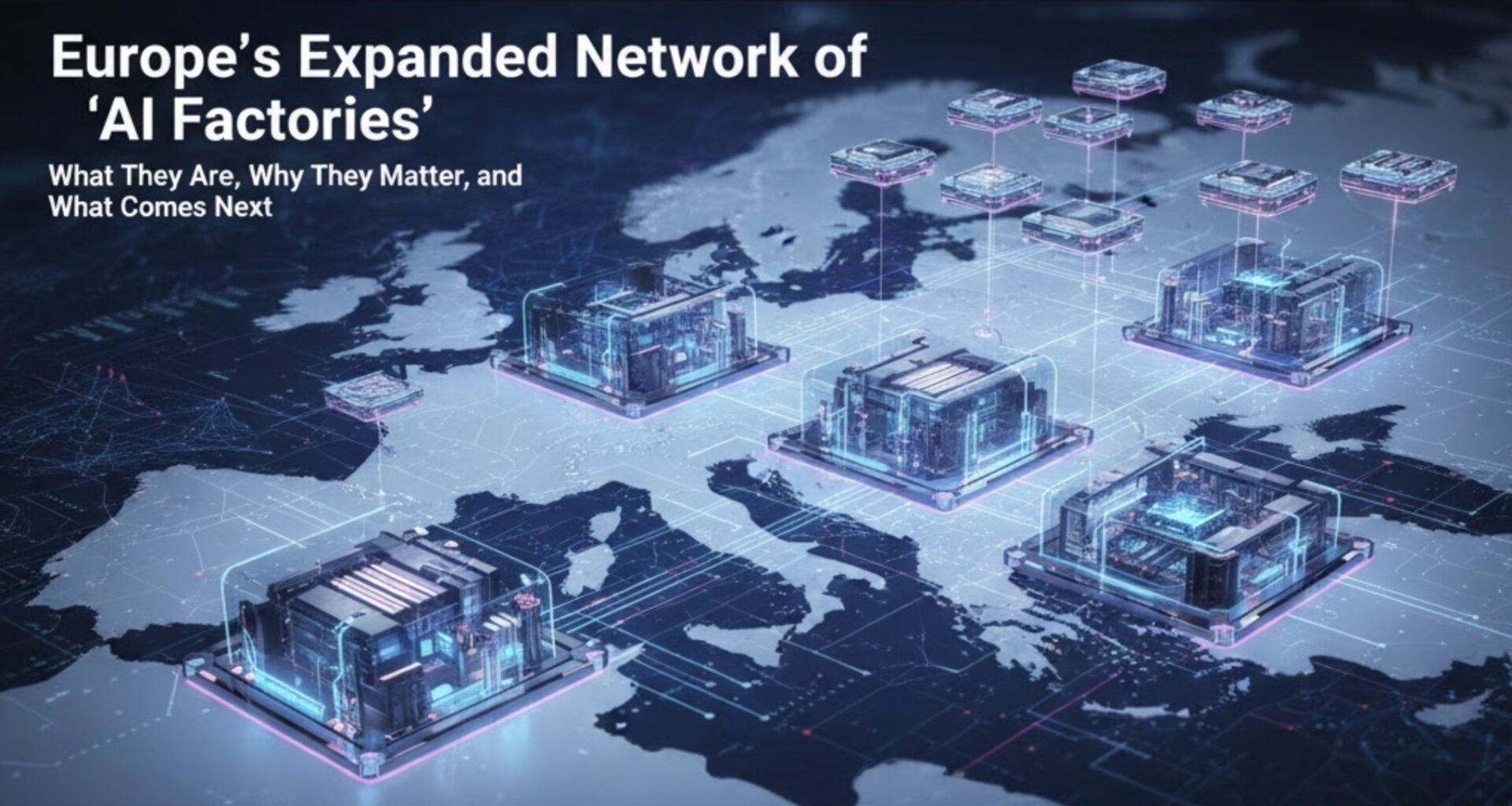
On October 10, 2025, the European Commission and the EuroHPC Joint Undertaking (EuroHPC JU) announced six additional AI Factories to be hosted in Czechia, Lithuania, the Netherlands, Poland, Romania, and Spain. These centers will provide companies, researchers, and public bodies with direct access to AI-optimized supercomputers, technical expertise, curated datasets, and hands-on support, bolstering the EU’s strategic push toward an “AI Continent.” The expansion complements earlier waves of sites named in December 2024 and March 2025, and aligns with the Commission’s broader Apply AI Strategy to accelerate industrial AI adoption and reduce dependency on non-EU infrastructure. Digital Strategy+3Digital Strategy+3eurohpc-ju.europa.eu+3

Corsair AI Workstation 300 Desktop PC – AMD Ryzen AI Max 385 CPU – AMD Radeon 8050S iGPU (Up to 48GBs vRAM) – 64GB LPDDR5X 8000MHz Memory – 1TB M.2 SSD – Black
AI-Optimized Compact Workstation: Experience AI performance out of the box with the compact 4.4L form factor, built for…
As an affiliate, we earn on qualifying purchases.
As an affiliate, we earn on qualifying purchases.
1) What exactly is an “AI Factory”?
An AI Factory is a one-stop national or regional hub that couples EuroHPC supercomputing capacity with an integrated stack: GPU-rich compute, storage, secure data access, MLOps tooling, model evaluation and safety resources, plus embedded teams for onboarding and training. The aim is to develop and adapt trustworthy, state-of-the-art models—including domain-specific foundation models—in Europe, and to lower the barrier for SMEs to exploit advanced AI. eurohpc-ju.europa.eu+1
Key functions
- Compute access: time allocations on AI-tuned EuroHPC systems and national clusters.
- Technical enablement: MLOps pipelines, fine-tuning support, benchmarking, safety and red-teaming guidance.
- Data enablement: curated, high-quality domain datasets with lawful access pathways.
- Go-to-market: advice on deployment, compliance with the EU AI Act, and integration in existing IT/OT. eurohpc-ju.europa.eu+1

GPU Mastery: Advanced Architectures, Evolution, and Cutting-Edge Applications in Gaming & Machine Learning
As an affiliate, we earn on qualifying purchases.
As an affiliate, we earn on qualifying purchases.
2) The new 2025 sites and timeline
The newly announced sites are in Czechia, Lithuania, the Netherlands, Poland, Romania, and Spain. According to the Commission’s communication, these will expand capacity and access from 2026 onward, with national partners standing up facilities, workforce, and program pipelines through 2025–2026. Digital Strategy+1
This cohort augments prior waves:
- Initial hosts (Dec 2024): Finland, Germany, Greece, Italy, Luxembourg, Spain, Sweden.
- Second wave (Mar 2025): Austria, Bulgaria, France, Germany, Poland, Slovenia.
- 2025 expansion (Oct 2025): Czechia, Lithuania, Netherlands, Poland, Romania, Spain. eurohpc-ju.europa.eu+1
Note: Some countries (e.g., Poland and Spain) appear in multiple announcements, reflecting multi-site ecosystems or phased build-outs across institutions. Official EuroHPC and Commission pages are the authoritative trackers for status and locations as they go live. eurohpc-ju.europa.eu+1

Seagate Skyhawk AI 8TB Video Internal Hard Drive HDD – 3.5 Inch SATA 6Gb/s 256MB Cache for DVR NVR Security Camera System with in-house Rescue Services (ST8000VEZ01)
ImagePerfect AI: Delivers zero dropped frames while supporting heavier workloads.
As an affiliate, we earn on qualifying purchases.
As an affiliate, we earn on qualifying purchases.
3) Strategic context: Europe’s “Apply AI” and digital sovereignty
The expansion dovetails with the Commission’s Apply AI Strategy, a €1B public push to help priority sectors (healthcare, energy, mobility, pharma, manufacturing, defense) adopt AI at scale under EU rules. It’s part of a wider investment architecture (Digital Europe, Horizon Europe, national funds, and private co-investment) intended to on-shore capability, cut time-to-value for SMEs, and de-risk compliance under the EU AI Act (effective since Aug 2024). Reuters+1
The move also sits within larger EU ambitions to mobilize tens of billions for AI and compute, complementing previously announced financing tracks (e.g., the European AI Champions Initiative and broader AI investment envelopes highlighted earlier in 2025). Reuters
Hands-On MLOps on Azure: Automate, secure, and scale ML workflows with the Azure ML CLI, GitHub, and LLMOps
As an affiliate, we earn on qualifying purchases.
As an affiliate, we earn on qualifying purchases.
4) What users get: programs and access model
While each site will differ in governance and national focus, common offerings include:
- Open calls / vouchers for SMEs and startups to obtain compute grants and engineering time.
- Standardized access tracks (exploratory pilots → scaling/fine-tuning → production readiness).
- Best-practice playbooks for AI safety, security, evaluation, and incident response throughout model lifecycle.
- Compliance toolkits mapping development and deployment to EU AI Act risk categories and documentation duties. LUMI+1
Who benefits first?
- SMEs/startups without in-house HPC and MLOps.
- Research labs & hospitals needing safe/sovereign compute for data-sensitive training.
- Industrial players (manufacturing, energy, mobility) targeting predictive maintenance, optimization, digital twins, and agentic AI on production lines. Reuters
5) Governance, funding, and the “Antennas” layer
EuroHPC JU coordinates co-funding (EU + Member States + host institutions), with national operators running day-to-day programs. In October 2025, EuroHPC also introduced “AI Factory Antennas”—lighter-weight nodes that extend reach into more regions, connecting local ecosystems to flagship factories and broadening access to compute and services. eurohpc-ju.europa.eu
6) Technical posture (at a glance)
- Compute: Clusters optimized for LLM and multimodal training/fine-tuning, typically GPU-dense with fast interconnects and large memory; integrated with EuroHPC flagship systems.
- Data: High-throughput storage, legally compliant data access, and privacy-preserving workflows.
- Tooling: MLOps stacks for experiment tracking, evals, red-teaming, and trustworthiness checks aligned with EU rules.
- Support: Resident engineers, domain experts, and training programs to upskill teams rapidly. eurohpc-ju.europa.eu+1
7) Competitive positioning vs. U.S./China
Europe’s challenge has been fragmented compute, talent dispersion, and limited “on-ramps” for SMEs. The AI Factories aim to:
- Aggregate demand and offer predictable access pricing;
- Shorten time-to-first-prototype with hands-on enablement;
- Anchor sovereign options for sensitive workloads;
- Catalyze regional clusters (e.g., healthcare in one site, robotics or climate in another).
This is the industrial adoption complement to cutting-edge model R&D, with an explicit regulatory-by-design flavor to align with the AI Act. Reuters
8) Risks and open questions
- Sustained OPEX: CapEx buys hardware; talent and run costs determine service quality. Sites must secure multi-year OPEX and vendor roadmaps.
- Demand management: Balancing SME access with large industrial projects to avoid crowd-out.
- Security & supply chain: Hardened pipelines are essential (poisoning/backdoors, model exfiltration, dataset provenance).
- Interoperability: Ensuring common APIs, shared service catalogs, and cross-site portability for workloads across the network.
- Metrics: Transparent KPIs (SMEs served, models deployed, time-to-market, safety incidents) will make or break credibility.
9) Practical next steps for prospective users
- Track calls for access and “fast-lane” SME schemes via EuroHPC and national operators; the 2024–2025 calls describe typical eligibility and evaluation. LUMI
- Line up data governance early (DPIAs, lawful bases, cross-border data rules) to accelerate onboarding.
- Design for the AI Act from day one (risk category assessment, logs, human oversight, post-market monitoring).
- Budget for MLOps & evals (red-teaming, bias audits, robustness testing), not just raw GPU hours.
- Leverage Antennas if you’re outside a host city—these nodes widen participation and can route you into the right program. eurohpc-ju.europa.eu
10) Outlook for 2026–2027
Expect staggered go-lives from 2026, gradual capacity ramp-up, and sector-specific pilots (healthcare screening, climate and energy agents, advanced manufacturing). The Commission’s Apply AI program and broader investment push suggest continued scaling of both compute and last-mile enablement services across Member States. Euractiv+1
Sources
- European Commission – “EU expands network of AI Factories” (countries named; access model). Digital Strategy
- EuroHPC JU – AI Factories overview (role, services). eurohpc-ju.europa.eu
- EuroHPC JU – AI Factories systems (technical framing). eurohpc-ju.europa.eu
- European Commission – Apply AI Strategy (policy context, sectors). Digital Strategy
- Reuters – €1B Apply AI plan (industrial focus, sovereignty). Reuters
- EuroHPC JU – AI Factory Antennas (network extension). eurohpc-ju.europa.eu
- Euractiv – deployment timeline into 2026. Euractiv
TL;DR
The EU’s six new AI Factories are pragmatic adoption engines: sovereign compute + expert enablement + compliant tooling, designed to bridge the SME gap and anchor industrial-grade AI in Europe. Watch for access calls, sector pilots, and the rollout of Antennas that extend reach beyond host cities.