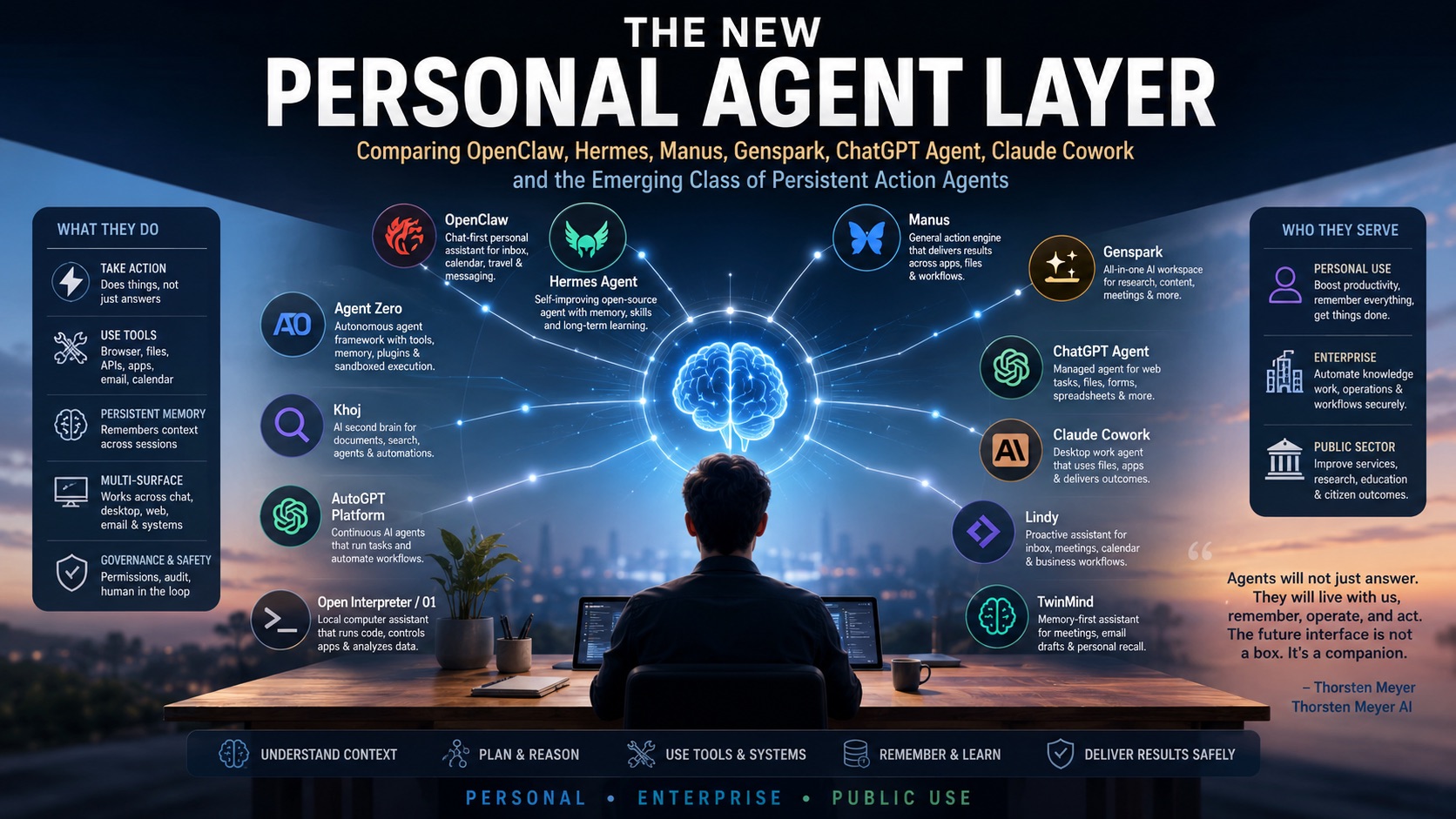
Comparing OpenClaw, Hermes, Manus, Genspark, ChatGPT Agent, Claude Cowork, and the emerging class of persistent action agents
By Thorsten Meyer
Thorsten Meyer AI
Research draft — May 2026
The next wave of AI products is not just about better chat. It is about agents that remember, use tools, control software, execute workflows, and increasingly act across the user’s private and professional digital environment. OpenClaw and Hermes sit at the center of this shift because they are not classic chatbots, coding assistants, or no-code automation tools. They are early examples of a broader category: persistent personal action agents.
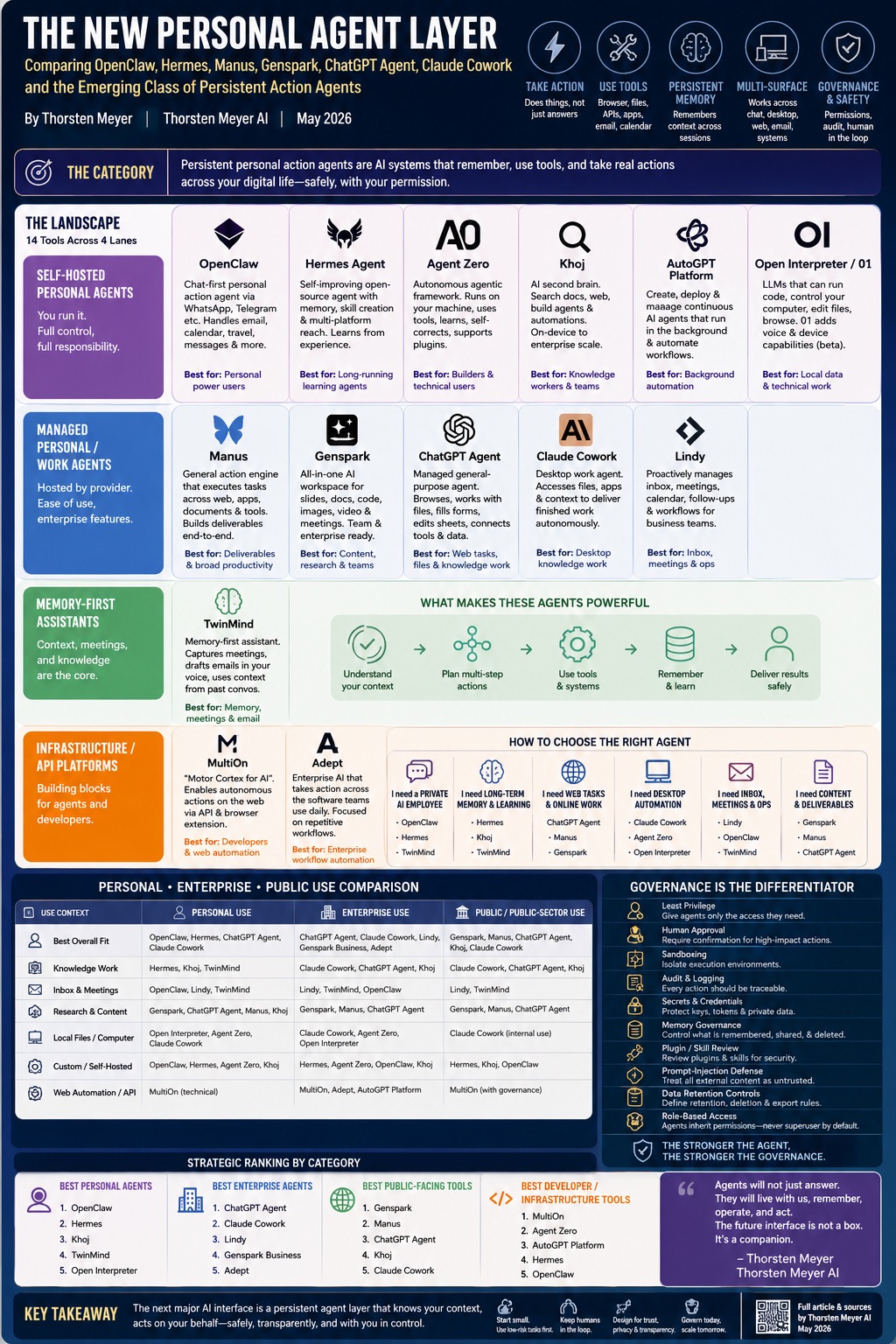
This category includes self-hosted assistants such as OpenClaw, Hermes, Agent Zero, Khoj, AutoGPT, and Open Interpreter; managed work agents such as ChatGPT Agent, Claude Cowork, Lindy, Manus, and Genspark; memory-first assistants such as TwinMind; and infrastructure/API players such as MultiOn and Adept.
The important question is not “which model is best?” The real question is: who owns the agent, where does it run, what can it access, what can it do, and who is accountable when it acts?
The New Personal Agent Layer.
Agents that remember, use tools, control workflows, and increasingly act across the private and professional digital environment.
This is not a comparison of ordinary chatbots. It is a map of systems that can take action, use browsers and files, connect to calendars or inboxes, build deliverables, and operate across personal, enterprise, and public-use workflows. The core question is not which model is smartest. It is who owns the agent, where it runs, what it can access, and who is accountable when it acts.

Claude Code for Beginners Made Easy: Learn Vibe Coding, Build Custom Apps, Create Tools, Claude Skills and Agents & Realize Entire Projects with Your … Intelligence for Beginners Made Easy)
As an affiliate, we earn on qualifying purchases.
As an affiliate, we earn on qualifying purchases.
Not chatbots. Personal action infrastructure.
The OpenClaw/Hermes bucket is best understood as the agent layer between the user and the software stack: systems that can remember, plan, click, write, retrieve, schedule, summarize, and trigger actions.
Self-hosted personal agents
You run the agent. You control the data path. You also carry the operational responsibility.
Managed work agents
Hosted by providers, easier to adopt, more polished, and better aligned with enterprise procurement.
Memory-first assistants
They focus on personal context: meetings, documents, conversations, tasks, and recall across sessions.
Agent infrastructure
Developer-facing platforms for web action, workflow automation, and enterprise app control.

Self-Hosted AI Assistant for Beginners: Build a Private Open-Source Workflow with OpenClaw
As an affiliate, we earn on qualifying purchases.
As an affiliate, we earn on qualifying purchases.
Capability is not enough. Fit depends on context.
The AI Workflow Blueprint: Master AI Tools, Build Smart Systems & Get Consistent Results Every Time
As an affiliate, we earn on qualifying purchases.
As an affiliate, we earn on qualifying purchases.
Personal, enterprise, and public use are different markets.
The stronger the agent, the stronger the governance.
Agents are risky because they can read, write, click, execute, remember, and connect systems. That changes the threat model from answer quality to operational control.
- Least privilege Agents should only access what the task requires.
- Human approval Required for sending, deleting, paying, publishing, or changing accounts.
- Audit logs Every meaningful action should be traceable.
- Prompt-injection defense Email, web, and documents are untrusted inputs.

Plaud Note Pro AI Voice Recorder, Transcribe & Summarize with AI Note Taker for Meetings & Calls, Professionals & Teams, Supports 112 Languages, Ultra-Slim, InstantView Display, Case Included, Silver
AI-POWERED TRANSCRIPTION & MULTI-DIMENSIONAL SUMMARIES: Plaud Note Pro is your professional voice transcriber, delivering high-accuracy transcription in 112…
As an affiliate, we earn on qualifying purchases.
As an affiliate, we earn on qualifying purchases.
Strategic ranking by category
Best personal agents
- OpenClaw
- Hermes
- Khoj
- TwinMind
- Open Interpreter
Best enterprise agents
- ChatGPT Agent
- Claude Cowork
- Lindy
- Genspark Business
- Adept
Best public-facing tools
- Genspark
- Manus
- ChatGPT Agent
- Khoj
- Claude Cowork
Best infrastructure tools
- MultiOn
- Agent Zero
- AutoGPT
- Hermes
- OpenClaw
The next major AI interface may not be a search box or a chat window. It may be an agent that knows your context, waits in the background, and acts when needed.
1. The category: persistent personal action agents
A persistent personal action agent has five defining traits:
- It can take action, not only answer questions.
- It can use tools, browsers, files, email, calendars, APIs, or local applications.
- It can maintain some form of memory or persistent context.
- It can work across familiar surfaces such as desktop, chat apps, browser, email, or enterprise systems.
- It needs a serious permission, audit, and safety model because it touches sensitive information.
OpenClaw describes itself as “the AI that actually does things,” with use cases such as clearing inboxes, sending emails, managing calendars, and checking users in for flights through WhatsApp, Telegram, or other chat apps. Its GitHub project positions it as a personal AI assistant users run on their own devices and access through existing channels.
Hermes Agent, by contrast, is positioned as a self-improving open-source agent with persistent memory, automated skill creation, and multi-platform reach. The Nous Research repository describes a learning loop that creates skills from experience, improves them during use, searches past conversations, and builds a deeper model of the user across sessions.
This makes OpenClaw and Hermes especially important. They point toward a future where the agent is not a website you visit, but a persistent layer around your digital life.
2. Market map: the tools compared
| Product | Core identity | Best fit |
|---|---|---|
| OpenClaw | Self-hosted personal action agent | Personal power users, private assistants, experimental teams |
| Hermes Agent | Self-improving open-source agent with memory and skills | Long-running personal/work agents, technical users, agent labs |
| Agent Zero | Open-source agentic framework with Linux environment, tools, memory, plugins | Builders, developers, self-hosted enterprise prototypes |
| Khoj | AI second brain with docs, web, agents, automations | Personal knowledge, research, internal knowledge assistants |
| AutoGPT Platform | Continuous background AI assistants | Workflow automation, experimental enterprise agents |
| Open Interpreter / 01 | Local computer-control and code-execution agent | Local desktop tasks, data work, technical personal use |
| Manus | General action engine for tasks, workflows, slides, websites, apps | Broad productivity, public content, business deliverables |
| Genspark | All-in-one AI workspace for slides, docs, media, code, meetings | Content teams, research teams, business productivity |
| ChatGPT Agent | Managed general-purpose agent for web, files, forms, spreadsheets | Personal and enterprise managed agent workflows |
| Claude Cowork | Desktop work agent for files, apps, finished deliverables | Knowledge workers, enterprise desktop workflows |
| Lindy | Business assistant for inbox, meetings, calendar, workflows | Enterprise operations, executives, sales, recruiting |
| TwinMind | Memory-first meeting and email assistant | Personal memory, meeting notes, email drafting |
| MultiOn | Web-action agent API | Developers building browser/web automation agents |
| Adept | Enterprise software-action agent | Large-company workflow automation |
3. Detailed tool comparison
OpenClaw
OpenClaw is the most “personal operating layer” of the group. It is open-source, self-hosted, and designed to be reached through the channels people already use. Its official positioning is simple: it clears inboxes, sends emails, manages calendars, and checks users in for flights from WhatsApp, Telegram, or similar chat surfaces.
For personal use, OpenClaw is one of the strongest tools in the category. It is attractive for users who want an always-on assistant that can live close to private workflows: messages, inbox, calendar, home tasks, reminders, personal admin, and lightweight automation.
For enterprise use, OpenClaw is powerful but operationally sensitive. The same qualities that make it compelling—local control, extensibility, messaging access, and deep permissions—also make it risky without central governance. It fits technical teams, innovation labs, founder offices, or small companies willing to maintain their own security model.
For public use, OpenClaw is best treated as an experimental self-hosted assistant rather than a default public-sector platform. It could support civic prototypes, public-service bots, or internal municipal assistants, but only with strict permission isolation, logging, and human approval.
Best use case: a personal AI employee that lives in chat and handles private digital tasks.
Main risk: over-permissioning a self-hosted agent that can touch sensitive accounts.
Hermes Agent
Hermes is the most interesting tool if the key question is agent memory and learning. Its official sources emphasize persistent memory, automated skill creation, multi-platform reach, and a built-in learning loop that improves skills over time.
For personal use, Hermes is ideal for users who want an assistant that learns routines and remembers projects. It is less “consumer-simple” than a hosted app, but more conceptually powerful because the agent can accumulate knowledge and reusable skills.
For enterprise use, Hermes is attractive for technical teams that want to build persistent internal agents. Its server/VPS orientation makes it more flexible than a laptop-bound assistant, and its skill system points toward reusable internal workflows. However, enterprises need to design controls around memory, secrets, tool permissions, and skill creation.
For public use, Hermes could become useful in contexts where a public institution wants a sovereign, self-hosted agent that can remember procedures and serve staff. But the more the agent learns and stores, the more important governance becomes.
Best use case: a long-running, self-improving agent that remembers projects and creates reusable skills.
Main risk: memory and skill accumulation can become a governance problem if not managed.
Agent Zero
Agent Zero belongs in the same open/self-hosted family as Hermes, but its emphasis is more framework-like. The official site describes it as an autonomous agentic AI framework that runs on its own computer, uses and creates tools, learns, self-corrects, and executes workflows. It also highlights sandboxed operation, plugins, and a CLI connector for working on a user’s machine.
For personal use, Agent Zero is best for technical users who want control and experimentation rather than a polished consumer assistant. It can browse, write code, use tools, cooperate with other agents, and maintain memory.
For enterprise use, Agent Zero is useful as a prototype platform for internal agents, especially where teams want to define their own tools, plugins, memory, and execution environment. Its plugin model is powerful, but plugin ecosystems require scanning and governance. Agent Zero’s own plugin documentation highlights checks for remote communication, secrets access, obfuscation, and agent manipulation.
For public use, Agent Zero is better suited to backend experimentation than direct citizen-facing deployment. It is powerful, but not inherently a public-service product.
Best use case: open-source framework for building and testing autonomous agents.
Main risk: too much power without enough enterprise control by default.
Khoj
Khoj is closer to an AI second brain than a full computer-control agent. Its official site describes it as a personal AI app for building agents, scheduling automations, and researching across documents and the web. The GitHub project says Khoj scales from an on-device personal AI to a cloud-scale enterprise AI.
For personal use, Khoj is excellent for knowledge workers who want to search personal documents, build context, research across files and the web, and create custom agents.
For enterprise use, Khoj fits internal knowledge management, research teams, documentation-heavy organizations, and companies that want self-hostable AI rather than pure SaaS.
For public use, Khoj is useful for public knowledge portals, research assistants, education, or civic knowledge bases, especially if the organization wants control over data and sources.
Best use case: personal or organizational knowledge assistant with agents and automations.
Main risk: less focused on autonomous computer action than OpenClaw, Hermes, or Agent Zero.
AutoGPT Platform
AutoGPT helped popularize the idea of autonomous agents. The current AutoGPT Platform is positioned as a system for AI assistants that run continuously and perform assigned tasks automatically. Its GitHub project describes it as a platform to create, deploy, and manage continuous AI agents that automate complex workflows.
For personal use, AutoGPT is less polished than OpenClaw or ChatGPT Agent. It is more useful for people who enjoy building workflows than for users who want a ready-made assistant.
For enterprise use, AutoGPT is relevant as a continuous-agent platform. It can be used for background processes, research monitoring, repetitive workflows, data collection, or task automation.
For public use, AutoGPT can support prototype services and public workflows, but it requires careful supervision. Continuous agents need clear boundaries because they can keep acting after the user stops paying attention.
Best use case: continuous background agents and workflow automation experiments.
Main risk: background autonomy without strong monitoring.
Open Interpreter / 01
Open Interpreter gives language models local computer capabilities through code execution and system interaction. Its GitHub project says it lets LLMs run Python, JavaScript, shell, and more locally, enabling tasks such as editing files, controlling a browser, and analyzing datasets.
For personal use, Open Interpreter is strong for technical users who want to work with local files, data, PDFs, scripts, and browser research. The 01 project extends this direction into voice-controlled devices, but its own repository warns that it is experimental and lacks basic safeguards before a stable release.
For enterprise use, Open Interpreter is valuable for data teams, analysts, and technical operators, but risky on unmanaged employee machines. It needs sandboxing, restricted accounts, and review before touching production data.
For public use, Open Interpreter is not the first choice for public-facing services. It is better as a local technical assistant or internal tool.
Best use case: local computer and code-execution assistant.
Main risk: local execution can be dangerous without sandboxing and permissions.
Manus
Manus positions itself as a broad “hands-on AI” action engine that goes beyond answers to execute tasks, automate workflows, and extend human reach. Its site highlights tasks such as creating slides, building websites, developing desktop apps, and design.
For personal use, Manus is useful for people who want finished outputs: websites, slides, app prototypes, designs, research, and task completion.
For enterprise use, Manus fits teams that want a deliverable-focused assistant rather than a pure chat or code tool. It can support marketing, sales enablement, internal tools, research decks, website drafts, and workflow automation.
For public use, Manus is one of the stronger tools for public-facing output: public websites, campaign materials, service pages, reports, explainers, and prototypes.
Best use case: turning broad goals into polished deliverables.
Main risk: output quality and accountability still require human review.
Genspark
Genspark is an all-in-one AI workspace. Its official site describes a workspace for slides, docs, images, video, code, and design, with a Chrome sidebar and meeting bot that can join meetings, record, and send notes.
For personal use, Genspark is useful for research, presentation creation, summaries, personal productivity, and content production.
For enterprise use, Genspark is especially relevant for teams. Its business page describes team and enterprise plans, 70+ models including ChatGPT, Claude, and Gemini, plus SOC 2 Type II and ISO 27001 certification.
For public use, Genspark fits public communication work: reports, explainers, decks, media, campaign assets, and education content. It is less of a private personal agent than OpenClaw or Hermes, but more polished for public outputs.
Best use case: AI workspace for research-to-content workflows.
Main risk: more workspace than autonomous personal assistant.
ChatGPT Agent
ChatGPT Agent is the strongest managed commercial reference point for this category. OpenAI’s help center says it can navigate websites, work with uploaded files, connect to third-party data sources such as email and document repositories, fill out forms, and edit spreadsheets while keeping the user in control.
For personal use, ChatGPT Agent is broad and accessible. It can perform online tasks, research, bookings, spreadsheet work, and document tasks through a familiar ChatGPT surface. OpenAI’s product page says it can interact with websites directly on behalf of users to book appointments, create slideshows, and handle complex tasks from start to finish.
For enterprise use, ChatGPT Agent becomes more important when combined with ChatGPT Business or Enterprise controls. OpenAI says business customers own and control their data, and that OpenAI does not train models on business data by default.
For public use, ChatGPT Agent is useful for public research, content creation, analysis, forms, and operations. For public-sector use, it needs procurement, data handling, accessibility, audit, and legal review.
Best use case: managed general-purpose agent for web, files, forms, and knowledge work.
Main risk: browser agents face prompt-injection and sensitive-data risks.
Claude Cowork
Claude Cowork is Anthropic’s broader work-agent direction. Anthropic describes it as a system that handles tasks autonomously: users give it a goal, and Claude works on the computer, local files, and applications to return a finished deliverable.
For personal use, Claude Cowork is best for users who live in desktop files and applications. It is more outcome-oriented than normal chat because it can move across local context and complete multi-step work.
For enterprise use, Claude Cowork is one of the most important tools in the category because it targets non-technical knowledge workers. Anthropic says it is designed for where knowledge work happens: local files, folders, and everyday applications.
For public use, Claude Cowork can support report writing, policy research, public documents, and internal public-sector administration. But it requires clear safety practices because Anthropic’s own support page notes that Cowork can access files, browser, connected services, and apps, and that this capability comes with risks.
Best use case: autonomous desktop knowledge work.
Main risk: desktop access creates a different threat surface than ordinary chat.
Lindy
Lindy is the clearest business-assistant product in the list. Its site says it proactively manages inbox, meetings, and calendar, and its documentation describes an assistant that manages inbox, meetings, follow-ups, meeting notes, and recordings.
For personal use, Lindy is useful for executives, founders, consultants, and anyone whose main bottleneck is email, meetings, calendar, and follow-up.
For enterprise use, Lindy is highly relevant because it is not a generic agent framework; it is shaped around workplace operations. Lindy’s security page says it is SOC 2 Type II certified and maps controls to HIPAA and PIPEDA. Its documentation also says data is encrypted, not sold, and not used to train models.
For public use, Lindy could support public-sector inbox triage, meeting administration, case follow-up, and office workflows. It should not be deployed to handle sensitive citizen cases without governance, audit, and data-retention review.
Best use case: inbox, meetings, calendar, and business workflow automation.
Main risk: sensitive communications need strict approval flows.
TwinMind
TwinMind is a memory-first assistant. Its official site says it captures meeting notes and drafts email replies in the user’s voice using context from past emails and meetings. Its email assistant page highlights email drafts, sorting, prioritization, meeting notes, summaries, and transcription in 140+ languages.
For personal use, TwinMind is strong for memory, meetings, lectures, conversations, and email drafting. It is not a full autonomous agent like OpenClaw, but it is valuable because memory is one of the hardest parts of personal AI.
For enterprise use, TwinMind fits sales, recruiting, consulting, customer success, internal meetings, and executive support. It can become a personal context layer for professionals.
For public use, TwinMind is useful for public meetings, minutes, interviews, and accessibility, but consent, recording laws, privacy, and retention rules become central.
Best use case: personal memory, meetings, and email context.
Main risk: always-on memory creates privacy and consent concerns.
MultiOn
MultiOn is less of an end-user personal assistant and more of an infrastructure layer. Its documentation calls it the “Motor Cortex layer for AI,” enabling autonomous actions on the web using natural-language commands, with an Agent API and browser extension.
For personal use, MultiOn is not the easiest choice unless the user is technical.
For enterprise use, MultiOn is important for developers who want to embed autonomous browser/web actions into products or internal systems. The quick-start documentation centers on creating agents through API keys and SDKs.
For public use, MultiOn can power public-facing web automation, but developers need careful verification. Its docs describe the current Agent V1 as beta and explicitly tell users to verify outputs.
Best use case: developer API for autonomous web action.
Main risk: web automation reliability and verification.
Adept
Adept is the enterprise workflow-action player. Its official site describes it as an enterprise AI tool that manages manual, repetitive workflows across the tools teams use daily. Its earlier ACT-1 work focused on taking high-level user requests and executing actions across software such as Salesforce-style workflows.
For personal use, Adept is not the primary fit.
For enterprise use, Adept is very relevant. It targets repetitive cross-application workflows that are hard to automate with traditional APIs or RPA alone.
For public use, Adept could apply to public-sector back-office processes, but only in controlled enterprise procurement settings. It is not a grassroots public assistant.
Best use case: enterprise workflow automation across existing software.
Main risk: enterprise deployment complexity and process accountability.
4. Personal use comparison
For individuals, the best tools depend on whether the user wants control, memory, convenience, or finished outputs.
| Personal need | Best tools |
|---|---|
| Always-on private assistant through chat | OpenClaw, Hermes |
| Long-term memory and learning | Hermes, Khoj, TwinMind |
| Local computer/file/data work | Open Interpreter, Agent Zero, Claude Cowork |
| Web tasks, forms, files, spreadsheets | ChatGPT Agent, Manus |
| Email, calendar, meetings | Lindy, OpenClaw, TwinMind |
| Research and content creation | Genspark, ChatGPT Agent, Manus, Khoj |
| Technical experimentation | Agent Zero, AutoGPT, Hermes, Open Interpreter |
The most personal tools are OpenClaw, Hermes, Khoj, TwinMind, and Open Interpreter. They are close to the user’s private context. The most convenient managed options are ChatGPT Agent, Claude Cowork, Lindy, Manus, and Genspark.
The trade-off is clear: self-hosted tools give control, but require responsibility; managed tools give polish, but require trust in the provider.
5. Enterprise use comparison
Enterprise adoption will not be decided by autonomy alone. It will be decided by governance: SSO, audit logs, permissioning, data retention, encryption, model-training policies, sandboxing, compliance, and the ability to review actions.
| Enterprise need | Best tools |
|---|---|
| Knowledge-work desktop automation | Claude Cowork, ChatGPT Agent |
| Inbox, meetings, calendar, follow-ups | Lindy, TwinMind, OpenClaw |
| Research-to-deck/content workflows | Genspark, Manus, ChatGPT Agent |
| Internal knowledge assistant | Khoj, ChatGPT Agent, Claude Cowork |
| Custom self-hosted agents | Hermes, Agent Zero, OpenClaw |
| Continuous background agents | AutoGPT, Hermes, Agent Zero |
| Web automation infrastructure | MultiOn |
| Enterprise app workflow automation | Adept, Lindy, ChatGPT Agent |
For regulated enterprises, the strongest near-term candidates are ChatGPT Agent, Claude Cowork, Lindy, Genspark Business, and Adept, because they are closest to enterprise procurement and governance. OpenAI’s enterprise privacy page emphasizes business-data ownership and no training on business data by default, while Genspark Business cites SOC 2 Type II and ISO 27001 certification, and Lindy cites SOC 2 Type II and other compliance mappings.
The self-hosted group—OpenClaw, Hermes, Agent Zero, Khoj, AutoGPT, Open Interpreter—is more attractive where the enterprise wants sovereignty, customization, or internal experimentation. But these tools require more internal security engineering.
6. Public use and public-sector use
“Public use” has two meanings:
First, public-facing use: content, websites, reports, public communication, educational material, public knowledge portals, and citizen-facing information services.
Second, public-sector use: government, municipal, education, healthcare, cultural institutions, and public administration.
For public-facing work, Genspark, Manus, ChatGPT Agent, Khoj, and Claude Cowork are strong. They can help produce public reports, decks, websites, explainers, research briefs, and service content.
For public-sector operations, the bar is higher. Agents that access citizen data, case files, health information, education records, or government systems need auditability, data minimization, accessibility review, human approval, and compliance assessment. In Europe, the AI Act entered into force on 1 August 2024, with prohibited-practice and AI-literacy obligations applying from 2 February 2025, GPAI obligations from 2 August 2025, and most high-risk AI-system rules from 2 August 2026.
In public-sector environments, the best candidates are likely:
| Public-sector scenario | Best fit |
|---|---|
| Public communication and education content | Genspark, Manus, ChatGPT Agent |
| Internal research and policy drafting | Claude Cowork, ChatGPT Agent, Khoj |
| Sovereign/self-hosted knowledge assistant | Khoj, Hermes, OpenClaw |
| Meeting notes and public hearings | TwinMind, Genspark, Claude Cowork |
| Back-office workflow automation | Adept, Lindy, ChatGPT Agent |
| Experimental civic agent infrastructure | Hermes, Agent Zero, MultiOn |
The public-sector rule should be simple: start with low-risk internal workflows, keep humans in the loop, and do not give autonomous agents unsupervised access to sensitive citizen systems.
7. Security and governance: the decisive layer
The biggest mistake is to compare these tools only by features. The real comparison is about risk boundaries.
AI agents introduce risks beyond ordinary chatbots because they can read, write, click, execute, remember, and connect systems. OWASP’s LLM Top 10 highlights prompt injection, insecure output handling, data poisoning, denial of service, and supply-chain vulnerabilities as major risks.
OpenAI’s own agent documentation emphasizes prompt injection as a general risk for agentic systems and says ChatGPT Agent includes safeguards such as confirmations for high-impact actions, refusal patterns, prompt-injection monitoring, and watch mode, while also noting that these measures do not eliminate all risk.
Anthropic’s Claude Cowork safety documentation similarly warns that giving an agent access to files, browsers, connected services, and apps creates risks users need to understand.
Any serious deployment should include:
| Governance layer | Why it matters |
|---|---|
| Least privilege | Agents should only access the tools and data needed for the task. |
| Human approval | Required for payments, sending messages, deleting files, account changes, legal/HR decisions, and public publication. |
| Sandboxing | Local execution agents should run in isolated environments. |
| Audit logs | Enterprise and public-sector agents need traceability. |
| Secrets isolation | Agents should not casually read API keys, tokens, browser passwords, or private credentials. |
| Prompt-injection defense | Web, email, and document agents process untrusted content. |
| Memory governance | Persistent agents need rules for what they remember, forget, export, and delete. |
| Plugin/skill review | Skill ecosystems can become a supply-chain attack surface. |
| Data retention controls | Especially important for enterprise and public-sector use. |
| Role-based access | Agents should inherit user permissions only where appropriate, not become superusers. |
The stronger the agent, the stronger the governance must be.
8. Strategic ranking by category
Best personal agents
- OpenClaw — best chat-first self-hosted personal action agent.
- Hermes — best self-improving memory-and-skills agent.
- Khoj — best second-brain and document-memory assistant.
- TwinMind — best meeting/email memory layer.
- Open Interpreter — best local computer/code-execution assistant.
Best enterprise agents
- ChatGPT Agent — strongest managed general-purpose option.
- Claude Cowork — strongest desktop knowledge-work agent.
- Lindy — strongest inbox/calendar/meeting work assistant.
- Genspark Business — strongest all-in-one content/workspace tool.
- Adept — strongest enterprise workflow-action specialist.
Best public-facing tools
- Genspark — public reports, decks, media, explainers.
- Manus — websites, prototypes, deliverables.
- ChatGPT Agent — research, documents, forms, web tasks.
- Khoj — public knowledge portals and research assistants.
- Claude Cowork — policy, reports, internal public-sector drafting.
Best developer/infrastructure tools
- MultiOn — web-action API.
- Agent Zero — open-source agentic framework.
- AutoGPT — continuous background agents.
- Hermes — persistent skill-learning agent.
- OpenClaw — self-hosted personal-agent gateway.
9. The key conclusion
The OpenClaw/Hermes bucket is not a side category. It may become the most important layer in AI.
Chatbots answer. Coding agents build. App builders generate. But persistent personal action agents live with the user, remember context, reach into tools, and execute work. That makes them more valuable—and more dangerous—than ordinary AI assistants.
The market is splitting into four lanes:
| Lane | Products |
|---|---|
| Self-hosted personal agents | OpenClaw, Hermes, Agent Zero, Khoj, AutoGPT, Open Interpreter |
| Managed personal/work agents | ChatGPT Agent, Claude Cowork, Lindy, Manus, Genspark |
| Memory-first assistants | TwinMind, Khoj, Hermes |
| Agent infrastructure/API platforms | MultiOn, Adept, AutoGPT |
The winning products will not simply be the smartest. They will be the ones that solve the hardest operational question:
How can an AI agent act for me without becoming a security, privacy, or accountability nightmare?
For personal users, the answer is control and trust.
For enterprises, the answer is governance and auditability.
For public use, the answer is transparency, compliance, and human accountability.
OpenClaw and Hermes show where the category is heading: toward agents that are not apps, but companions, operators, and personal infrastructure. The next major AI interface may not be a search box or a chat window. It may be an agent that knows your context, waits in the background, and acts when needed.