
There’s a question buried at the end of every honest discussion about Mistral right now, and the company’s recent AI Now Summit in Paris brought it into sharp focus. The question is this: is Mistral playing a different game because it has a genuine strategic insight, or because it has already lost the frontier-model game and is making the best of it?
I don’t think that question has a clean answer. I think both readings are defensible from the same set of facts — and that the most useful thing I can do is lay out what Mistral actually said, what its critics actually argue, and the one structural reality that makes the whole debate legible.
Different game, or already lost?
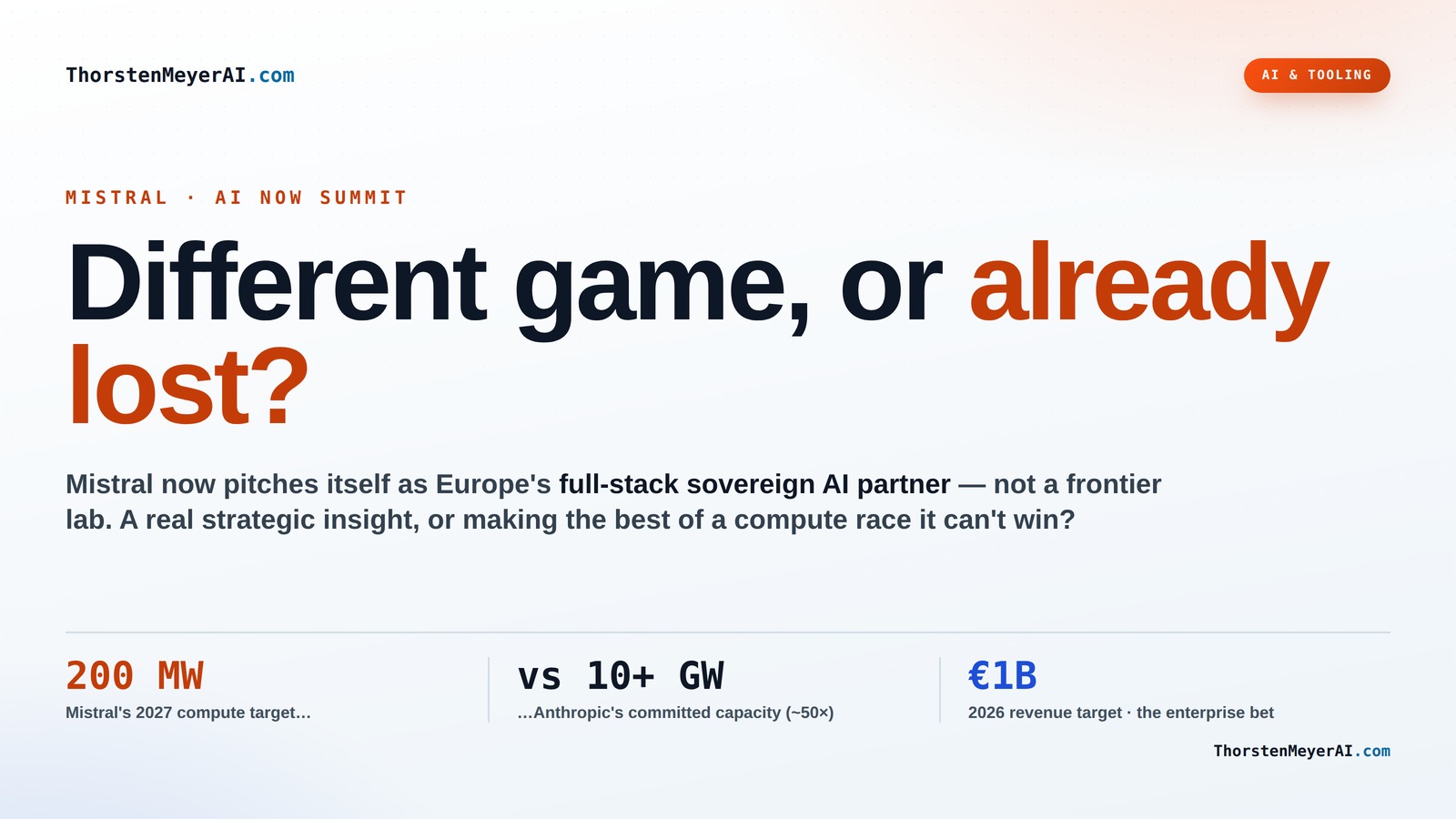
Mistral now pitches itself as Europe’s full-stack AI provider — compute, models, platform, consultancy — not a frontier-model lab. Is that a real strategic insight, or making the best of a race it can’t win? Both readings fit the same facts.
From model lab to full-stack provider
The clearest signal from the summit wasn’t a model — it was a posture. Heavy on enterprise logos and partnerships (ASML, BNP Paribas, Alexa+), light on new-model announcements. That absence is exactly what skeptics seized on.
Compute
40MW Paris DC + Sweden build · 200MW target by 2027
Models
Open & custom · efficient · you own and run them
Platform
Forge for custom models · Vibe for Work agent
Consultancy
Sales teams, integrators, EU provenance & support

Mastering Enterprise Platform Engineering: A practical guide to platform engineering and generative AI for high-performance software delivery
As an affiliate, we earn on qualifying purchases.
As an affiliate, we earn on qualifying purchases.
Small & focused, or large & general?
Mistral bets on specialized small models. The claim isn’t that they win a reasoning leaderboard — they don’t. It’s that on the metrics that matter in production agent systems, a purpose-built small model wins. Flip the metric to see the case reverse.
Small specialized vs large general — by what you measure
In token-heavy agentic apps making hundreds of calls, speed/energy/cost compound. Toggle the metric.

BXQINLENX Professional 17 PCS Model Tools Kit Modeler Basic Tools Craft Set Hobby Building Tools Kit For Gundam Car Model Building Repairing and Fixing
- Suitable for All Skill Levels: Ideal for beginners and advanced modelers
- Complete Tool Set: Includes separator, file, polishing blocks, tweezers, and more
- Versatile Use: Perfect for cars, robots, buildings, and crafts
As an affiliate, we earn on qualifying purchases.
As an affiliate, we earn on qualifying purchases.
Narrow models doing real work
Each is one model doing one thing efficiently — the tangible version of the strategy. Strong on their own terms; the open question is whether the bundle beats a free Chinese open-weight download.
On-prem KYC compliance
Mistral models run inside the bank’s walls for know-your-customer checks. Sensitive financial data never leaves. (BNP was Mistral’s first customer, 2023.)
Voxtral multilingual voice
A focused voice model powering Alexa+ across Europe — speed and efficiency over raw size.
Robostral industrial robotics
Plus a “physics AI” push (via the Emmi acquisition) into aerospace, automotive & semiconductor design and simulation.
Document AI / OCR at scale
Large-scale text extraction — the unglamorous, high-volume enterprise work small models excel at.

ASUS ESC8000A-E13 4U AI GPU Server Barebones with 3+1 3200W Titanimum CRPS Supporting Eight (8) 2-Slot Server GPUs (e.g. Pro 6000, H200), Dual (2) EPYC 9005 CPUs & 24-Channels of DDR5 ECC RDIMM RAM
- Maximum AI Compute Power: Supports dual AMD EPYC CPUs and 8 GPUs
- Advanced Thermal Efficiency: Independent airflow tunnels and hot-swap fans
- Flexible Storage Expansion: Supports Gen5 NVMe, SAS, SATA drives, PCIe 5.0 slots
As an affiliate, we earn on qualifying purchases.
As an affiliate, we earn on qualifying purchases.
The strategy is downstream of the compute gap
Once you see the raw numbers, “why is Mistral behind?” answers itself — and the specialized-small-model strategy starts looking partly like a smart adaptation to a binding constraint, not a pure philosophical choice.
Compute & capital · Mistral vs a frontier leader, this same week
Not a knock — it’s the constraint that forces the efficiency-first, sovereignty-wedge strategy. Adapting intelligently to your position is what good strategy is.

Enterprise AI Consulting: Enterprise AI architecture | AI service scaling | AI innovation trends | AI solution design | AI case studies | AI and industry insights | AI business transformation
As an affiliate, we earn on qualifying purchases.
As an affiliate, we earn on qualifying purchases.
“I want them to win, but I’m worried”
That ambivalence is the most accurate read of where Mistral sits. The enterprise pivot gets read two opposite ways — and both deserve airing.
On-prem, real sales teams, the Koyeb deployment acquisition, EU provenance — exactly what regulated enterprises want, and stickier than consumer mindshare. Targeting €1B revenue in 2026 with 1,000 staff, up from 15 people and one customer in 2023. US closed-API labs structurally can’t match the sovereignty axis.
“Software consultancy with a data center,” not a foundation-model moat. Enterprise B2B is where European startups go when they can’t win consumer or world-scale SaaS. Why pay Mistral on-prem when you could run Qwen free? One paying Le Chat Pro user said the quality gap with frontier labs is now hard to ignore.
The repositioning: from model lab to full-stack provider
The clearest signal from the summit wasn't a model. It was a posture. Mistral presented itself as no longer "just a model company" but as a builder of the full AI stack — compute, models, platform, and consultancy. CEO Arthur Mensch put it bluntly: to deploy AI in the enterprise, "you actually need, as an AI provider, to own the full stack." He described the business, memorably, as "transforming electrons into tokens and intelligence."
The evidence backs the framing. Mistral owns a 40MW data center near Paris (in Bruyères-le-Châtel), with more coming — including a €1.2 billion build in Sweden — toward a stated target of 200 megawatts of European compute capacity by 2027. It launched Vibe for Work, an agentic assistant positioned squarely against Claude for Work and similar products. And the messaging leaned hard on partnerships: ASML, BNP Paribas, Amazon's Alexa+. The unifying pitch is efficient, open, custom models that customers own and run on their own infrastructure — which is precisely the thing OpenAI and Anthropic, as closed-API providers, structurally cannot offer.
That last point is the strategic core, and it's worth taking seriously. For a regulated European bank or a defense contractor, "you can own the weights and run them inside your own walls" is not a minor feature. It's a category difference.
Here's what was conspicuously light, though, and what disappointed both the summit's chronicler Koen van Gilst and a chunk of the Hacker News thread that followed: new model announcements and technical breakthroughs. The event was heavy on signed enterprise logos and lighter on evidence that Mistral can keep pace technically. For a company whose entire value proposition rests on its models being good enough, that absence is exactly what the skeptics seized on.
The wedge: on-prem AI for regulated Europe
The most concrete part of Mistral's case is its enterprise wedge, and the examples are genuinely strong on their own terms.
BNP Paribas — notably, Mistral's first customer back in 2023 — runs Mistral models on-prem for know-your-customer compliance in Belgium, keeping sensitive financial data inside the bank. Abanca uses agent orchestration to handle sensitive customer information across an app serving more than a million customers. The pattern is consistent: data that legally or commercially cannot leave the building, processed by models that don't require it to.
The optimist read is that this is exactly what a large slice of the European enterprise market wants, and that US closed-API labs can't easily follow without rearchitecting their entire business. The skeptic read, voiced repeatedly on Hacker News, is sharper than it first appears: if a company wants to run a model on-prem, why pay Mistral instead of running Qwen or another capable open-weight model for free? That's the real competitive question, and it doesn't have a comfortable answer. Mistral's bet is that EU provenance, support, the Forge customization platform, and a model that's genuinely tuned for the task close the gap against a free download. Whether that bundle is worth paying for, at scale, against rapidly improving Chinese open weights, is the open question the summit didn't fully answer.
The strategy underneath: small, fast, focused
The most technically interesting thread was Mistral's argument for specialized small models over giant general-purpose ones. The claim is not that a small model beats a frontier model on a reasoning leaderboard — it plainly doesn't. The claim is that on the metrics that matter in production agent systems, speed, energy consumption, and cost per token, a purpose-built small model can win decisively. And in token-heavy agentic applications where a workflow might make hundreds of model calls, those production metrics compound.
The examples make the case tangible. Document AI for OCR, used by the European Patent Office for large-scale text extraction. Voxtral for multilingual voice, powering Amazon's Alexa+ in Europe. Robostral for industrial robotics with ASML, plus a broader "physics AI" push into manufacturing simulation following Mistral's acquisition of Emmi. Each is a narrow model doing one thing efficiently, rather than a giant model doing everything expensively.
There's a real strategic debate inside this, and it split the room. One camp argues that a lab competing with Google, OpenAI, and Anthropic should build very large reasoning models and let the community distill them down — "you can scale a small model down, but not up" was the memorable framing. The opposing camp notes that smaller models are what actually run locally and on-prem, and that for hobbyist and edge use the practical ceiling is hardware, not ambition: a 22–32B model is already substantial for local use, and a 240GB download of a giant model is a real barrier. Both are correct about different things, which is why the debate doesn't resolve. The honest synthesis is that small-model focus is genuinely valuable and potentially a constraint dressed as a choice — more on that below.
The papyri: the moment that earned the room
If you want the single example that best captures the upside of Mistral's approach, it isn't a bank. It's a pile of ancient garbage.
A research team from the Austrian Academy of Sciences fine-tuned Mistral's coding model Codestral into a system — named Apollo, built with partner Sail Reply — to read tiny fragments of millennia-old discarded papyri that had sat unpublished for decades. The work helps make a collection of roughly 180,000 documents found in the Egyptian desert accessible, a task estimated to take more than 2,000 years by hand. There are over a million unread Greek papyri worldwide; tens of thousands sit in the Austrian National Library alone. Multiple summit attendees independently flagged this as the standout technical presentation.
It's worth dwelling on why this lands. It's a humanities problem, not a commercial one. It uses a small, specialized, customizable model running in a controlled European environment. And it does something genuinely impossible at human scale. This is the version of Mistral's pitch that needs no spin: AI as a focused tool that unlocks real, otherwise-unreachable value. If the company's future is a thousand Apollos across regulated and specialized domains, that's a real business and a real contribution.
The reality that makes the debate legible: compute
Here is the structural fact that I think reframes the entire "why is Mistral behind?" conversation, and it's one the Hacker News thread circled without quite naming.
Mistral has raised roughly $3.9 billion across nine funding rounds in its history. Its compute target is 200 megawatts by 2027. Those are serious numbers for a European startup. They are also, in frontier-lab terms, small. For direct contrast: this same week, Anthropic raised $65 billion in a single round — about 16 times Mistral's entire lifetime funding — and has committed to more than 10 gigawatts of compute across its infrastructure deals. Ten gigawatts against 200 megawatts is a fifty-fold gap in planned capacity. The capital gap is of similar magnitude.
Once you see those numbers, the strategy stops looking purely like a philosophical choice and starts looking partly like an adaptation to a binding constraint. You cannot train frontier-scale general models without frontier-scale compute and capital, and Mistral has neither at the level OpenAI, Anthropic, Google, and the largest Chinese labs do. The specialized-small-model, efficiency-first, sovereignty-wedge strategy is the rational thing to do given that constraint. That doesn't make it wrong — adapting intelligently to your actual position is what good strategy is. But it does mean the question "different game or already lost?" may be a false binary. Mistral is playing a different game because it cannot win the frontier game on compute, and whether that different game is large enough to sustain a major company is the thing genuinely in doubt.
A related subthread is worth naming honestly: some argued European firms may be less willing to use the legally and ethically gray training data, or the distillation from frontier-model outputs, that competitors might lean on. OpenAI's terms of use, for instance, prohibit using its output to develop competing models. If European labs hold themselves to stricter data sourcing, that's admirable and also a competitive handicap. Both things are true at once.
How to read the enterprise pivot
The enterprise strategy gets read two opposite ways, and both deserve airing.
The optimistic reading: on-prem deployment, real sales teams, consultants, the Koyeb acquisition for deployment-at-scale expertise, and EU provenance are exactly what enterprise customers want, and they produce stickier revenue than consumer mindshare. Mistral is targeting €1 billion in revenue for 2026 with 1,000 employees, up from 15 people and one customer in 2023 — a genuinely steep growth curve if achieved.
The skeptical reading, which I'll quote in spirit because it's the sharpest line in the discourse: this is "software consultancy with a data center," not a trillion-dollar foundation-model moat. In this view, enterprise B2B is where European startups retreat when they can't win consumer markets or world-scale SaaS — a respectable business, but not the thing that justified the AGI-race framing Mistral once invited. The Hacker News mood captured the tension precisely: a great many commenters want Mistral to win, root for a European alternative and for small-model approaches, and simultaneously worry that the company has fallen behind on model quality, cost, and reasoning. One paying Le Chat Pro user said the quality gap with frontier labs was becoming hard to ignore.
That ambivalence — "I want them to win, but I'm worried" — is, I think, the most accurate emotional read of where Mistral sits.
The honest verdict
I won't pretend to resolve the question, because the facts genuinely don't. What I'll offer instead is the clearest framing I can.
Mistral has a real and defensible position: full-stack European AI for regulated industries that care about sovereignty, on-prem control, owned models, and return on investment now rather than AGI someday. The papyri work, the BNP on-prem deployment, the EPO OCR — these are not vaporware. They are working systems delivering value that the closed US labs structurally cannot match on the sovereignty axis.
Mistral also faces a real and possibly existential constraint: it is competing on a fiftieth of the compute and a sixteenth-of-one-round of the capital available to the frontier leaders, against US labs racing toward AGI and Chinese open-weight models that are improving fast and are free. The specialized-small-model strategy is a smart adaptation to that constraint, but it is downstream of the constraint, not independent of it.
So: different game, or already lost? My honest read is that Mistral has lost the frontier game on compute — that race is, realistically, over for any European pure-play — and is now betting that there's a large, durable, profitable game in being Europe's sovereign full-stack AI partner. That second game is real. Whether it's big enough to matter at the scale Europe needs, and whether Mistral can hold it against free Chinese open weights, is the thing none of us can yet answer. The summit was the sound of a company committing fully to the bet. The next two years are the test of whether the bet was wisdom or consolation.
I'm rooting for it to be wisdom. I'm watching the compute numbers to find out.
Sources: Koen van Gilst's notes on the Mistral AI Now Summit and the associated Hacker News discussion; Mistral AI summit materials; VentureBeat, TechCrunch, Data Center Dynamics, and the Austrian Academy of Sciences. Figures current as of late May 2026. This is independent commentary on public discussion and is not affiliated with Mistral or any party mentioned.