
There’s a small, automatic gap in your day that you’ve stopped noticing. Your hand finds the phone. Your thumb finds the app. Before you’ve actually decided anything, the feed is already moving — and a little of your attention has left and won’t come back. It happens dozens of times a day. The gap is so reflexive that it doesn’t feel like a choice anymore, which is exactly why it’s so hard to reclaim.
AmenGate is a Christian prayer-lock for iPhone built to stand in that gap. Open a distracting app and, instead of the scroll, you meet a short prayer in the words of your own tradition. Pray it, and the gate opens for as long as you chose; then it quietly closes again. That’s the entire idea. What makes it worth a spotlight isn’t the concept — phone-friction apps are a dime a dozen — it’s how carefully the thing is built around two problems those apps almost always get wrong: staying meaningful past week one, and being trustworthy enough that you’d actually rely on it.
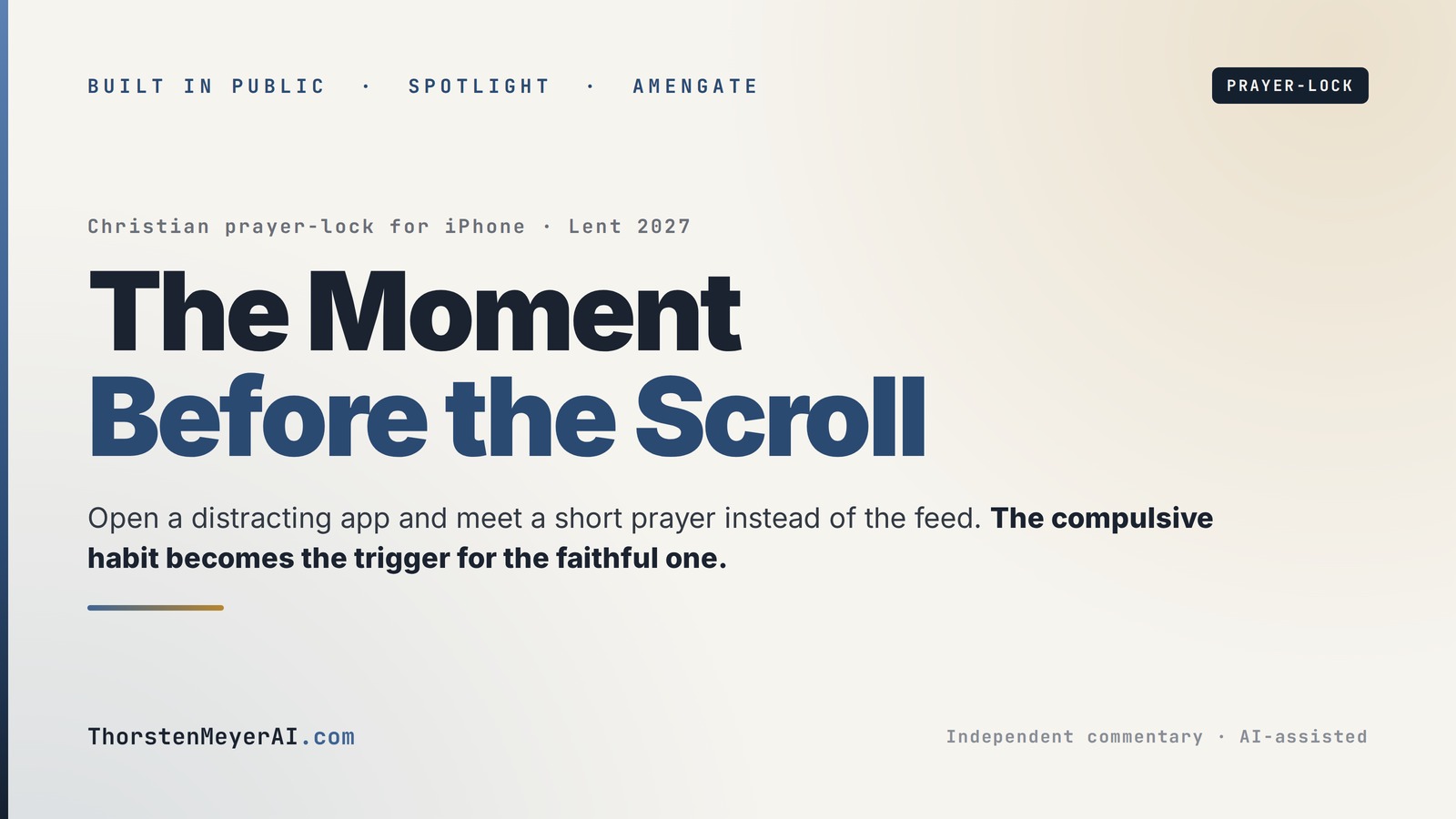
The Moment Before the Scroll
Open a distracting app and, instead of the feed, you meet a short prayer in the words of your own tradition. Pray it, and the gate opens for as long as you chose. The compulsive habit becomes the trigger for the faithful one.
Most friction apps die when the friction goes mechanical and you tap through without arriving. AmenGate’s answer isn’t harder friction — it’s an interruption that keeps telling the truth about your faith, so it keeps meaning something.
Every prayer is free at the point of use. Pro pays for the machinery — grace was never for sale.
Launches for Lent 2027 — in time for Ash Wednesday, 10 February 2027 — on iPhone, in English. No better forty days to trade a compulsion for a practice.
Independent commentary, produced with AI assistance under human editorial oversight. The views are the author’s own and may change. This describes a product’s design and stated features — not an endorsement of any religious tradition, and not business, financial, legal, technical, or spiritual advice. AmenGate is a forthcoming app; described features, review status, pricing, and availability are stated by the product and may change. Pricing is set in the App Store and varies by region. Product, model, and company names are trademarks of their respective owners; mention does not imply endorsement.
The reframe: change what’s waiting, don’t add shame
Most attempts to curb phone use treat the reflex itself as the enemy and try to make reaching for the phone feel bad. AmenGate makes a different bet — that the reflex isn’t the problem, the emptiness on the other side of it is. It doesn’t shame you out of picking up the phone. It changes what’s there when you do.
The unit of the whole app is a Gate: you choose what it guards, and it chooses how you pray. Crucially, it’s built on Apple’s own Screen Time frameworks — the same machinery behind iOS app limits — so the pause is a real system-level interruption, not a nag screen you can swipe past. The texture of a day with it is dozens of tiny returns to yourself: a collect, a psalm verse, a breath of silence, then the app, then the gate closing behind you. You don’t end the day having “used your phone less,” exactly. You end it having prayed more times than you can count. The compulsive habit becomes the trigger for the faithful one.

Phone Access Blocker Device – Subscription-Free Magnetic Focus Device for iPhone & Android – Strict Mode App Blocker to Reduce Screen Time & Distractions – Improve Focus & Productivity for Work, Study
- Focus Enhancement: Supports consistent focus habits over time
- Easy App Control: Select and block apps with a tap
- Emergency Access: Quick access when needed
As an affiliate, we earn on qualifying purchases.
As an affiliate, we earn on qualifying purchases.
The hard part: still working in week six
Here’s the engineering insight that actually matters, because it’s where nearly every friction app dies. The friction goes mechanical. By day ten your thumb taps through the speed bump before your mind has arrived; the interruption is still there but the meaning has drained out of it, and soon after that you turn the whole thing off.
AmenGate’s answer isn’t harder friction — it’s an interruption that keeps telling the truth about how you already pray, so it keeps meaning something. Three design choices carry that weight. Prayer flows are drawn from a denomination-fit pool and rotated so you rarely meet the same words two gates running, which keeps the pause from calcifying into rote. The practice follows the church year — seasonal packs reshape your gates for Advent, Lent, Holy Week, and Eastertide, so the season you’re in is the season you pray. And optional difficulty days lean on observances your tradition already keeps — a Friday abstinence, a Lenten intensifier — rather than artificially dialing up annoyance. That’s the distinction that lets it survive the week-six cliff: the friction stays rooted in something real to the person praying, instead of being manufactured for its own sake.
Christian prayer lock app for iPhone
As an affiliate, we earn on qualifying purchases.
As an affiliate, we earn on qualifying purchases.
Prayers that sound like your church, not a wellness app
Most prayer apps hand every Christian the same interchangeable, vaguely spiritual text. AmenGate asks first. Choose your tradition and the gates speak its language.
The part that signals real seriousness here is the review process. Each reviewed pack is checked by a clergy- or seminary-trained reviewer in that tradition before it ships, reviewers are credited in the app, and every prayer carries its source. The honest version of the launch state, which the app states plainly rather than papering over: at launch, the Catholic and Anglican packs are clergy-reviewed, while every other tradition is selectable from day one and served a carefully written, clearly labelled general pack until its own reviewed pack arrives. The benefit is quiet but it’s the whole point — you never find yourself praying words your own priest would wince at. The interruption belongs to your faith, not to a generic spirituality with a cross bolted on top.

ZOX The Lord Is My Shepherd Bible Verse Interactive Bracelet
- Bible Verse Scan Bracelet: Interactive reversible wristbands with beautiful designs
- Easy Verse Access: Tap your phone to read new passages
- Personalized Reflection: Choose topics for meaningful devotionals
As an affiliate, we earn on qualifying purchases.
As an affiliate, we earn on qualifying purchases.
A lock you can actually trust
A lock you don’t trust is worse than no lock, because you’ll simply turn it off. So AmenGate is built to be relied on rather than fought, and the trust features are not afterthoughts — they’re the difference between a tool you hand real control to and a gimmick you abandon.
There’s an emergency unlock with a fifteen-second countdown and a short reason prompt — long enough to interrupt a reflex, never a wall when something real is happening. The essentials always pass through: Phone, Messages, Maps, and Find My are never gated, because a prayer lock that stands between you and an emergency call is indefensible. Every lock carries a “Why am I blocked?” screen, and you get a transparent preview of what a schedule will do before it does it. And the whole thing is fail-open by design — if the prayer flow ever crashes, the lock releases. You are never stranded behind your own app.
That last principle is the quiet center of the design. You can hand AmenGate genuine authority over your day precisely because it’s built never to hold you hostage with it. Trust is the feature that makes every other feature usable.

DalVick Intelligent Electronic Counter Suitable for Accurate Step Tracking Daily Prayer Time Management Rechargeable Digital Prayer Counter
- Touch Counter with LCD Screen: Low power, accurate counting
- Versatile Use: Suitable for religious, fitness, and professional settings
- Spiritual and Professional Tool: Supports meditation, prayer, and ceremonies
As an affiliate, we earn on qualifying purchases.
As an affiliate, we earn on qualifying purchases.
Your prayer life is nobody’s product
This is where AmenGate connects to everything else in this portfolio, and it’s the part I’d underline hardest. Your denomination and your prayer history say more about who you are than almost any data you own. Under Article 9 of the GDPR they are special-category data — and AmenGate treats them that way in its architecture, not merely in a policy document nobody reads.
Everything stays on your device unless you opt into iCloud sync, and that sync goes only to your own private iCloud account, which the developer cannot read. There are no third-party SDKs, no analytics beacons, and no ad networks — not in the app, and not on its website. Your religious data is handled only under your explicit consent, which you can withdraw at any time. No ads. No tracking. Ever. — and the telling detail is that this wasn’t bolted on at the end as a marketing line; it was the first design constraint that everything else was built around. That’s the same local-first conviction that runs through this whole portfolio, applied here to the single most sensitive category of data a person has.
Grace was never for sale
The pricing carries an ethic that’s worth stating plainly, because it’s unusual and it’s deliberate. Every prayer, every verse, every word of liturgical content is free at the point of use — in the free tier, in Pro, and on the day a subscription lapses. Scripture does not go behind a paywall. What you pay for, if you pay, is the software layer and never the prayer: unlimited Gates, multi-app group blocking, custom release windows, the rotation engine, seasonal delivery, and a weekly “attention redeemed” report.
The free tier isn’t a crippled demo, either — it keeps one fully working Gate, the daily prayer and verse, the liturgical calendar, and public-domain Bible text, permanently, at no cost. Pro runs $6.99 a month, or $39.99 a year with a seven-day free trial (about $3.33 a month), cancellable through Apple in under a minute. The line the app uses for this is the cleanest summary of the whole posture: Pro pays for the machinery. Grace was never for sale. In a category full of apps that meter the spiritual content itself, drawing the paywall around the engineering and leaving the prayer free is a real choice, and a defensible one.
Built for the season it’s meant for
AmenGate launches for Lent 2027, in time for Ash Wednesday on 10 February 2027, on iPhone, in English. There’s a logic to that timing beyond marketing: Lent is the forty days the tradition already sets aside for trading a compulsion for a practice, which is precisely what the app is for.
Why it belongs in the portfolio
AmenGate looks, at first, like the outlier here — a consumer faith app among operator tools, decision skills, and infrastructure. But it’s the same stance wearing different clothes, and arguably the purest expression of one facet of it. It keeps the most sensitive data a person owns on that person’s own device, by architecture rather than by promise. It refuses the ad-and-analytics business model that the entire rest of its category takes for granted. And its whole reason for existing is subtraction in the most literal sense: removing the empty scroll and handing back the small, repeated moment it was quietly eating.
The moment before the scroll is small. It’s also yours. AmenGate is a carefully built, privacy-first attempt to help you take it back — and whatever one’s tradition or lack of one, the design discipline underneath it is the thing worth paying attention to.
Independent commentary, produced with AI assistance under human editorial oversight; the views are the author’s own and may change. This is a description of a product’s design and stated features, not an endorsement of any religious tradition or practice, and not business, financial, legal, technical, or spiritual advice. AmenGate is a forthcoming app scheduled to launch for Lent 2027; described features, review status, pricing, and availability are stated by the product and may change before or after release. Pricing is set in the App Store and subject to regional variation. Product, model, and company names are trademarks of their respective owners; mention does not imply affiliation, sponsorship, or endorsement. © 2026 Thorsten Meyer · Powered by Thorsten Meyer AI. See Imprint/Impressum and Privacy Policy.