
There is a particular kind of friction that everyone who has ever tried to make a video knows and almost no one can name. It isn’t the recording. It’s the part afterward — the scrubbing, the keyframes, the dragging of little blocks along a timeline, the hunt for the exact frame where a sentence ends. The timeline is where good footage goes to wait. Most people who could be making video aren’t, and the timeline is a large part of the reason.

Get business pricing on tech for your team
- Business-only prices and quantity discounts
- Tax-exempt purchasing
- Multiple users, one account, clear invoices
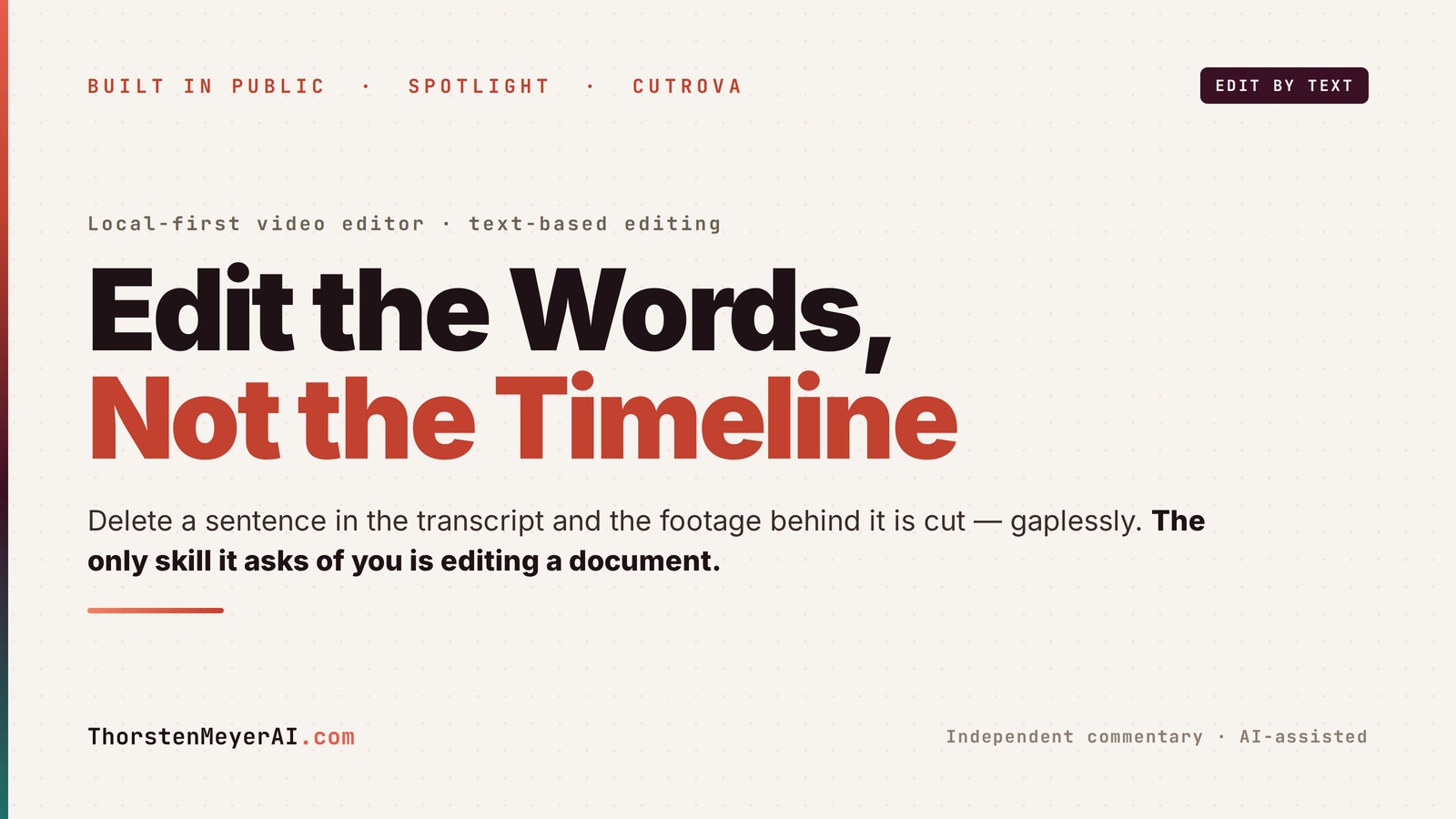
Cutrova starts from a single idea aimed straight at that friction: edit the words, not the timeline. Delete a sentence in the transcript and the footage behind it is cut — gaplessly, no scrubbing, no keyframes. The skill you already have, editing a document, becomes the only skill the tool asks of you. That is the whole thesis, and every other thing Cutrova does is downstream of it.
If that sounds familiar, it should: it’s the high end-class move, text-based editing for video and audio. Cutrova’s wager is not that the idea is new but that the idea belongs on your machine, owned and private by default, rather than rented from a cloud you don’t control. That’s the part of this spotlight worth reading closely, because it’s also the thread that runs through everything else in this portfolio.
Edit the Words, Not the Timeline
Delete a sentence in the transcript and the footage behind it is cut — gaplessly. The skill you already have, editing a document, becomes the only skill the tool asks of you. Everything else falls out of that one idea.
Cloud AI — translation, dubbing, the heavier generative features — is available on your own keys, as an opt-in, not a default you’re billed for. The local core is the text editing, transcription, cleanup, and captions.
The careful part: legal wording is legally significant, so the dark restyle was run verify-first. One canonical page, four restyled in parallel, then an adversarial pass diffed each legal body word-for-word against git show HEAD. All five came back byte-identical — statute references, the address, the ß, and the curly quotes all preserved exactly — while the design was fully adopted.
- The mailbox isn’t live yet.
contact@cutrova.comstill needs creating — the Impressum and contact pages depend on it. - Lawyer review is pending. The Impressum and Datenschutzerklärung are careful templates; the project’s own notes flag they should be reviewed and kept in sync. This is not legal advice.
- “Get started” points at email. There’s no signup flow to wire the CTAs to yet.
- Frontier features are a frontier. The text-editing core is load-bearing; several AI features are optional, cloud-based, or key-dependent and may change.
Independent commentary, produced with AI assistance under human editorial oversight. The views are the author’s own and may change. This is not business, financial, legal, or technical advice. Cutrova is an early-stage product; some capabilities are local and shipped, while others are optional, cloud-based, or key-dependent. Legal-page references describe templates, not advice. Product, model, and company names are trademarks of their respective owners; mention does not imply endorsement.
The one idea, and why it lowers the floor
Most editing tools are built for editors. They assume you want a timeline because they assume you already know how to use one. That assumption quietly excludes almost everyone — the founder who should be shipping product demos, the teacher recording a lesson, the team that has a webinar to clip and no editor on staff. The cost of video isn’t the camera anymore. It’s the post.
Editing by transcript removes the assumption rather than teaching around it. You read what you said, you cut what you don’t want, you reorder what’s out of order — the same gestures you’d use on an email. A rough cut that used to take an evening of timeline work becomes a few minutes of typing. The interesting claim isn’t “faster,” though it is faster. The interesting claim is lower — the floor of who can make a finished video drops to anyone who can edit a paragraph.
From that one move, the rest of the feature set falls out almost mechanically. Filler words and dead air can be stripped in a single pass, because they’re just text to delete. Captions come more or less for free, because the transcript already exists — styled, karaoke-highlighted, exportable as SRT or VTT for reach and silent-feed viewing. A flubbed word can be fixed by correcting the text and overdubbing, rather than re-recording the take. A vertical social clip that follows the speaker, an audiogram, a blog transcript, and the long-form original can all come out of a single recording. None of these are separate products bolted on. They’re consequences of having the words.
local-first text-based video editor
As an affiliate, we earn on qualifying purchases.
As an affiliate, we earn on qualifying purchases.
Local-first, on purpose
Here is where Cutrova diverges from the cloud-native editors it resembles, and the divergence is the point.
Cutrova runs on your machine. Recordings are transcribed locally; the core editing flow works offline; your media never has to leave the computer it was recorded on. The benefits of that are practical before they’re philosophical. Privacy: confidential or unreleased footage stays on hardware you control, which matters enormously for anything under NDA, anything pre-launch, anything compliance-sensitive. Speed: there are no gigabytes to upload before you can start and none to download when you’re done. Cost and control: the editing you do all day doesn’t meter against a per-minute cloud bill, and it keeps working when the connection doesn’t.
Cloud AI is available when you want it — translation, dubbing, the heavier generative features — but on your own keys, as an opt-in, not a default you’re billed for. That’s the honest shape of the product: a local-first core you own outright, with optional cloud capability you reach for deliberately. It’s worth being precise that several of the most eye-catching AI features sit on that optional side and depend on a provider key; the local core is the text-based editing, the transcription, the cleanup, the captions. The pitch is built to be true on day one, not just true once you’ve wired up an account.
This isn’t a marketing posture. It’s the same stance that produced every other thing in this portfolio: own your compute and your data, because renting your core capability is a quiet form of fragility. Cutrova is what that stance looks like when you point it at video.
transcript editing software for videos
As an affiliate, we earn on qualifying purchases.
As an affiliate, we earn on qualifying purchases.
What you can actually make
Cutrova is deliberately one tool across many formats rather than a different app per output. The same recording becomes a product demo or explainer, a captioned tutorial that’s easy to update, an audio or video podcast with promo clips, a vertical social short with karaoke captions, a trimmed-and-captioned webinar with a highlight reel cut out of it, or an accessible, described, multi-language edition of any of the above.
For a solo creator, that compresses to a simple promise: studio-grade output without a studio or an editor, and a consistent posting cadence — the thing that actually grows a channel — because turnaround drops from hours to minutes. For a team, it reads differently but rhymes: demos, training, and internal comms get made in-house and same-day, anyone who can write can edit so there’s no specialist bottleneck, reusable caption styles keep everything on-brand, and the local-first default keeps NDA’d and unreleased material on machines you control. Built-in captions and audio description aren’t only reach — they’re a meaningful step toward meeting accessibility obligations, which is both good practice and increasingly not optional.
I’d rather undersell this than oversell it, in keeping with how the rest of the series has been written: Cutrova is a working local application with a real core, and a set of AI capabilities that range from shipped to key-dependent to early. The honest version of the pitch is that the core idea is fully load-bearing and the frontier features are exactly that — a frontier.
video editing tools with timeline removal
As an affiliate, we earn on qualifying purchases.
As an affiliate, we earn on qualifying purchases.
Built in public: giving Cutrova a public face
For most of its life so far, Cutrova had a problem that’s easy to overlook and embarrassing to leave standing: it worked, and it didn’t exist. The application ran locally, but cutrova.com served nothing. The few legal pages that existed pointed their footers at an empty /. A real product with no public face is, to the rest of the world, not a product.
The work documented here is the part that fixed that — and it’s the part I want to be most concrete about, because it actually shipped and can be verified. The goal was narrow and complete: a modern marketing landing page that demonstrates the idea rather than describing it, the legal pages a private operator in Germany is obliged to publish, one coherent brand across all of it, and then — the part teams most often defer — an actual deployment to the live host.
The brand is a small, deliberate token set rather than a framework: a deep plum-wine surface, cream for reading, coral for action, Fraunces for headlines, Inter for everything else, and a wordmark sitting beside a coral “cut-mark” glyph — a notch shaped like a film splice. Every page ships its own inline CSS and uploads as-is to static hosting; no bundler, no asset pipeline, no build step. The landing page leads with an in-browser editor mockup built entirely in HTML and CSS — a transcript with one sentence struck through, a caption preview, a filmstrip-and-waveform strip — so the core idea (delete the text, cut the video) is shown, not just claimed, before a visitor has clicked anything.
privacy-focused video editing software
As an affiliate, we earn on qualifying purchases.
As an affiliate, we earn on qualifying purchases.
The careful part: changing legal text without changing it
The most instructive piece of the build wasn’t the marketing page. It was the legal pages, because legal wording is legally significant — a cosmetic restyle is not allowed to alter a single word.
The site is operated by a private individual in Germany, which triggers specific, concrete obligations: a legal notice under § 5 DDG with a § 18 (2) MStV responsible-for-content block, a no-VAT statement under § 27 a UStG, and a § 36 VSBG dispute declaration; a GDPR/DSGVO privacy policy naming the host as an Art. 28 processor, the cookie position under § 25 TTDSG, the full data-subject rights, and the competent supervisory authority; terms with a German tiered liability limitation under German governing law; an advertising-disclosure page meeting UWG §§ 5a/5b and MStV § 22; and a contact page. These are not decorative. Getting a statute reference or an address subtly wrong is the kind of mistake that matters.
So the restyle — taking five pages from an initial light theme onto the dark homepage brand — was run as a verify-first workflow rather than a careful-hands hope. One page was hand-built as the canonical dark reference. The remaining pages were restyled in parallel, each copying the reference’s shared chrome (head, header, footer) while preserving its own legal body verbatim. Then an independent pass diffed each restyled legal body word-for-word against the previously committed version, and separately confirmed every design element was correctly adopted. The result that matters: all five passed with the legal text byte-identical — statute references, the address, the ß character, and the curly typographic quotes all preserved exactly — while the design was fully adopted and the “Powered by Thorsten Meyer AI” attribution linked correctly from every footer.
That’s the texture of doing agentic work responsibly. The leverage is real — many pages restyled in parallel, an automated adversarial check instead of a manual proofread — but the leverage is pointed at verification, not just production. The machine does the typing and the diffing; a person decides what “correct” means and refuses to ship until the diff is clean.
Shipping it, and the small honest frictions
Deployment was the unglamorous proof that it’s live. Credentials were kept local, gitignored, locked down, and deliberately stored at the repository root outside the deployable folder so they could never be uploaded alongside the site. SFTP turned out to be a dead end — the host gates SSH separately and the credentials were FTP-only — so the site went up over FTPS, encrypted on both control and data channels. Because the webspace root was empty with no domain subfolder, the document root simply was the home directory; only the .html files went up, never the internal notes or the secrets. Then every URL was checked: all of them return HTTP 200 over valid HTTPS with the right title, and a headless browser confirmed the homepage renders over the network — fonts, hero, mockup — with no console errors.
Cutrova is live at https://cutrova.com: a marketing homepage plus five cohesive, German-law-aware legal pages, in one dark brand.
And then the honest list of what isn’t done, because a spotlight that only lists wins isn’t worth much. The contact@cutrova.com mailbox still needs to be created in the host panel — the Impressum and contact pages depend on a working address. The Impressum and Datenschutzerklärung are carefully written templates reflecting German and EU requirements, and the project’s own notes flag plainly that they should be reviewed by a lawyer and kept in sync with whatever third-party services actually get used; this article isn’t legal advice and neither are they. The “Get started” buttons currently point at the contact email because there’s no signup flow to point them at yet. Open Graph images, a sitemap, and privacy-respecting analytics behind a consent banner are all still on the list. None of that undercuts the launch. It’s just the difference between shipped and finished, and they aren’t the same word.
Why this one belongs in the portfolio
Cutrova is, on its surface, a video editor, and it would be easy to file it under “creator tools” and move on. But the reason it sits comfortably alongside a content engine, a regulated-QA system, and a satellite-radar platform is that it’s the same idea wearing different clothes. It lowers a skill floor by changing what you have to know. It keeps your data on your own ground by default. It treats the heavy cloud AI as a deliberate, key-in-hand option rather than an always-on dependency. And the work of building it was less about generating output than about deciding what was correct and refusing to ship until it was — the legal diff that had to come back clean, the credentials that were never allowed near git, the buttons honestly pointed at an email instead of a fake flow.
Edit the words, not the timeline. It’s a good line for a video tool. It’s also, if you squint, the same instruction the whole portfolio keeps giving itself: work in the medium you actually understand, own what you make, and spend your judgment on what to cut.
Independent commentary, produced with AI assistance under human editorial oversight; the views are the author’s own and may change. This is not business, financial, legal, or technical advice. Cutrova is an early-stage product; some capabilities are local and shipped, while others are optional, cloud-based, or key-dependent and may change. The legal-page references templates and are not legal advice — the Impressum and Datenschutzerklärung should be reviewed by a qualified lawyer. Product, model, and company names are trademarks of their respective owners; mention does not imply affiliation, sponsorship, or endorsement. © 2026 Thorsten Meyer · Powered by Thorsten Meyer AI. See Imprint/Impressum and Privacy Policy.
Fall Picks
fall essentials
As an affiliate, we earn on qualifying purchases.