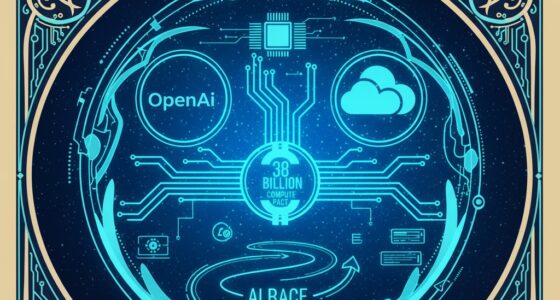
The Control Series, Part 1. An occasional series on where power actually sits in the AI stack — and who has started to squeeze.
Prime for Young Adults — start your free trial
Fast free delivery, streaming and member deals for eligible 18–24 year olds.
Try it freeAs an affiliate, we earn on qualifying purchases.
For about a decade, the pitch for artificial intelligence was the pitch for electricity. A utility. You plug in, it’s always on, it’s broadly neutral, and it flows to whoever pays. The metaphor did real work: it justified the spending, calmed the customers, and framed AI as infrastructure that would simply be there, like the grid.
In a single stretch of weeks in 2026, that story broke.
A government switched off a frontier model worldwide on roughly ninety minutes’ notice. A defense ministry turned its war into a rentable dataset with strings attached. And the most capital-rich AI company on earth leased its supercomputers to its direct rivals — with a clause to seize them back if it doesn’t like what they’re trained to do.
None of these were glitches. They were demonstrations. The common thread is control: AI does not flow freely like a utility. It passes through a small number of chokepoints, and 2026 is the year the people who own those chokepoints started using them.
This piece maps the six. Each will get its own installment later; consider this the index.
The Six Chokepoints
For a decade AI was sold as a utility — abundant, neutral, always on. In 2026 it became a lever: scarce, controlled, revocable. Here are the six places power actually sits — and who started to squeeze.
Every layer is concentrating into fewer hands, and 2026 is the year the holders stopped treating their leverage as theoretical. A kill switch wasn’t discussed — it was pulled. The utility you’re allowed to forget about; the lever, you have to watch who’s holding. Optionality just became architecture.
Utility versus lever
The difference is not cosmetic. A utility assumes abundance, neutrality, and permanence — it’s there tomorrow, for everyone, on the same terms. A lever assumes the opposite: scarcity, control, and revocability. The thing can be throttled, gated, repriced, or shut off, and someone specific decides.
Everything below is a place where the second description is now winning.
high performance GPU for AI training
As an affiliate, we earn on qualifying purchases.
As an affiliate, we earn on qualifying purchases.
1. Power
Start at the bottom, because that’s where the real ceiling is. The binding constraint on frontier AI isn’t talent or even chips — it’s gigawatts. SpaceX’s Memphis complex runs toward roughly two gigawatts, and it got there by building its own on-site gas generation rather than waiting on a utility interconnection that takes years. Memphis’s grid strained; the company routed around it.
Whoever can conjure power at that scale sets the ceiling on everyone else’s compute. Increasingly that’s a contest between a few hyperscale builders and the states that permit them. The lever-holder: those who can finance and permit power faster than the grid can deliver it — which is a very short list.
As an affiliate, we earn on qualifying purchases.
2. Compute
One layer up, the concentration is starker. xAI’s Colossus holds on the order of 555,000 GPUs, and the tell of 2026 is who’s renting it. Anthropic agreed to pay roughly $1.25 billion a month for the output of Colossus 1; Google signed a separate deal near $920 million a month — together about $26 billion a year flowing to a competitor’s data centers. OpenAI leans on Stargate and Oracle. The frontier labs largely do not own the compute they run on. They rent it, sometimes from rivals, sometimes under contracts that reserve the owner’s right to reclaim it.
The lever-holder: the handful of entities that can amass clusters at this scale — and Nvidia, sitting upstream of all of them.
As an affiliate, we earn on qualifying purchases.
3. Data
The input you cannot simply buy is the next chokepoint, and the clearest 2026 example wears camouflage. Ukraine’s Avengers Labs turns real combat footage — millions of annotated frames no one outside the war can collect — into a resource that domestic and foreign companies may train on, on the condition that Ukraine keeps the improved model. It’s data as a sovereign asset, licensed without ever leaving the room. Perplexity’s Search-as-Code makes a quieter version of the same bet: that proprietary, hard-to-collect, well-labeled data is the moat that survives even as the models themselves commoditize.
The lever-holder: whoever sits on a unique, adversarial, well-labeled corpus — a war, a fleet, a patient population, a market nobody else can see.
As an affiliate, we earn on qualifying purchases.
4. Model access
Then there’s the model itself — or rather, the right to keep using it. On June 12, the U.S. government issued an export-control directive that forced Anthropic to disable its newest models, Fable 5 and Mythos 5, for every customer on the planet, citing national security. Allies who’d been using the technology for cyber defense lost it overnight; one former administration AI adviser called the move “baffling.” The single most damaging line in the aftermath came from a Deutsche Bank economist: you can’t rely on something that could be switched off.
Access is revocable — by governments via export controls, or by providers via terms, pricing, and geofencing. The lever-holder: governments and the labs themselves, jointly.
5. Distribution
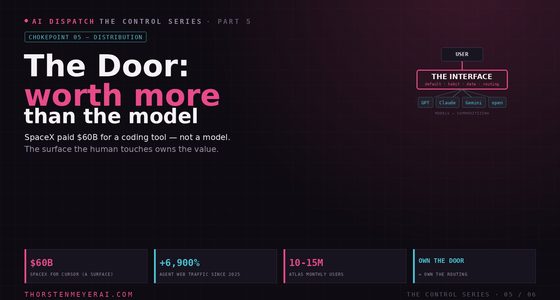
Owning the model means little without the channel to a user, which is why the application layer is a chokepoint of its own. SpaceX paid $60 billion for Cursor — not for a model, but for the surface where AI already makes real money: developers’ daily tooling, plus the usage data that flows back from it. OpenAI and Anthropic are fighting over the same developer surface. Control the interface — the IDE, the browser, the OS it rides on — and you control which model gets reached and which feedback loop gets fed.
The lever-holder: whoever owns the application and the platform beneath it.
6. Capital
The last chokepoint is the most boring and the most decisive: who can afford to play. SpaceX went public at a multi-trillion-dollar valuation; Anthropic and OpenAI are expected to follow. The buildout runs on circular, intra-industry financing — billions in compute rentals between competitors, multi-billion all-stock acquisitions — that flatters everyone’s numbers heading into their listings. The sheer capital intensity is itself a gate, and it excludes all but a few balance sheets and sovereign funds.
The lever-holder: the small set of investors and states large enough to fund a frontier run — and patient enough to wait for it to pay.
The pattern
Read the six together and the shape is unmistakable. Every layer is concentrating into fewer hands, and 2026 is the year the holders stopped treating their leverage as theoretical. A kill switch wasn’t discussed; it was pulled. A dataset wasn’t theorized as strategic; it was gated and licensed. A rival’s compute wasn’t imagined as a dependency; it was leased on reclaimable terms.
The utility framing assumed you’d never have to ask who controls the wire, because the wire was neutral and always live. The lever framing forces the question at every layer: who can throttle this, and what do they want?
What it means
For builders, the lesson is architectural, not philosophical: optionality and portability stop being nice-to-haves. If any single chokepoint can be squeezed, single-sourcing it is a latent outage. Multi-model, exit ramps in contracts, and the ability to fall back to weights you run yourself are now table stakes — not ideology.
For nations, AI sovereignty graduates from slogan to budget line. Europe in particular got its clearest evidence yet that depending on someone else’s switchable model is a strategic exposure, not just a procurement choice. Expect the conversation about European compute, power, and open weights to get louder and better funded.
And the quiet winner of a kill-switch era may be open-weight models — including the Chinese ones now only months behind the frontier — for the simple reason that weights you can download and run can’t be revoked by anyone.
The honest caveat: concentration is not purely sinister. The same chokepoints that enable control also enable efficiency, coordinated safety review, and the raw scale that makes frontier models possible at all. A grid with a few operators is also a grid that mostly stays on. The question 2026 raised isn’t whether the chokepoints should exist — they will — but who holds them, under what rules, and whether the rest of us keep any optionality at all.
The series ahead
Each of these deserves its own reckoning, and over the coming installments this series will take them one at a time: power and the gigawatt race; compute and the neocloud cartel forming among rivals; data as the new sovereign asset; model access and the precedent of the switch; distribution and the war for the interface; and capital and the circular financing holding the whole thing up.
The utility you’re allowed to forget about. The lever, you have to watch who’s holding. 2026 is the year we found out which one AI was all along.
Synthesis draws on prior reporting in this series’ sources: Anthropic’s official statements, Axios, the Wall Street Journal, Reuters, CBS, TechCrunch, Semafor, Ukraine’s Ministry of Defense, Perplexity Research, Challenger Gray & Christmas, and SpaceX’s SEC filings (March–June 2026). Compute-lease and acquisition figures are from SpaceX filings. Analysis and opinions are the author’s.
Fall yard work Picks
leaf blowers
As an affiliate, we earn on qualifying purchases.