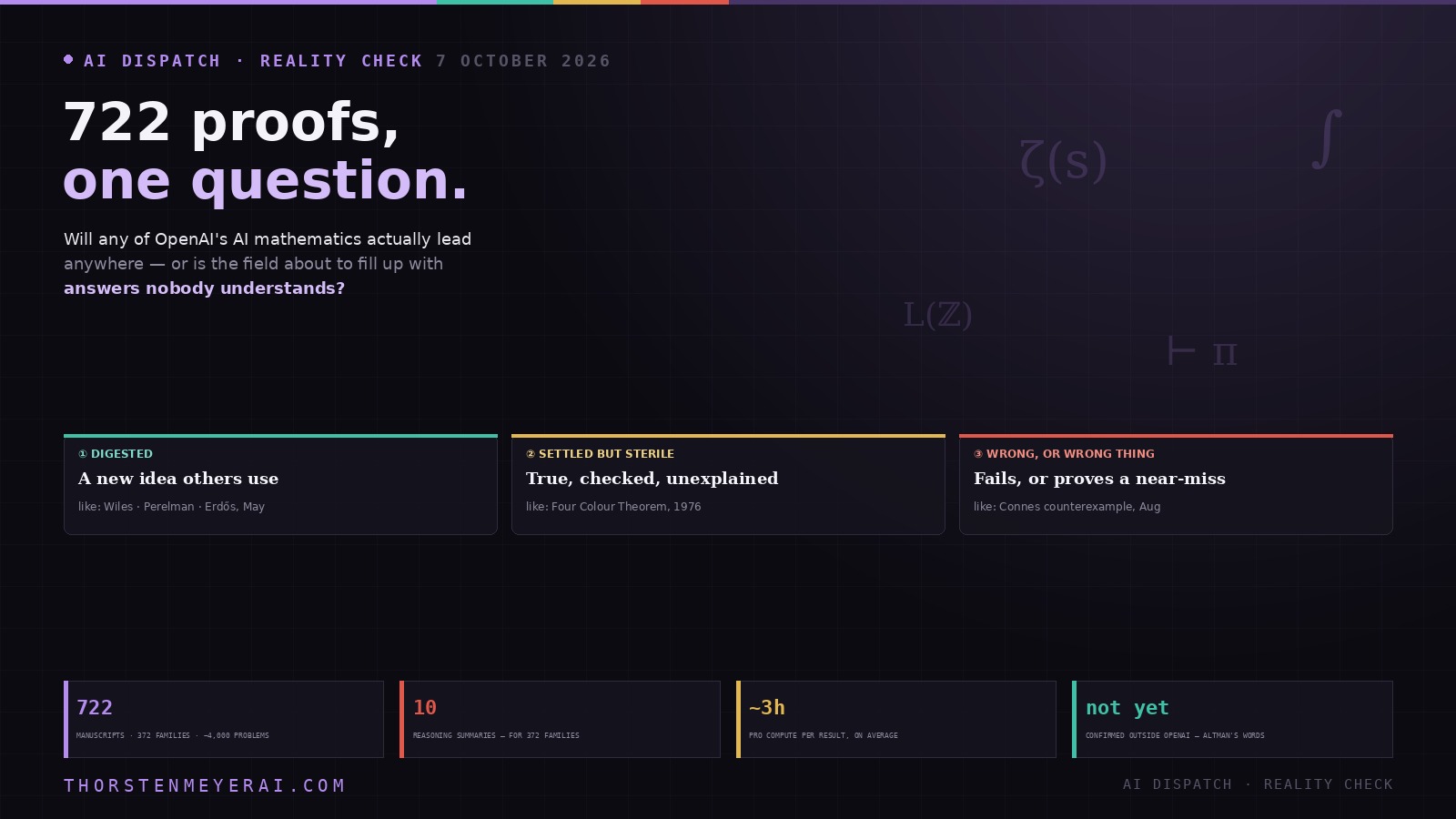

On Monday, OpenAI published 722 mathematical manuscripts written by a model it hasn’t released and hasn’t named. They’re grouped into 372 families of related results, drawn from roughly 4,000 problems posed to the model. The average result took about three hours of ChatGPT Pro thinking compute.

Get business pricing on tech for your team
- Business-only prices and quantity discounts
- Tax-exempt purchasing
- Multiple users, one account, clear invoices
The rumours were true. The catalogue is also far stranger than the headline. Among the claimed results:
- a proof of the Unique Games Conjecture, the central open problem in hardness of approximation;
- a resolution of Hilbert’s tenth problem over the rationals;
- a proof that all nonabelian free group factors are isomorphic, open since the 1940s;
- a zero-free region for the Riemann zeta function to the right of Re(s) = 11/12 — a “quasi-Riemann hypothesis”;
- the Hodge conjecture for CM abelian varieties;
- the Mahler conjectures in convex geometry.
Any one of these, if correct, would define a career. OpenAI is claiming dozens at once.
722 proofs, one question: will any of OpenAI’s AI mathematics actually lead anywhere?
An unreleased, unnamed model produced claimed proofs of results that would each define a career. Sam Altman calls them “claims not yet confirmed by outside mathematicians.” The real question isn’t whether it’s impressive. It’s whether answers nobody understands become discoveries anyone can build on.
Same day: Alon, Bloom, Gowers, Litt, Sawin post a digested, human-verified version. The model for success.
Connes rigidity counterexample challenged within a day — constructed groups fail the required condition. Three rival machine “counterexamples” from different labs now circulate.
~10,000 agents, 88 hours, est. ~$22M at retail. Priority dispute; 25 Fields Medalists sign “A Severe Misalignment” — not saying it’s wrong, saying it’s not understood.
Altman now hedges at announcement — a shift from September. Verification has barely started.
Humans extract the technique, write it up, build on it. This is where downstream discovery comes from.
The question is answered; nobody learns anything reusable. Closes a door without opening a field.
The proof breaks, or proves a statement that doesn’t match the conjecture as mathematicians mean it.
The Unique Games Conjecture is the clearest case. Results like the optimality of Goemans–Williamson for Max-Cut are proved assuming UGC. A correct proof converts them all — no understanding required. A zero-free strip for zeta works the same way for prime-distribution results. Free group factors, Kadison, Mahler would redirect whole programmes — but how depends on the method, which means digestion.
Technology. A Navier–Stokes blow-up proof doesn’t change how anyone designs aircraft; engineering turbulence models never depended on the answer. Near-term consequences are mathematical, not industrial. “AI will cure cancer next” skips several steps.
“Verification abundance, adjudication scarcity” — making proof-checking cheap doesn’t reduce the burden of deciding what’s true and what matters. 722 manuscripts land on a review system built for a trickle, filtered by a selection nobody outside OpenAI made.
Humans re-deriving results, like Alon–Gowers et al. in May
Other people’s work building on these manuscripts
How many unformalized results survive expert checking
Do the Lean statements match the real conjectures?
Do any survive peer review?
Some of it, yes — where a literature is waiting (UGC), a correct proof pays off immediately; where a proof carries a new technique humans digest, it can open a field. Most of it, probably not on its own: at 722 manuscripts with 10 reasoning summaries, the Four Colour pattern is the likely default unless mathematicians are funded and given time. And some will be wrong — OpenAI says so itself. It’s an industry pattern, not one company’s: the forced-Euler result came from an Anthropic researcher, and rival machine-generated Connes “counterexamples” circulate from different labs. The proofs arrived this week. The discoveries, if they come, will arrive at the speed of human understanding.
So the honest first sentence is the one Sam Altman himself used: these are claims not yet confirmed by outside mathematicians. And the honest question — the one worth an article — isn’t “is this impressive?” It’s: will any of it lead to bigger, meaningful discoveries? Or is mathematics about to fill up with answers nobody understands?
What was actually released
The verified facts, from OpenAI’s post and its GitHub repository:
- 722 manuscripts in 372 families, spanning number theory, geometry, operator algebras, topology, theoretical computer science and mathematical physics, published under Apache-2.0.
- Lean formalizations for many, but not all of the results — including, according to reporting, the Unique Games, quasi-Riemann and free-group-factor manuscripts. OpenAI’s own README warns that “some of the unformalized results could have issues.”
- Ten abridged reasoning summaries — out of 372 families.
- A selection funnel: about 4,000 problems posed, filtered by OpenAI for “an appropriate level of significance.” Nobody outside OpenAI made that selection.
- Two exceptions to the standard procedure: the Riemann zero-free region and the Hodge result. The Riemann write-up was edited by humans for readability.
As an affiliate, we earn on qualifying purchases.
The track record, so far
This is OpenAI’s fourth major mathematics release this year, and the first three tell you most of what you need to know about the fourth.
May — the Erdős unit-distance conjecture. It worked. OpenAI’s model produced a counterexample to a 1946 conjecture. The same day, five mathematicians — Noga Alon, Thomas Bloom, Tim Gowers, Daniel Litt and Will Sawin — posted what they called a digested, human-verified version. The operative word is digested: humans converted machine output into something the field could evaluate, then evaluated it. That’s the model for success.
August — “Ten Advances”. Mixed. Of ten claimed results, the claimed counterexample to Connes’s rigidity conjecture was disputed within a day: a critique found the constructed groups don’t satisfy the condition the conjecture actually requires. At least three mutually independent machine-generated “counterexamples” to that same conjecture, from different labs, are now in circulation.
September — Navier–Stokes. OpenAI announced a Lean-formalized proof that the Navier–Stokes equations can blow up in finite time — a Millennium Prize problem — produced by about 10,000 concurrent agents over 88 hours. One analyst estimated the effort would have cost a paying customer on the order of $22 million at retail prices. The result arrived amid a priority dispute with concurrent work on the forced Euler equations by Levent Alpöge, an Anthropic researcher, and NYU’s Tristan Buckmaster. Three days later, 25 Fields Medalists, including Terence Tao, Peter Scholze and Maryna Viazovska, signed a declaration titled “A Severe Misalignment of AI in Mathematics.”
Their complaint was not that the proof was wrong. It was that solving famous problems as benchmarks, without human understanding, works against what mathematics is for.
That distinction is the key to the whole question.
formal verification tools for mathematicians
As an affiliate, we earn on qualifying purchases.
As an affiliate, we earn on qualifying purchases.
Why a proof isn’t the same as a discovery
Here’s the part outsiders usually miss. In mathematics, the value of a great proof is rarely the answer. It’s the method.
- Andrew Wiles’ proof of Fermat’s Last Theorem mattered less because Fermat was right than because its techniques opened up the modularity programme, which reshaped number theory for decades.
- Grigori Perelman’s proof of the Poincaré conjecture mattered because Ricci flow with surgery became a tool others could use.
- The Four Colour Theorem, proved by computer in 1976, is the cautionary contrast. It settled the question, but the proof was a case-check humans couldn’t survey, and it produced comparatively little new theory. It closed a door without opening a field.
So every AI result in this catalogue will end up in one of three places:
- Digested. Humans extract a new idea, write it up, and build on it — the Erdős pattern. This is where real downstream discovery comes from.
- Settled but sterile. The statement is true, the proof checks, and nobody learns anything reusable — the Four Colour pattern. The question is answered; the field doesn’t move.
- Wrong, or right about the wrong thing. The proof fails, or proves a statement that doesn’t quite match the conjecture mathematicians care about — the Connes pattern.
Which bucket each of the 372 families lands in is not a question about the AI. It’s a question about whether humans do the work of understanding it.
AI-assisted theorem proving software
As an affiliate, we earn on qualifying purchases.
As an affiliate, we earn on qualifying purchases.
Where real downstream value could come from
If you want to know which results could lead somewhere quickly, look for the ones where a whole literature is waiting on them.
The Unique Games Conjecture is the clearest case. A large body of theoretical computer science consists of results proved assuming UGC — for example, that certain approximation algorithms, like the classic Goemans–Williamson algorithm for Max-Cut, are the best possible. If the conjecture is proved and the proof holds up, every one of those conditional results becomes a theorem overnight. That’s genuine, immediate downstream value, and it doesn’t even require anyone to understand the proof.
A zero-free strip for Riemann zeta would be similar in spirit. It would sharpen what can be proved about how prime numbers are distributed, with consequences across analytic number theory — again, results that today carry an explicit “assuming” clause.
The free group factor problem, Kadison’s similarity problem and the Mahler conjectures sit at the centre of their fields. Their resolutions would redirect research programmes. But how they redirect them depends on the method, which brings us back to digestion.
What you shouldn’t expect is technology. A Navier–Stokes blow-up proof doesn’t change how anyone designs aircraft. Engineers model turbulence with methods that never depended on the answer. The near-term consequences here are mathematical, not industrial, and anyone selling this as “AI will cure cancer next” is skipping several steps.
As an affiliate, we earn on qualifying purchases.
The real bottleneck: adjudication, not proof
A recent arXiv paper put the structural problem in a single phrase: verification abundance, adjudication scarcity. Making proof-checking cheap doesn’t reduce the burden of deciding what’s true, what matters, and what’s been shown.
Three reasons that matters here:
Lean checks the proof, not the question. A formal proof verifies that a stated theorem follows from its axioms. It doesn’t verify that the stated theorem is the conjecture as mathematicians mean it. The Connes dispute was exactly that failure. For every one of these 722 manuscripts, a human expert still has to confirm that the formal statement matches the real problem.
722 manuscripts exceed what the field can absorb. No group of referees can check this quickly. Mathematics has a fixed supply of experts in, say, operator algebras, and they have their own research. A flood of claimed results, most unformalized and some flagged by their own author as possibly flawed, lands on a review system built for a trickle.
The selection is invisible. About 4,000 problems in, 372 families out, filtered by the company that built the model. We know the denominator. We don’t yet know, per problem, what was tried, what failed, and what was quietly dropped.
What the advisory group asked for — and what OpenAI did
OpenAI says it “drew on” the recommendations of the Advisory Group on Mathematics and Artificial Intelligence at the Institute for Advanced Study. Those recommendations, published on 29 September after more than 600 responses from mathematicians, open with a sentence OpenAI’s post doesn’t quote: the group does not endorse labs testing advanced problems on proprietary models, and asks them to stop.
Against the group’s specific asks, the release looks like this:
| The advisory group asked for | OpenAI’s release |
|---|---|
| A repository not controlled by any AI lab | OpenAI’s own GitHub; “exploring” community alternatives |
| The name of the model | Unnamed internal model |
| The prompts used | Not published |
| A summarized chain of thought per result | 10 summaries for 372 families |
| Time taken and compute cost | Yes — average ~3 hours of Pro compute |
| How many problems were tried and failed | Partly — ~4,000 posed; per-problem detail not in the README |
| Thorough citation of related literature | Acknowledged as needing improvement |
| Formalization where possible | Many, but not all |
| Funding for human understanding, distributed by existing non-profits | Workshops and conferences promised; the mechanism isn’t specified |
| Not to treat releases as marketing | — |
This is real progress over September. There’s a versioned repository, compute disclosure, partial Lean coverage, and a CEO who now hedges at the moment of announcement rather than afterwards. It still falls well short of what the community asked for, on the items that matter most for adjudication: the prompts, the per-problem failures, and an independent home for the results.
What this means in the broader sense
Four things, beyond mathematics.
It’s the clearest evidence yet that AI self-improvement works where verification is strong. This publication argued last month that self-improvement tracks verifier strength, and that a formal proof checker is the strongest verifier there is. Mathematics with Lean is exactly that regime, which is why it’s where the most dramatic results are appearing. Expect the same pattern wherever a hard verifier exists, and much slower progress where one doesn’t.
The bottleneck has moved from producing answers to understanding them. That isn’t just mathematics. Code, chip design and drug candidates are all heading the same way: machine output cheaper than the human attention needed to trust it.
It’s an industry pattern, not one company’s stunt. The forced-Euler result came from an Anthropic researcher working with an NYU mathematician on an internal Anthropic model. Rival machine-generated counterexamples to Connes’s conjecture are circulating from different labs. The Fields Medalists’ letter was addressed to AI labs plural, and the race it describes involves all of them.
Access is becoming two-tier. The model that produced these results is unreleased. The advisory group’s sharpest warning is that labs using internal models to do frontier mathematics risk “alienating the mathematical community from its own discipline.” The people who will have to verify, understand and build on these results can’t use the tool that produced them.
The take
Will any of this lead to bigger, meaningful discoveries?
Some of it, yes — and you can already see which. Where an entire literature is waiting on a single result, as with the Unique Games Conjecture, a correct proof pays off immediately, whether or not anyone understands it. Where a proof contains a genuinely new technique and humans take the time to digest it, as happened with the Erdős counterexample in May, it can open a field.
Most of it, probably not on its own. A proof nobody understands settles a question without teaching anyone anything. That’s the Four Colour pattern, and at 722 manuscripts with 10 reasoning summaries, it’s the likely default for most of this catalogue unless mathematicians are funded and given time to do the digesting.
And some of it will turn out to be wrong. OpenAI says so itself. The August batch already produced one disputed result, and the more famous the problem, the more carefully the statement has to be checked against the formalization.
So watch the signals that actually tell you whether discovery is happening. Digest papers by human mathematicians, like the Alon–Gowers paper in May. Citations of these manuscripts in other people’s work. The errata rate as experts check the unformalized results. Statement audits of the Lean formalizations. And whether any of these results survive journal peer review.
The proofs arrived this week. The discoveries, if they come, will arrive at the speed of human understanding — which is exactly what the Fields Medalists were trying to say.
Sources: OpenAI, “Sharing AI progress in mathematics” (6 October 2026) and the openai/math GitHub repository README (722 manuscripts, 372 families, ~4,000 problems, ~3 hours of ChatGPT Pro compute per result, Lean coverage partial, ten reasoning summaries, the Riemann zero-free region and Hodge exceptions, human-edited Riemann write-up, “some of the unformalized results could have issues”); catalogue contents (Unique Games, Hilbert’s tenth over ℚ, free group factors, Kadison similarity, Mahler, Hodge for CM abelian varieties) via OfficeChai and the AI Daily Digest; Sam Altman’s characterization of the results as unconfirmed via the AI Daily Digest; OpenAI, “On the Navier–Stokes Millennium Prize Problem” (8 September 2026: ~10,000 agents, 88 hours, Lean formalization, the concurrent Alpöge–Buckmaster forced-Euler result); the ~$22 million retail-cost estimate attributed to Zvi Mowshowitz via arXiv:2609.28591; the Erdős unit-distance result and Alon–Bloom–Gowers–Litt–Sawin digest, and the disputed Connes rigidity counterexample from “Ten Advances”, via arXiv:2608.28997 (“Verification abundance, adjudication scarcity”); the Fields Medalists’ declaration “A Severe Misalignment of AI in Mathematics” (11 September 2026) via Terence Tao’s announcement and contemporaneous reporting; Advisory Group on Mathematics and Artificial Intelligence, “Responsible Release of AI-Generated Mathematics” (29 September 2026). Historical examples (Wiles, Perelman, Appel–Haken) are matters of public record; their characterization is the author’s. None of the mathematical claims in the catalogue have been independently verified by this publication. Not investment advice. Analysis and framing are the author’s.
Halloween Picks
halloween
As an affiliate, we earn on qualifying purchases.