By Thorsten Meyer | November 10, 2026 | ThorstenMeyerAI.com

Get business pricing on tech for your team
- Business-only prices and quantity discounts
- Tax-exempt purchasing
- Multiple users, one account, clear invoices
Key takeaways
- The number: China sold $1,042.6 billion more goods to the world than it bought in the first ten months of 2026, according to the preliminary figures of China’s General Administration of Customs (GACC) published on November 10. That is the second year in a row above $1 trillion, and a month earlier than last year.
- The engine is AI hardware. China’s exports of integrated circuits more than doubled, from $161.6 billion to $341.1 billion in January to October (+111.1%). Computers and parts, the category that includes servers, rose 60.6% to $266.5 billion. High-tech products now make up about 30% of all exports, by my calculation from the customs tables.
- The money flows both ways. China also imported $566.5 billion of integrated circuits (+65.1%). Its deficit with South Korea roughly tripled and its deficit with Taiwan grew, while its surplus with the EU rose to $310.7 billion.
- The tension is the story. Reuters reports that the surplus is likely to sharpen frictions with trading partners, especially the EU. China and the US extended their trade truce by two months, according to Reuters.
- For businesses: if your servers, components or devices come from or through China, the AI boom has made that dependency bigger, and tariff risk has not gone away.
Products Worth Considering

Apple MacBook Air 13.6-inch Laptop with M5 Chip, 16GB Memory, 512GB SSD, Midnight

Sonos Arc Ultra Soundbar with Dolby Atmos, Black

Bose TV Speaker Compact Soundbar with Bluetooth and HDMI-ARC, Black
As an affiliate, we earn on qualifying purchases.
A trillion dollars, a month early
On Tuesday, November 10, China’s customs office put out a short table. Its last line, “Export-Import Balance”, reads 10,425.9 in units of 100 million US dollars for January to October. Translated: China exported $1,042.6 billion more than it imported in ten months.
Last year China crossed the $1 trillion mark only in November, according to the same office’s tables, and ended 2025 at $1,189.0 billion. This year it got there in October. Reuters, as published by The Straits Times, called it “topping US$1 trillion for a second consecutive year and reaching the milestone a month earlier than in 2025.”
Another way to see the scale: China’s exports in the first ten months of 2026, $3,782.8 billion, are already larger than its exports in the whole of 2025, $3,771.9 billion. That comparison is mine, from two GACC tables.
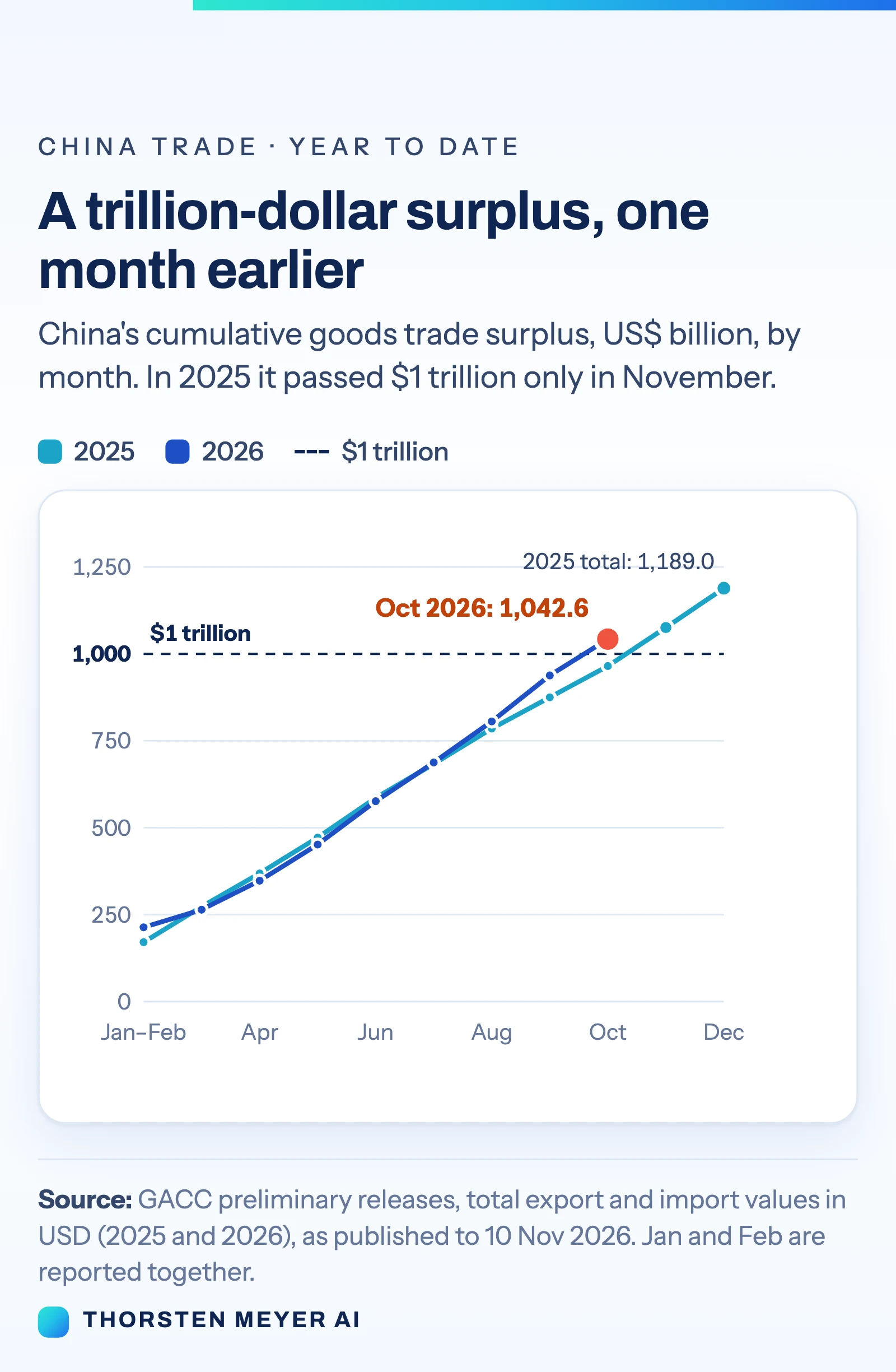
October itself was strong but not record-breaking. Exports rose 35.2% from a year earlier to $412.3 billion, and imports jumped 41.6% to $307.1 billion. The monthly surplus of $105.3 billion was smaller than September’s $133.5 billion. Reuters says exports beat economists’ forecast of a 33.5% rise, and imports beat the forecast of 32% by a wide margin.
What China is selling: the AI build-out, in customs codes
Customs tables do not have a line called “AI”. But they have the lines AI is made of: chips, computers, servers. Those are where the growth sits.
| Export category, January to October | 2025 | 2026 | Change |
|---|---|---|---|
| Integrated circuits | $161.6 bn | $341.1 bn | +111.1% |
| Computers and parts (automatic data processing machines) | $166.0 bn | $266.5 bn | +60.6% |
| Motor vehicles | $111.4 bn | $169.5 bn | +52.2% |
| Mobile phones | $94.4 bn | $107.2 bn | +13.6% |
| Garments and clothing accessories | $126.2 bn | $133.8 bn | +6.1% |
| All high-tech products | $766.1 bn | $1,132.9 bn | +47.9% |
Source: GACC preliminary release, table 5, October 2026 (USD). Values rounded to one decimal.
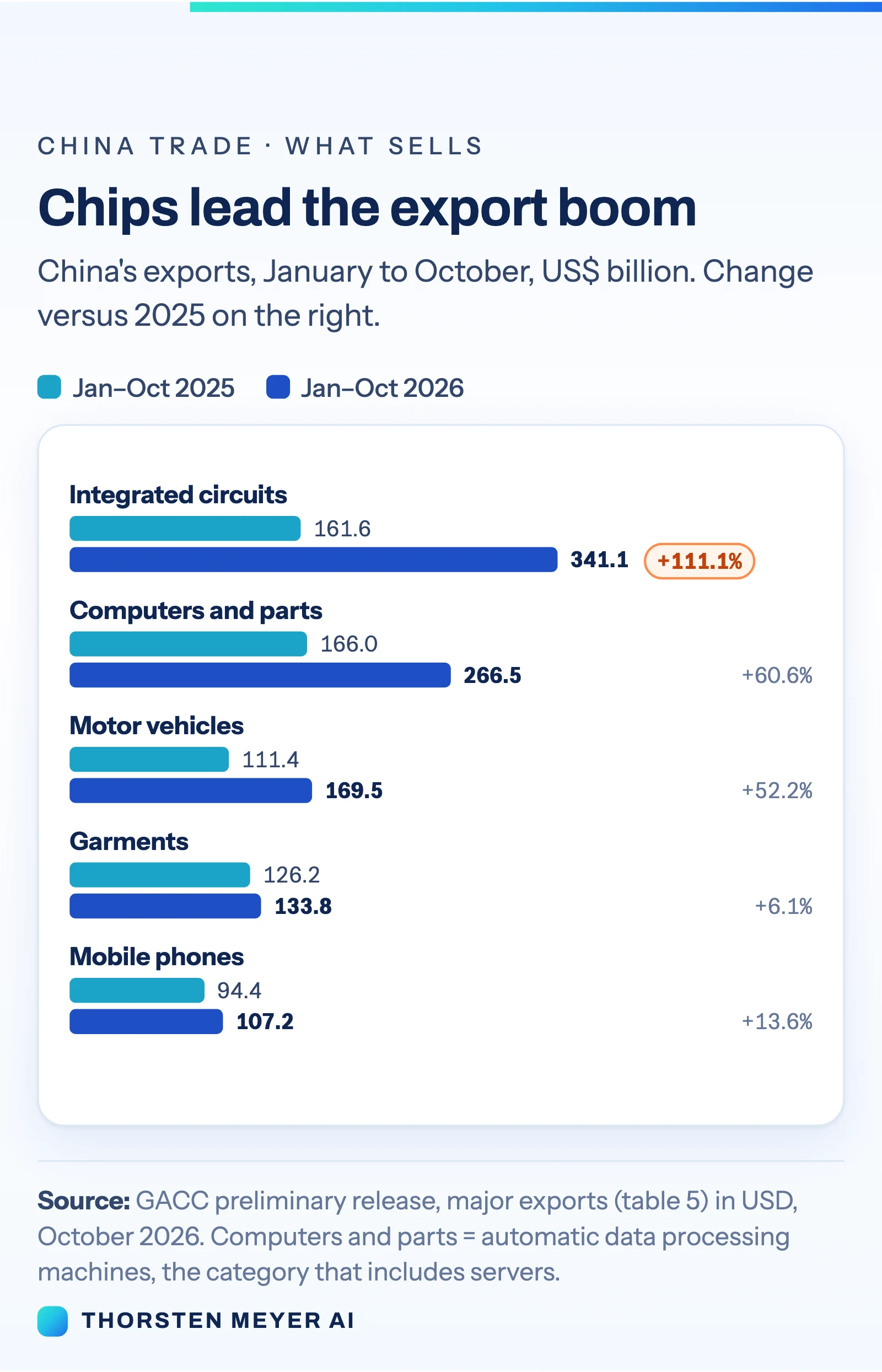
Look at the chips line more closely. The number of integrated circuits China exported rose only 3.2%. Their value rose 111.1%. Same number of chips, more than twice the money. The customs table does not say why. More expensive chips, a different mix of products or higher prices for the same parts would all fit; the data alone cannot tell them apart.
Reuters puts the cause in one sentence: “Much of the strength in exports in 2026 has been fuelled by a global push to expand AI infrastructure.” CNBC reported that much of the surge reflects demand for China’s chips and other AI-related hardware.
Who earns: follow the imports, too
A trade surplus sounds like China keeps the money. The import tables tell a more complicated story.
China imported $566.5 billion of integrated circuits in the first ten months, up 65.1%. That is far more than it exported. By my arithmetic, China’s trade deficit in chips grew from $181.5 billion to $225.4 billion. Its imports of computers and parts more than doubled, up 136.7%.
The country table shows where some of that money goes. China’s trade deficit with South Korea grew from $32.9 billion to $100.5 billion in January to October, and its deficit with Taiwan from $120.6 billion to $148.5 billion (my calculation from GACC table 4). The customs office does not break these country figures down by product, so the table alone does not prove that chips explain the change. But imports from South Korea rose 79.1% in ten months, and imports from Taiwan 29.2%.
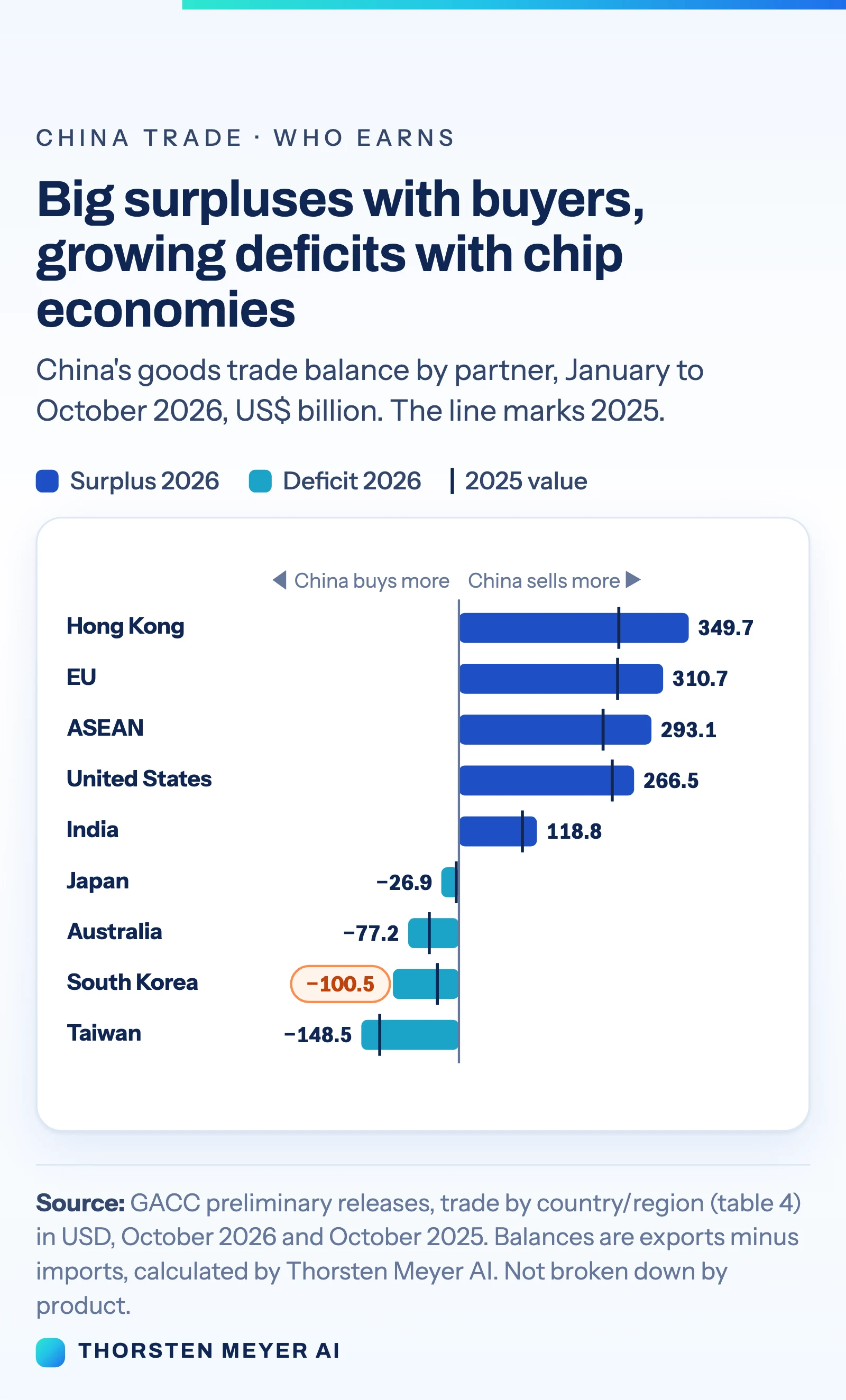
On the other side of the ledger are the buyers. China’s surplus with the EU rose from $241.6 billion to $310.7 billion, with the US from $233.4 billion to $266.5 billion, with the ten ASEAN countries from $219.4 billion to $293.1 billion, and with Hong Kong from $243.3 billion to $349.7 billion. Exports to Hong Kong rose 50.3%. Hong Kong is a major trading hub, and the table does not show where those goods end up.
So who earns from the AI hardware boom? On the evidence of China’s own trade tables: Chinese factories that assemble and ship chips, servers and computers; the suppliers in South Korea and Taiwan whose parts flow into them; and the data-center builders around the world who buy the result. The tables show money moving through all three.
The pressure points: tariffs and timing
A surplus this size does not stay a statistic. Reuters reports that it “could fuel further tensions with the EU”, where leaders have called for more trade curbs with China after an agreement with Beijing to limit Chinese exports of hybrid vehicles to the bloc. Because those measures have not taken effect, Reuters says, factories are expected to bring shipments forward.
With the US, Reuters reports that China announced on November 9 a two-month extension of the trade truce that was due to expire on November 10. Presidents Xi Jinping and Donald Trump are expected to meet at the Asia-Pacific Economic Cooperation summit in Shenzhen next week, according to Reuters.
“The risk of additional tariffs and other trade barriers will remain elevated in 2027, particularly as Chinese manufacturers continue expanding their presence in overseas markets,” Joe Peissel, lead macroeconomist at Trivium China, told Reuters.
There is also a domestic side. Reuters describes an economy “hobbled by subdued consumption and a protracted property slump”, which makes China more dependent on selling abroad. Exports carry growth that Chinese households are not providing.
And there is the obvious risk: the boom itself. “The outlook for exports depends on how long the AI boom will last,” Macquarie analysts wrote, as quoted by Reuters. They expect exports to accelerate in the fourth quarter and to start slowing from the first quarter of 2027.
What this means for businesses
Know where your AI hardware really comes from. Servers, network gear, power supplies and components often pass through Chinese factories even when the brand is not Chinese. The customs data shows that flow growing fast. If you buy compute, ask your suppliers for the country of manufacture and of final assembly, not just the brand.
Plan for tariff changes in your contracts and budgets. A two-month truce is a short horizon for a hardware purchase that takes months to deliver. Reuters quotes analysts expecting tariff risk to stay “elevated” into 2027. Who pays if duties change between order and delivery? That is a question for your contracts, and for your lawyers, not for this article.
Watch the parts you cannot replace quickly. China’s chip imports show how interlinked this supply chain is: parts from South Korea and Taiwan, assembly in China, buyers everywhere. A disruption at any point, from export controls to a regional crisis, travels down the whole chain.
If you compete with Chinese exporters in Europe, expect more trade defence debate, not less. The EU surplus figure is the one Brussels watches.
If you sell to China, the import numbers are a reminder that the country is also a huge buyer of high-tech parts, energy and raw materials. Tianchen Xu, senior economist at the Economist Intelligence Unit, told CNBC that import growth was mainly driven by demand for tech-related goods, critical minerals such as copper, and energy supplies.
What this means for users
For most people, this story arrives as hardware. The AI build-out competes for the same chips, memory and factory capacity as laptops, phones and game consoles. When one buyer group grows this fast, other buyers can feel it in availability and in price. If the tariff truces fail, import duties could add to that.
There is a quieter point too. The data centers that run the AI tools many people now use every day are built from parts that cross several borders, often more than once. This is one reason trade policy has become technology policy.
What we don’t know
- Exactly how much is “AI”. Customs codes count chips and computers, not their use. Some of the growth is phones, cars and other goods.
- Why chip values doubled while volumes barely moved. Prices, product mix or both; the tables do not say.
- Where re-exports end up. Goods shipped to Hong Kong or ASEAN countries may move on to other markets.
- Revisions. These are preliminary figures. GACC itself notes that, because of data verification after the preliminary release, “the monthly bulletin is of more accuracy.”
- How long the boom lasts. Forecasts like Macquarie’s are opinions, not data.
The bottom line
China’s trillion-dollar surplus is not just a story about cheap goods any more. Its fastest-growing exports are the building blocks of AI data centers, and its fastest-growing imports are too. That makes China both a winner of the AI boom and dependent on it, and it makes the global AI build-out dependent on a supply chain that runs through some of the world’s most sensitive trade relationships.
For more context, read how imported computer gear shows up in US growth figures, why a memory shortage could reach phones and PCs, and how China blocked SoftBank’s ABB robotics deal.
I’m Thorsten Meyer. The full sources are below, and more reality checks are at thorstenmeyerai.com.
Sources
- General Administration of Customs of the People’s Republic of China (GACC), preliminary release, October 2026, in USD: (1) Total export and import values; (4) by country/region; (5) major exports; (6) major imports. Published November 10, 2026, english.customs.gov.cn
- GACC, preliminary releases 2026 (February to September) and 2025 (February to December), table (1) in USD, for the year-to-date balances, english.customs.gov.cn
- GACC, October 2025 preliminary release, table (4) in USD, for the 2025 comparison by partner, english.customs.gov.cn
- Reuters via The Straits Times: “China’s trade surplus soars past US$1 trillion as AI boom powers exports”, November 10, 2026 (also published by CNA and the New Straits Times)
- CNBC: China October trade data report, November 10, 2026
- China Daily and Global Times: reports on the GACC release in yuan terms, November 10, 2026
Researched and drafted with AI assistance, including Anthropic’s Claude. No government or company named here reviewed or sponsored this article. Not investment, trade-compliance or legal advice. Figures are preliminary customs data as published on November 10, 2026; shares, differences and balances by partner are my arithmetic from the official tables. Images: AI-generated illustration (Runware) and graphics by Thorsten Meyer AI; no real ports, people or logos are shown.