
By Thorsten Meyer — May 2026
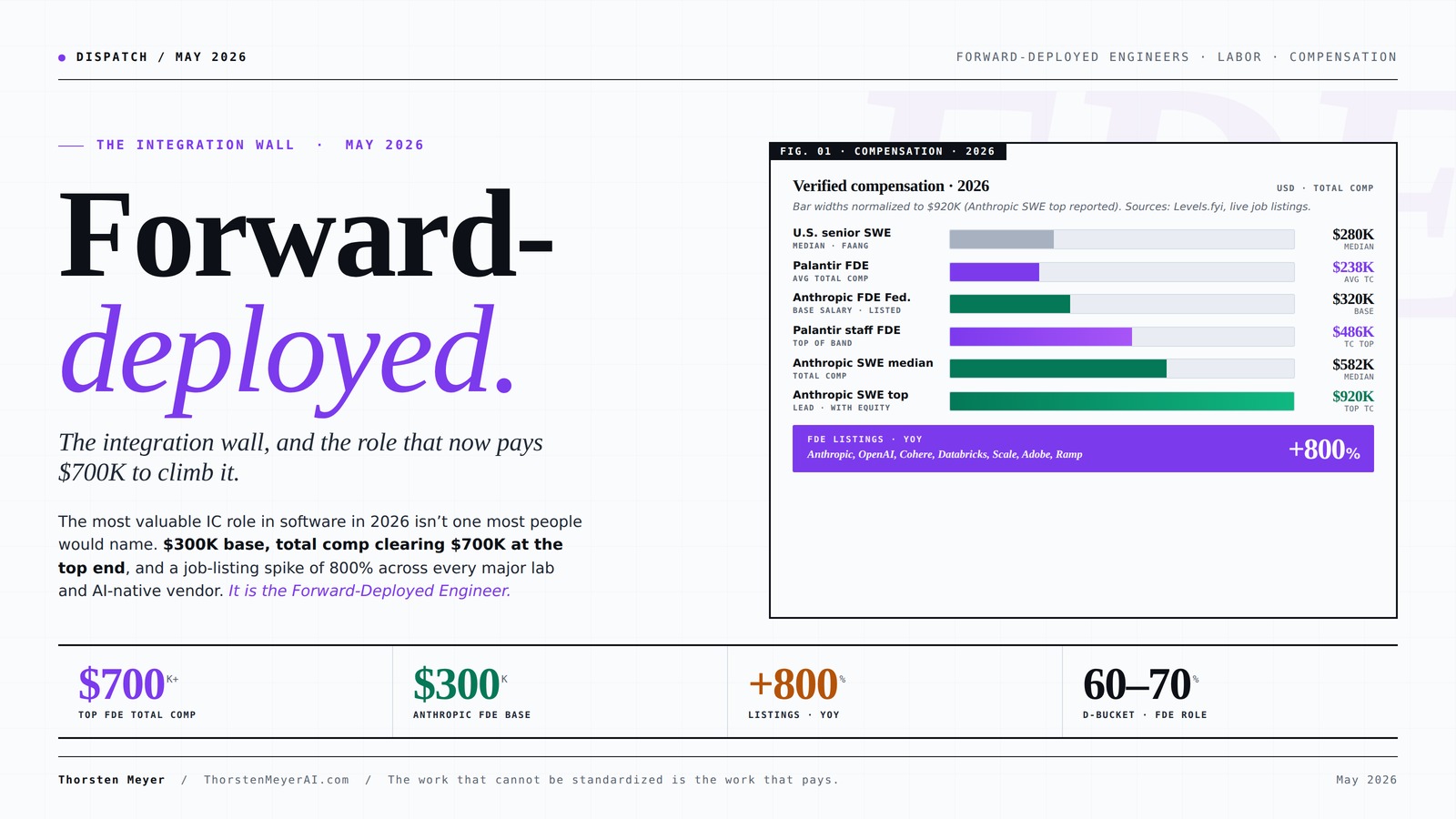
The most valuable IC role in software in 2026 is not one most people would name if asked. It is not a senior staff engineer at FAANG. It is not a frontier-lab research scientist. It is a job title that did not exist as a category five years ago and which, today, commands $300K base salaries and total compensation packages that clear $700K at the top end.
It is the Forward-Deployed Engineer.
Anthropic is currently hiring multiple FDE roles. The Federal Civilian listing alone offers $280K–$320K base. Anthropic’s Applied AI FDE listing — the role that puts engineers inside the company’s most strategic enterprise customers — is uncapped on equity. Palantir, which invented the function, pays an average of $238K total compensation for an FDE, with staff-level FDEs clearing $630K. OpenAI, Cohere, Databricks, and Scale AI all run their own forward-deployed motions. Job listings for the role have spiked 800% in twelve months.
This is not a coincidence. It is the structural answer to every previous dispatch in this series.
The agent supply chain that compromises through OAuth scope. The open-weight inflection that re-prices the model layer. The 47.9% / 9% layoff narrative gap. The enterprise platform race. The productivity-expectation bubble. The agent trap. The PE channel acquisition.
All of these forces share one trait: they describe what happens to standardized work in a market where standardized work is being repriced to near-zero. The role that emerges on the other side — the role that captures the value those forces are creating — is the role that can do the part standardized work cannot: walk into a customer’s environment, understand the specific accumulated mess of their stack, and ship something that works.
That role is the FDE. And it is now the highest-paid IC role in tech.
Forward-deployed.
The integration wall, and the role that now pays $700K to climb it.
The most valuable IC role in software in 2026 is not one most people would name. It is not a senior staff engineer at FAANG. It is not a frontier-lab research scientist. It is a job title that didn’t exist as a category five years ago and which, today, commands $300K base salaries and total compensation packages clearing $700K at the top end. It is the Forward-Deployed Engineer.
Most AI projects don’t fail at the model. They fail at the wall.
Getting the demo working in a sandbox is roughly 20% of the project. The other 80% is enterprise SSO, brittle ETL pipelines, regulatory constraints, data residency, and the politics of getting production credentials from a security team that has never heard of the vendor. No amount of prompt engineering fixes any of those problems.

Big Data Analytics: From Strategic Planning to Enterprise Integration with Tools, Techniques, NoSQL, and Graph
As an affiliate, we earn on qualifying purchases.
As an affiliate, we earn on qualifying purchases.
The work that climbs the wall pays accordingly.
Levels.fyi and live job listings as of May 2026. The premium is real, persistent, and structural. Open-weight models commoditize the model layer; they do not commoditize the engineer who deployed it inside a Fortune 500 health-insurance back office.

Ai Automation Kit PLC Programming Software, Logic Function HMI, Run Simulator
1 PLC Controller
As an affiliate, we earn on qualifying purchases.
As an affiliate, we earn on qualifying purchases.
The FDE role is the inverse of every other senior IC bucket mix.
Last week’s personal-audit dispatch introduced the four-bucket taxonomy: Theatre, Commodity, On-the-line, Durable. Most senior IC roles audit to ~25/30/25/20. The FDE role inverts almost completely. This is why the role pays what it pays.
Most weeks · 80% on thin ice.
- TTheatre · status · slide refresh~25%
- CCommodity · routine code · templates~30%
- LOn-the-line · contested judgment~25%
- DDurable · context · relationships~20%
The week, flipped.
- TThe customer needs results, not status<5%
- CBespoke integrations resist templating<10%
- LJudgment under enterprise ambiguity~25%
- DCustomer-specific · accumulating · yours~60%

ASUS Ascent GX10 Personal AI Supercomputer, NVIDIA GB10 Grace Blackwell Superchip, 128GB LPDDR5x Unified Memory, 2TB NVMe SSD, DGX OS, Wi-Fi 7, 10GbE, AI Workstation for Local LLM and RAG
[Personal AI Supercomputer]: Built for AI developers, researchers, data scientists, startup labs, and university labs, the ASUS Ascent…
As an affiliate, we earn on qualifying purchases.
As an affiliate, we earn on qualifying purchases.
Three reasons the FDE premium does not mean-revert.
The wall doesn’t shrink as models improve.
Capability gains accrue at the model layer. They do not accrue at the customer’s 12-year-old SQL warehouse, OIDC federation trust, or data residency contract. The wall stays the same height regardless.
Labs cannot vertically integrate the function.
A model lab employs a few hundred FDEs before HR overhead breaks. The Anthropic × Wall Street $1.5B JV is the explicit acknowledgement: scale requires a separate organizational entity. Specialized firms compete for the same talent the labs draw from.
The credentials cannot be machine-generated.
A CIO putting production data through a Claude-based runtime wants a human in the room with personal accountability. The FDE is the insurance certificate. There is no version where the customer accepts an LLM doing the same job, regardless of capability.

Reusable Firmware Development: A Practical Approach to APIs, HALs and Drivers
As an affiliate, we earn on qualifying purchases.
As an affiliate, we earn on qualifying purchases.
Eight major shops. One talent pool.
The same people are competing for the same 200 candidates.
The talent pool, in practice, comes from three sources: former technical founders, existing FDE-shop alumni (Palantir, Scale, Databricks), and senior engineers from consulting backgrounds. The standard university-to-FAANG-to-startup pipeline does not produce candidates for this role. The pipeline does not yet exist.
The work that cannot be standardized is the work that pays. The FDE is what that work looks like in 2026.
Four assignments. By role.
If your audit came back with D < 15%, this is the cleanest inversion.
Anthropic, OpenAI, Cohere, Databricks, Scale, Adobe, Ramp are all hiring. Read the listings before you decide it’s not for you — most are wider than the title suggests. Former technical founders explicitly encouraged.
If you don’t have an FDE function, the customer-shaped value is leaking elsewhere.
The competing model lab’s FDE is sitting in your customer’s office right now, learning your customer’s stack, and earning standing your engineers wish they had.
The FDE unit economic looks unusual on first inspection.
$700K total comp against $5M–$25M of customer expansion ARR is a different economic than a senior platform engineer. The ROI is legible only if it’s measured. Most finance teams have not yet built the model.
Your existing pipeline doesn’t produce this hire.
If your firm recruits seniors via the university-to-FAANG-to-startup track, you are not in this market. You will need to build a different pipeline — or pay the premium to recruit from the existing one.
Executive Summary
| Metric | Q2 2026 |
|---|---|
| Anthropic FDE Federal Civilian base salary | $280K–$320K |
| Anthropic Applied AI FDE | Open — total comp expected $400K+ |
| Palantir FDE avg total compensation | $238K (range $205K–$486K) |
| Palantir staff-level FDE | $630K+ |
| Anthropic median software engineer total comp | $582K |
| Anthropic top SWE comp | $756K–$920K |
| FDE job listings YoY change | +800% |
| Companies hiring FDEs | Anthropic, OpenAI, Cohere, Databricks, Scale AI, Adobe, Ramp, others |
| Typical FDE bucket mix (per the audit framework) | ~60–70% D / 20–30% L / <10% C / <5% T |
| What McKinsey/Bain/BCG cannot do that an FDE can | Ship production code into client systems |
The FDE is the highest-D role in modern software. It is also structurally scarce, because the supply pipeline for it does not exist inside any traditional career track.
1. The Integration Wall Is the Whole Job
Most AI projects that fail in 2026 do not fail because the model is bad.
They fail because the model has to talk to a legacy SQL database that was migrated three times in the past decade, handle OIDC/SAML authentication that the customer’s security team only half-documented, meet data residency requirements written in a procurement contract nobody at the customer can locate, and survive a production cutover that the customer’s CIO has pushed back twice already.
This is the integration wall. Getting the demo working in a sandbox is roughly 20% of the project. The other 80% is navigating enterprise SSO, brittle ETL pipelines, regulatory constraints, and the politics of getting production credentials from a security team that has never heard of the vendor.
No amount of prompt engineering fixes any of those problems. No amount of model capability fixes them either. What fixes them is a person on-site, with production access, who can ship code, who knows what an Active Directory federation trust actually does in practice, and who has the standing to walk into the customer’s security review and explain why the deployment satisfies the threat model.
The FDE is that person.
The label is new. The function is older — Palantir invented it in the late 2000s when their analytics platform kept failing to deploy at government and intelligence customers because the customers’ data was unique, the auth requirements were unique, and the workflows were unique. Palantir solved this by sending engineers on-site, indefinitely, with the explicit charter to make the platform work inside the customer’s specific environment. The role evolved from “a deployment engineer” to “an engineer who is structurally embedded in the customer’s organization.”
In 2026, every AI lab and AI-native enterprise tooling vendor is rebuilding this motion at scale. Because the integration wall — for AI products — is bigger than it ever was for analytics.
2. Why the Consulting Firms Cannot Do This
The natural question is: hasn’t this always been a consulting problem? Don’t McKinsey, Bain, and BCG already do this work?
The answer, structurally, is no. Consulting firms cannot do FDE work because of what they are.
A consulting partner sells process, methodology, and recommendations. The deliverable is a deck, an organizational design, a workshop, a strategic memo. The consulting firm specifically does not ship code into the customer’s production systems. There are insurance reasons, partnership-structure reasons, and liability reasons for this. The McKinsey engagement letter explicitly excludes anything that would put McKinsey on the hook for a production system failure.
This is not a defect in McKinsey. It is the entire structure of the consulting business. The model is professional services with high margins. Production responsibility breaks the model.
The FDE function is the inverse. The deliverable is shipped code. Working agents. MCP servers, sub-agents, agent skills (per Anthropic’s own job description), running inside the customer’s environment, surviving the customer’s security review, integrated with the customer’s authentication and data residency stack. The FDE owns the production outcome. If it does not work, the FDE is on the hook.
The consulting firms have responded — McKinsey QuantumBlack, BCG X, Bain’s AI/Vector practice — by partnering with implementation specialists and acquiring small engineering shops. They are real moves. They are not equivalent moves. The structural fact is that an FDE function inside a model lab combines three things — production code shipping authority, deep model expertise, and customer-side credibility — that the consulting firm structurally cannot combine without becoming a different kind of firm.
The PE channel acquisition documented in The Channel Move is the explicit institutional version of this realization. Blackstone, Hellman & Friedman, Goldman, and Anthropic did not put $1.5B into a McKinsey-style consulting partnership. They put it into a forward-deployed-engineer joint venture. Because the deliverable they need — Claude running in production inside thousands of portfolio companies — is a deliverable a consultancy cannot ship.
3. The FDE Bucket Mix · the Inverse of Most IC Roles
The Quiet Audit published last week introduced a four-bucket taxonomy for any knowledge-work role: Theatre, Commodity, On-the-line, and Durable. Most senior IC roles, audited honestly, come out at roughly 25/30/25/20 — with the durable bucket the smallest.
The FDE role inverts this almost completely.
| Bucket | Typical senior IC | Typical FDE |
|---|---|---|
| T · Theatre | 20–25% | <5% — the customer needs results, not status meetings |
| C · Commodity | 25–35% | <10% — bespoke integrations resist templating |
| L · On the line | 25–30% | 20–30% — judgment calls under ambiguity |
| D · Durable | 15–20% | 60–70% — context, relationships, decisions that compound |
This is why the role pays what it pays. It is also why the role is scarce. Most existing senior engineers, asked to run a year-long embed at a single customer, are not equipped for it. The skills required are partially engineering, partially diplomacy, partially product management, partially customer success. The standard career pipeline for senior engineers does not produce people who have been asked to do all four at once.
The talent pool, in practice, comes from three sources:
- Former technical founders, who already know how to operate under ambiguity inside someone else’s organization.
- Engineers from existing FDE shops (Palantir, Scale, Databricks) who already speak the function’s language.
- Senior engineers from consulting backgrounds, where the customer-side standing is real but the production-shipping muscle has to be rebuilt.
Anthropic’s own job descriptions specify “3+ years of experience in a technical, customer-facing role such as Forward Deployed Engineer, or as a Software Engineer with consulting experience. Former technical founders are also encouraged to apply.” The hiring market is small enough that the major labs are recruiting from the same handful of pools.
4. The Career Math for the IC Reading This
If you ran the audit from last week’s dispatch and your D-bucket came out below 15%, the FDE direction is one of the cleanest available inversions of your current role mix.
Three structural reasons.
Reason 1 · The work is high-D by definition. Customer-specific judgment, accumulated context inside a single account, relationships built over months, decisions about what not to build for this customer. None of these are templatable. None of them get repriced by a token cost decline. None of them get absorbed by a chat box wired to OAuth.
Reason 2 · The compensation premium is real and persistent. Palantir staff FDEs at $630K+, Anthropic FDE base at $280K–$320K with significant equity upside, OpenAI’s Solutions Engineering motion paying comparably. The premium exists because the function captures value the model layer cannot capture. Open-weight models can replicate the model. They cannot replicate the engineer who deployed the model into a Fortune 500 health-insurance back office.
Reason 3 · The exit options compound. An FDE who ran a 12-month embed at a major bank ends up with three career paths: stay at the model lab and lead the bank vertical, leave to become a senior IC inside the bank at a meaningful premium, or leave to start a vertical-specific AI company with a customer who already wants to be the first design partner. All three paths are durable. None of the three is available to the senior IC who spent the year shipping platform code in a frontier lab without ever speaking to a customer.
The trade-off is that the role is hard, the travel is real, the customer politics are real, and the comfort of the platform-engineering identity is gone. If you have spent ten years writing the kind of code that other engineers read, the FDE transition asks you to write code that customers’ security teams audit and customers’ CFOs sign off on. Different muscle. Different career.
The ones who make the transition early are the ones for whom the audit produced a low-D number and the L-bucket compression felt imminent. The ones who do not make it are the ones who told themselves, in the audit, that their L-bucket was actually D.
5. Why This Structurally Will Not Cool
The temptation is to read the FDE compensation premium as a 2026 spike that mean-reverts. It will not. Three structural reasons.
Structural reason 1 · The integration wall does not get smaller as models get better. Capability gains accrue at the model layer. They do not accrue at the customer’s specific authentication setup, data residency contract, or 12-year-old SQL warehouse. The wall stays the same height regardless of what the model can do.
Structural reason 2 · The labs cannot vertically integrate the function. A model lab employs a few hundred FDEs at most before the function exceeds the lab’s HR overhead. Anthropic’s $1.5B PE joint venture is the explicit acknowledgement that the FDE function needs a separate organizational entity to scale across thousands of customers. The math forces the role into specialized firms; the specialized firms then compete for the same talent pool the labs draw from.
Structural reason 3 · The credentials cannot be machine-generated. A customer’s CIO who is being asked to put production data through a Claude-based agent runtime wants the FDE in the room to have personal accountability. That accountability requires a human with reputation, prior projects, and a track record that survived audit. There is no version of this where the customer accepts an LLM doing the same job, regardless of how capable the LLM becomes. The CIO is buying insurance, and the FDE is the insurance certificate.
The premium might compress slightly as the talent pool grows. It will not compress to senior IC parity, because the function is structurally different from senior IC work. The premium reflects an economic reality: the integration wall is the bottleneck, the FDE removes it, and the marginal value of removing it for an enterprise customer is in the millions.
What to Do This Quarter
1. Senior ICs: If your audit came back with a D-bucket below 15%, the FDE direction is one path that re-stacks your bucket mix toward durability without leaving software engineering. Anthropic, OpenAI, Cohere, Databricks, Scale, Ramp, and Adobe are all hiring. Read the job descriptions before you decide it is not for you — most are wider than the title suggests.
2. Engineering leaders: If you run a senior engineering team and you do not yet have an FDE function, the customer-shaped value your team produces is leaking somewhere it can be captured. The competing model lab’s FDE is sitting in your customer’s office right now, learning your customer’s stack, and earning the standing your engineers wish they had.
3. CFOs: Per-FDE economics are unusual — a $700K total compensation package against $5M–$25M of customer expansion ARR is a different unit economic than a senior platform engineer. The ROI is legible, but only if it is measured. Most finance teams have not yet built the model.
4. CHROs: The FDE talent pool is being drained from technical-founder ranks, ex-Palantir engineers, and senior consultants. If your firm hires senior engineers through the standard university-to-FAANG-to-startup pipeline, you are not in this market. You will need to build a different pipeline — or pay the premium to recruit from the existing one.
The Strategic Read
The dispatches that came before this one have all been describing forces acting on standardized work. The agent supply chain compromise made standardized OAuth tokens the new perimeter. The open-weight inflection made standardized model output a commodity. The layoff narrative gap made standardized roles the most-talked-about and most-displaced. The enterprise platform race made standardized agent governance the next moat. The productivity bubble made standardized executive expectations the under-priced risk. The agent trap made standardized features dressed as platforms the procurement landmine. The PE channel acquisition made standardized deployment the wholesale path into the real economy.
This dispatch is about what is left when standardized work has been priced.
What is left is the work that cannot be standardized. It is bespoke. It is contextual. It is built once, for one customer, by a person who took the time to learn that customer’s specific environment in detail. It is the integration that the integration wall demanded. It is the FDE.
The compensation numbers — $700K, $920K, the 800% spike in listings — are not the headline. They are the symptom. The headline is that the structural shape of value capture in software is moving from “build a product that scales” to “deploy a system that fits this customer.” The first kind of value is what models, frameworks, and platforms do. The second kind is what humans, embedded, do. And in 2026, the second kind is the kind that pays.
If you have spent ten years getting good at the first kind, and your audit suggests the role is compressing under you, the second kind is the move. The career math is legible. The compensation premium is verifiable. The integration wall is the same height it has always been. The labs are hiring. The PE firms have already paid $1.5B to scale the function.
The role does not have a cool name yet. That is part of why it pays what it pays.
The work that cannot be standardized is the work that pays. The FDE is what that work looks like in 2026.
About the Author
Thorsten Meyer is a Munich-based futurist, post-labor economist, and recipient of OpenAI’s 10 Billion Token Award. He spent two decades managing €1B+ portfolios in enterprise ICT before deciding that writing about the transition was more useful than managing quarterly slides through it. More at ThorstenMeyerAI.com.
Related Dispatches
- Your AI Vendor’s AI Vendor — agent supply chain compromise (Vercel × Context AI)
- Single Digits — the April 2026 open-weight inflection
- AI-Washed — the 47.9% / 9% layoff narrative gap
- The 27% Problem — Anthropic’s enterprise lead and Google’s $750M check
- The Bubble Is Not in Valuations — the productivity gap
- The Agent Trap — why 90% of AI launches are infrastructure liars
- The Channel Move — Anthropic × Wall Street PE channel acquisition
- The Quiet Audit — the personal audit framework (publishing this week on ThorstenMeyerAI.com)
Sources
- Anthropic, Forward Deployed Engineer, Applied AI job listing (greenhouse.io, accessed 2026-05)
- Anthropic, Forward Deployed Engineer, Federal Civilian job listing (ZipRecruiter, accessed 2026-05)
- Levels.fyi, Anthropic Software Engineer compensation (accessed 2026-05-05)
- Hashnode, The Complete 2026 Guide to the Forward Deployed Engineer (2026-02)
- Palantir, Forward Deployed Engineer compensation data (Levels.fyi)
- jobsbyculture.com, Anthropic Salary 2026 (2026-03-28)
- Internal series synthesis (prior ThorstenMeyerAI.com dispatches, 2026-04 / 2026-05)