

Deepfakes are evolving rapidly, with projections of over 8 million AI-generated fake videos by 2025. They can convincingly manipulate opinions, threaten security, and erode trust in media and institutions. While the hype emphasizes their risks, advances in detection and awareness are vital for resilience. Understanding the true impact involves recognizing both the technological challenges and societal responses. Explore further to uncover how society is fighting back and what steps you can take to stay informed.

Get business pricing on tech for your team
- Business-only prices and quantity discounts
- Tax-exempt purchasing
- Multiple users, one account, clear invoices
Key Takeaways
- While deepfake technology is advancing rapidly, widespread public trust erosion remains limited due to low detection awareness.
- Deepfakes pose significant threats in fraud and misinformation but are not yet causing widespread societal distrust.
- The hype often overstates current capabilities; many high-quality fakes are still detectable with proper tools.
- Increased awareness, detection methods, and regulation can mitigate trust issues rather than eliminate all risks.
- Overall societal trust remains relatively resilient, but unchecked deepfake proliferation could undermine confidence over time.
As an affiliate, we earn on qualifying purchases.
The Growing Tide of Deepfake Files and Their Impact

The number of deepfake files is skyrocketing, with projections reaching 8 million by 2025—up from just 500,000 in 2023. This rapid growth means you’re likely to encounter more synthetic videos and audios in everyday life. As the volume increases, so does the risk of misinformation, scams, and malicious manipulation. You might not realize how widespread these deepfakes are until you see their impact firsthand. The technology behind them is evolving fast, making detection increasingly difficult. With more content circulating online, distinguishing real from fake becomes a challenge for everyone. Businesses, governments, and individuals face mounting pressure to stay vigilant, as the sheer scale of deepfake files amplifies their potential to deceive and disrupt trust across sectors. Deepfake detection tools are continually being developed to combat this growing threat, but their effectiveness varies.
biometric authentication security tools
As an affiliate, we earn on qualifying purchases.
As an affiliate, we earn on qualifying purchases.
Common Use Cases and the Rising Threat Landscape

You should be aware that deepfakes are increasingly used for biometric fraud, making it harder to verify identities and protect sensitive data. Political manipulation via deepfake videos is rising, threatening trust in public institutions and elections. Additionally, fake voice scams are growing rapidly, with malicious actors using synthetic voices to commit financial fraud and deceive individuals. The proliferation of deepfake technology also underscores the importance of space and organization in detecting and preventing misuse.
Biometric Fraud Trends
Biometric fraud has become a growing concern as deepfake technology advances, with malicious actors increasingly exploiting it to bypass security measures. You might not realize how easily deepfakes can manipulate facial recognition, voice authentication, or fingerprint scans. As these tools evolve, scammers use realistic fakes to impersonate individuals and gain unauthorized access. The risk is especially high in sectors like banking and government, where identity verification is essential.
- Deepfakes now account for 40% of biometric fraud attempts
- Attackers use synthetic voices for financial scams
- Facial deepfakes bypass face recognition systems
- Fraudulent fingerprint videos challenge biometric sensors
- Criminals leverage AI to craft convincing fake IDs
Staying ahead requires advanced detection and continuous vigilance.
AI Security developments emphasize the importance of ongoing monitoring and robust safety measures to combat these evolving threats.
Political Manipulation Risks
As deepfake technology becomes more sophisticated, its potential to influence political landscapes grows considerably. You might see false videos of politicians making controversial statements or engaging in scandals that never happened. These manipulations can sway public opinion, undermine trust in leaders, and even disrupt elections. Deepfakes make it easier to spread misinformation quickly and convincingly, often before authorities can verify authenticity. The rise of such content fuels polarization and erodes confidence in political processes. You may also encounter fake speeches or interviews designed to mislead voters or manipulate public sentiment. As these threats increase, you need to stay vigilant, question suspicious content, and rely on trusted sources to verify information—because deepfakes threaten to distort political realities and threaten democratic stability. Additionally, the increasing availability of verified information is crucial to counteract these deceptive practices and maintain trust.
Fake Voice Scams
Have you noticed how synthetic voice scams are increasingly infiltrating financial and insurance sectors? You might get a call from someone claiming to be your CEO or bank officer, asking for urgent transfers or personal info. These scams exploit deepfake voice technology to sound convincing and trustworthy. The threats are rising fast, with fraud attempts increasing by 475% in insurance in 2024. Here’s what you should watch for:
- Impersonation of executives or authority figures
- Urgent requests for money or confidential info
- Calls from unfamiliar or suspicious numbers
- Voice tone and phrasing that feels off or inconsistent
- Pressure tactics to rush decisions
- The importance of color accuracy in assessing the authenticity of voices and images.
Stay alert, verify identities through multiple channels, and never share sensitive info over a single call. Voice scams are a growing danger you can’t ignore.
As an affiliate, we earn on qualifying purchases.
Public Awareness and the Challenges of Detection

Public awareness of deepfakes remains surprisingly low, despite their rapid proliferation and growing threat to trust and security. You might know about fake images or videos, but only 71% of people globally are aware of what deepfakes are, and just 0.1% can reliably detect them. Human detection accuracy is also limited, with only 24.5% correctly identifying high-quality deepfakes. This knowledge gap makes it easier for malicious actors to spread false information or commit fraud. Meanwhile, 60% of organizations feel unprepared to combat these threats, and only 29% have taken concrete steps to protect themselves. Without increased awareness and better detection tools, deepfakes will continue to undermine trust across social, political, and economic spheres. Additionally, advancements in generative AI in media and entertainment could further complicate the ability to distinguish authentic content from manipulated media.
As an affiliate, we earn on qualifying purchases.
Economic Consequences and Future Projections

You should be aware that deepfake-related financial losses are expected to skyrocket, with projections indicating fraud costs could reach $40 billion annually by 2027. As technology advances, the economic risks will intensify, making it harder for businesses and individuals to protect themselves. This trend signals a growing threat to global economic stability if effective mitigation strategies aren’t implemented promptly. Additionally, the rise of Relationship – Personality Test insights can help in developing better detection and prevention techniques to combat deepfake frauds.
Rising Financial Losses
Financial losses caused by deepfake-related scams are escalating rapidly, threatening both individuals and organizations. These scams can drain resources, damage reputations, and erode trust in digital systems. As deepfake technology becomes more sophisticated, the potential financial impact grows. You should be aware that:
- Businesses lost nearly $500,000 on average per deepfake incident in 2024
- Fraud attempts increased by 3,000% in 2023, with losses climbing accordingly
- The financial sector accounts for about 6.5% of all fraud attacks involving deepfakes
- Deloitte predicts U.S. fraud losses could reach $40 billion by 2027
- Deepfake scams are targeting individuals through cloned voices, causing personal financial harm
- The use of essential oils for health concerns highlights how misinformation can also influence perceptions of safety and trust.
These trends suggest that without increased safeguards, financial costs will continue rising, affecting your security and stability.
Future Economic Risks
As deepfake technology continues to advance, the economic risks it poses are set to grow exponentially. You’ll see fraud losses skyrocket, with predictions suggesting U.S. fraud costs could reach $40 billion by 2027, up from $12.3 billion in 2023. Businesses face mounting expenses, averaging nearly $500,000 per deepfake incident, threatening financial stability. The financial sector remains particularly vulnerable, accounting for 6.5% of all fraud attacks. Fraudsters will increasingly target individuals using cloned voices and manipulated videos, amplifying personal losses. As deepfake volumes increase by 900% annually, public trust erodes, and regulatory bodies struggle to keep pace. If these trends continue, economic instability and widespread financial disruption are inevitable, underscoring the urgent need for robust detection and preventative measures. Additionally, the rising sophistication of deepfake technology calls for increased awareness and awareness campaigns to educate the public and businesses about potential threats.
Technological Advances and Social Manipulation Risks
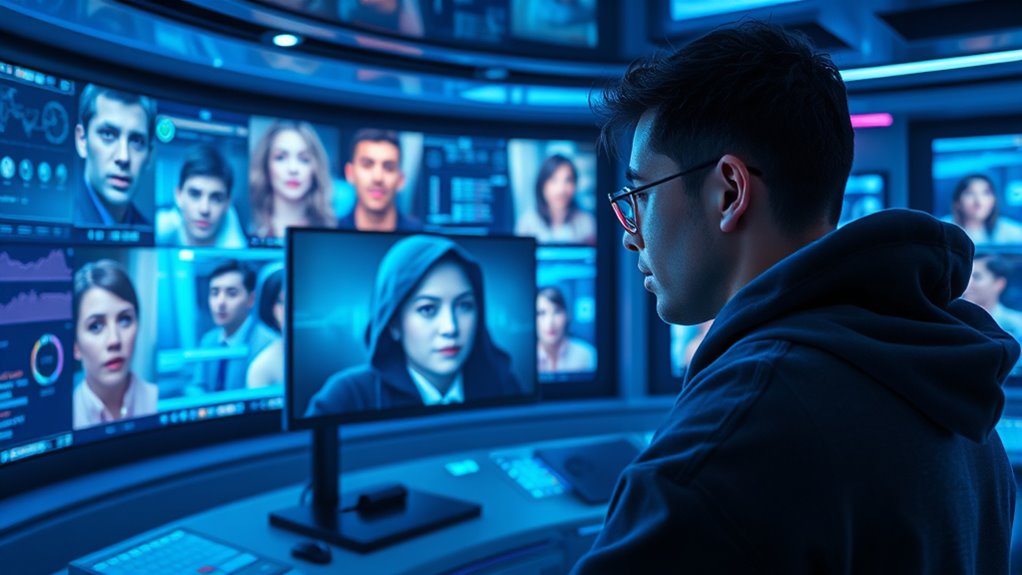
Technological advances in deepfake creation have reached a level of sophistication that makes distinguishing real from fake increasingly difficult. You now face highly realistic videos and audio that can manipulate perceptions instantly. These advances enable:
- Rapid production of convincing deepfakes, spreading misinformation faster
- Use of emotionally impactful formats to sway public opinion
- Increased use of deepfakes for political and social manipulation
- Growing difficulty for detection tools to keep up with evolving techniques
- Widespread proliferation, with deepfake videos increasing by 900% annually
As a result, social manipulation risks grow, threatening trust in media, institutions, and even personal relationships. The more realistic these fakes become, the harder it is to verify truth, amplifying concerns about deception and societal division.
Strategies for Mitigation and Building Resilience

To effectively counter the rising sophistication of deepfake technology, organizations and individuals must adopt thorough mitigation strategies. You should invest in advanced detection tools that can identify high-quality deepfakes more accurately and quickly. Educate yourself and your team on recognizing warning signs of manipulated content, such as inconsistencies or unnatural movements. Building resilience also requires establishing clear policies for verifying information, especially in critical sectors like finance and politics. Collaborate with industry peers and regulators to develop and adopt standards for authenticity and accountability. Public awareness campaigns can help users become more skeptical of suspicious content. Finally, advocate for stronger legal frameworks that penalize malicious deepfake use, reinforcing the importance of responsible AI development and usage.
Frequently Asked Questions
How Effective Are Current Deepfake Detection Methods?
Current deepfake detection methods are only about 24.5% effective against high-quality videos, so you can’t rely solely on human judgment. You need advanced technological tools because deepfake technology is evolving rapidly. Organizations are investing in better detection systems, but many still feel unprepared. To stay protected, you should combine multiple approaches, including AI-driven detection and public education, since no single method guarantees accuracy yet.
What Legal Measures Exist Against Deepfake-Related Crimes?
Legally, you’re steering a minefield, with laws like the U.S. DEEPFAKES Accountability Act and California’s AB 730 trying to catch up. These measures criminalize malicious deepfake creation and distribution, impose penalties, and require transparency. However, the rapid evolution of deepfake tech often outpaces legislation, leaving gaps. Countries are working on regulation, but enforcement remains a challenge, so staying informed and cautious is your best defense against these digital wolves in sheep’s clothing.
Can Ai-Generated Content Be Reliably Distinguished From Real Media?
You can’t reliably distinguish AI-generated content from real media yet. As deepfake technology advances rapidly, detection tools struggle, with human accuracy only around 24.5%. Public awareness is limited, and most people can’t identify fakes confidently. This makes it easy for malicious actors to deceive, so staying cautious and using advanced detection methods is essential to avoid being duped by convincing AI-created media.
How Do Deepfakes Influence Political and Societal Trust?
Deepfakes substantially erode political and societal trust by spreading false information and manipulating public perception. You might find it harder to distinguish truth from fiction, which fuels skepticism and distrust in leaders, media, and institutions. As deepfake technology advances, its use in misinformation campaigns increases, making it even more challenging for you to rely on authentic sources. This growing mistrust can polarize communities and weaken the foundation of democratic processes.
What Role Does Public Education Play in Combating Deepfake Risks?
Public education plays a pivotal role in combating deepfake risks by increasing your awareness of what deepfakes are and how to identify them. When you learn about their features and limitations, you become less vulnerable to manipulation. Educating yourself and others helps build resilience against misinformation, making it harder for malicious actors to exploit deepfakes. Ultimately, an informed public strengthens trust and supports efforts to develop better detection tools and regulations.
Conclusion
Remember, a lie can travel halfway around the world while the truth is putting on its shoes. As deepfakes become more sophisticated, stay vigilant and informed. Trust is fragile, but by understanding the risks and adopting proactive measures, you can help preserve it. Don’t let the hype overshadow the reality — with awareness and resilience, you can navigate this new digital landscape and protect what matters most.
Fall Picks
fall essentials
As an affiliate, we earn on qualifying purchases.