By Thorsten Meyer — May 2026
There are 140+ free Agent Skills on community marketplaces today. There are 17 Anthropic-published official skills under Apache 2.0 in github.com/anthropics/skills. There is an Anthropic partner directory listing skills from Atlassian, Canva, Cloudflare, Figma, Notion, Ramp, and Sentry. There is a published open standard at agentskills.io that OpenAI’s Codex CLI adopted within months. Microsoft, Google, and Vercel are all publishing skill collections.
The directory layer exists. The marketplace layer does not.
There is no skills equivalent of the App Store. No revenue share. No vetted-author verification. No security audit pipeline beyond “trust the source.” No cross-surface portability — a skill uploaded to Claude.ai is not available via the API, and vice versa. No discovery beyond GitHub stars and word of mouth. No paid skills at all.
This is the gap. And the company that closes it captures the most defensible position in the post-model-commoditization AI stack.
The dispatch on the agent trap flagged skills as the portable infrastructure layer that survives a model swap. The dispatch on the open-weight inflection showed why model differentiation is compressing. The dispatch on the 27% problem showed enterprise distribution as the new moat. This piece is about what sits on top of all three: the layer where customer-specific judgment, organizational expertise, and procedural knowledge get packaged into portable, durable artifacts that become the actual unit of value capture.
If you ran your audit and your D-bucket came back small, this is the layer where new D-bucket work gets created. If you build AI products and you do not have a skills strategy, you are about to be in the position SaaS vendors were when iOS launched without an App Store: still selling licenses while the value moves to the ecosystem.
The skills marketplace.
The directory exists. The marketplace doesn’t. Here’s the gap — and who closes it.
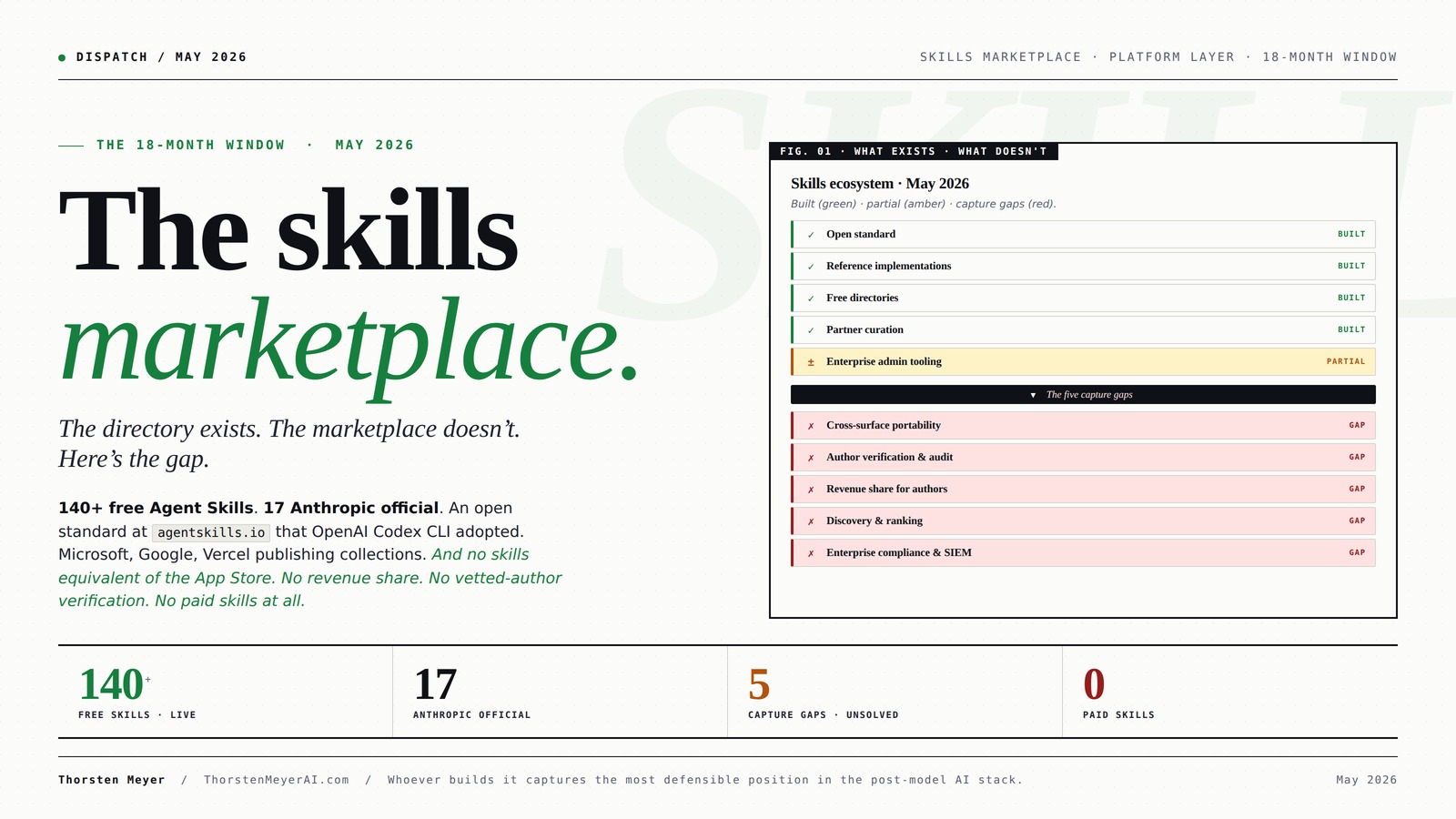
There are 140+ free Agent Skills on community marketplaces today. 17 official Anthropic skills under Apache 2.0. A published open standard at agentskills.io that OpenAI’s Codex CLI adopted. Microsoft, Google, Vercel publishing skill collections. And no skills equivalent of the App Store. No revenue share. No vetted-author verification. No security audit pipeline. No paid skills at all.
Folder. Frontmatter. Instructions.
A skill is a directory containing a SKILL.md file with YAML frontmatter and Markdown instructions, plus optional scripts and templates. Progressive disclosure: the agent loads only metadata into context until the skill becomes relevant. The format is simple. The implication is significant.
AI skills marketplace platform
As an affiliate, we earn on qualifying purchases.
As an affiliate, we earn on qualifying purchases.
The directory exists. The marketplace doesn’t.
Five layers, in roughly the order they emerged. The first five are real and growing. The last five are the capture gaps — each is a real product, each is uncaptured, and any company that solves four of five wins the layer.
agentskills.io · Anthropic + OpenAI · Dec 2025AI agent skills development kit
As an affiliate, we earn on qualifying purchases.
As an affiliate, we earn on qualifying purchases.
The platform owner’s incentives do not align with the developer’s.
Same structural problem that produced the App Store / Play Store / Steam separation in mobile and gaming. The platform owner extracts rent at the marketplace layer; the developer wants to publish once and distribute everywhere. The two only align if a third party owns the marketplace.
Skills as a platform retention feature.
- Cross-surface friction is a soft retention mechanism, not a bug
- Partner directory is curated to drive distribution into their stack
- Revenue share competes with the lab’s own enterprise sales motion
- Verified-publisher status is awkward when the auditor is also the model vendor
- Skills tied to one model = same problem the standard was built to solve
Three fronts the labs cannot credibly compete on.
- Cross-surface neutrality — “publish once, run on any model”
- Verified-publisher status as a paid security service
- 70/30 revenue share creates incentives for vertical specialists
- Trust calculation is cleaner: auditor ≠ model vendor
- Wins by being the only neutral broker between labs and enterprise

AI Programming Made Practical: A Step-by-Step Guide to Building AI-Powered Applications, Writing Better Code Faster, and Using Modern AI Tools with Confidence
As an affiliate, we earn on qualifying purchases.
As an affiliate, we earn on qualifying purchases.
Smaller than you assumed. Closer than you think.
~20 engineers · $30–50M Series A · founded 2026 H2 / 2027 H1. Reference: Replicate’s positioning in model hosting — neutral, multi-vendor, developer-first. The challenge is distribution.
GitHub (= Microsoft, conflict). Cursor. Replit. Linear. The most legible path is “GitHub Skills” — but Microsoft competes at the model layer, reproducing the original problem.
Harvey in legal · a healthcare-AI company yet to emerge · Bloomberg in finance. Slower path, structurally stronger trust position. Customer never has to ask “is this skill safe?”
![Free Fling File Transfer Software for Windows [PC Download]](https://m.media-amazon.com/images/I/41Vq6ZqHfjL._SL500_.jpg)
Free Fling File Transfer Software for Windows [PC Download]
Intuitive interface of a conventional FTP client
As an affiliate, we earn on qualifying purchases.
As an affiliate, we earn on qualifying purchases.
The 2026 H2 author looks like the 2007 YouTube creator.
Write the skills now. Capture when the marketplace ships.
The capture mechanism does not yet exist. Skills you write today have no way to charge for themselves. This is a feature, not a bug, for the next 12 months. Write skills, accumulate authorship reputation, build a portfolio that becomes legible the moment a marketplace with revenue share goes live.
The directory exists. The marketplace doesn’t. Whoever builds it captures the most defensible position in the post-model AI stack.
Four assignments. By role.
Start writing skills now.
The marketplace doesn’t exist yet but the reputation system runs on what you publish in 2026. The early-mover advantage when the marketplace ships is real. GitHub stars compound into discoverable authorship.
The window is open. Funding is favorable through Q3.
The standard is set, the demand is forming, the labs won’t build it themselves, and the second-mover penalty in marketplaces is severe. The “App Store of agents” thesis is investable today.
Demand a skill governance roadmap.
If your AI vendor’s answer is “we trust Anthropic to vet skills,” the answer is incomplete. Demand SIEM integration, audit logging, enterprise approval workflows. Current admin controls are a starting line.
The position is winnable in 2026 H2.
Natural fits: GitHub, Cursor, Replit. If you build developer tooling but aren’t one of those, you have 12 months to figure out whether your product becomes a skills publishing channel — or watches the value flow past it.
Executive Summary
| Layer | Exists? | Capture mechanism |
|---|---|---|
| Open standard | ✓ agentskills.io, Dec 2025 | Specification, not capture |
| Reference implementation | ✓ Anthropic, OpenAI Codex CLI | Lock-in via tooling |
| Free directories | ✓ SkillsMP, ClaudeWorld, claudeskills.info, GitHub | Discovery, no monetization |
| Partner curation | ✓ Anthropic partner directory (7 brands) | Distribution, no revenue share |
| Cross-surface portability | ✗ Claude.ai ↛ API, vice versa | The current friction |
| Author verification | ✗ “Trust the source” | The current security gap |
| Revenue share | ✗ All skills are free | The current capture gap |
| Enterprise compliance | Partial · admin controls | The next enterprise move |
| Audit pipeline | ✗ User self-audits SKILL.md | The next security move |
| Discovery and ranking | ✗ GitHub stars + community | The next product move |
The standard exists. The marketplace does not. The window is roughly 9–18 months. The companies in position to capture it are smaller than the assumed candidates, and that asymmetry is the thesis.
1. Why Skills Became the Portable Layer
The case for skills as an infrastructure category — rather than as a feature of one chatbot — is not subtle, but it is recent.
A skill is a folder containing a SKILL.md file with YAML frontmatter and Markdown instructions, plus optional scripts, templates, and resources. The agent loads only the metadata (name, description) into its system prompt at startup. When a skill becomes relevant, the agent loads the body. This is “progressive disclosure”: context budget stays tight until the skill is needed.
The format is simple. The implication is significant. A skill written for Claude Code can be loaded into OpenAI Codex CLI, into Cursor, or into any agent runtime that implements the spec. The model underneath is interchangeable. The skill is the artifact the customer wrote — and crucially, the artifact the customer keeps.
This is the inverse of the prior decade of AI product design. Through 2024, the model was the product; the prompt was the user’s input; everything else was a wrapper. By mid-2026, the model is the engine; the skill is the IP; the wrapper is the runtime. The leverage in the value chain has moved.
A skill is the artifact your team wrote. The model is the chip. A buyer with 40 skills against an internal runtime can swap the model layer in an afternoon.
The most quietly important detail in the spec is YAML frontmatter. It means a skill is not code; it is configuration plus instructions. A non-engineer at a healthcare company can write a billing-coding skill for their organization without writing a line of Python. The skill is then loaded by the agent, and it becomes part of every interaction the agent has with that customer. The author is the company’s senior coder. The artifact is theirs. The model — Claude, GPT, Llama, Gemini — is a substitutable input.
That’s the layer. The marketplace is what gets built on top of it.
2. What Already Exists · Five Layers
The skills ecosystem in May 2026 has five layers, in roughly the order they emerged.
Layer 1 · The open standard. Anthropic published the Agent Skills spec as an open standard on December 18, 2025, after launching the feature internally in October. The standard lives at agentskills.io. OpenAI’s Codex CLI adopted the same SKILL.md format. The standard is not the capture point — the standard is the precondition for capture, the way HTTP was the precondition for the web economy, not the capture point itself.
Layer 2 · Reference implementations. Anthropic ships skills natively in Claude.ai, Claude Code, Claude API, and the Claude Agent SDK. OpenAI ships them in Codex CLI and ChatGPT. This is where the lock-in begins to accumulate — not via the standard but via the tooling each lab builds around it.
Layer 3 · Free directories. SkillsMP, ClaudeWorld, claudeskills.info, and GitHub itself host community skills. Skills.info lists 140+ free, open-source skills. None of these are monetized; all are discovery layers, none are capture layers. They are the Hugging Face equivalent for the skills format — useful, valuable, but not the iOS App Store.
Layer 4 · Partner curation. Anthropic launched a partner directory in March 2026 with skills from Atlassian, Canva, Cloudflare, Figma, Notion, Ramp, and Sentry. This is closer to capture: the partners get distribution into Claude’s enterprise customer base, Anthropic gets specialized capability without building it. But there is no revenue share visible to the public. The partners are likely paying Anthropic for the placement, not the other way around.
Layer 5 · Enterprise admin tooling. Team and Enterprise administrators can now control which skills are provisioned for users and which are enabled by default. This is the first move toward the enterprise governance plane — and the first time skills have entered the procurement conversation. It is not a marketplace. It is the substrate the marketplace eventually runs on.
The five layers together are coherent. They are not, however, capture-shaped. They produce a healthy open ecosystem with no economic flywheel inside it for the people writing skills.
3. The Five Capture Gaps
A skills marketplace that captures meaningful economic value has to solve five things the existing layers do not.
Gap 1 · Cross-surface portability. A skill uploaded to Claude.ai today is not automatically available via the Claude API. A skill installed in Claude Code is not synced to Claude.ai. This is documented in Anthropic’s own platform documentation. A user who creates a skill on one surface re-creates it on the others, or builds tooling to sync them. This is the friction the standard does not solve. A real marketplace solves it: one upload, all surfaces, with appropriate per-surface adaptation handled in the marketplace layer.
Gap 2 · Author verification. Anthropic’s documentation says: “We strongly recommend using Skills only from trusted sources: those you created yourself or obtained from Anthropic.” That sentence is the current security architecture. A skill is just executable instructions — a malicious skill can direct the agent to invoke tools or execute code in ways that don’t match its stated purpose. The marketplace move is verified-publisher status, sandboxed execution, and a security review pipeline. None of these exist today.
Gap 3 · Revenue share for skill authors. There is no paid skill in any current marketplace. Authors publish for status, GitHub stars, or as marketing for their company’s services. This is fine for the current cohort — early adopters, model labs, partner brands. It is not durable for the next cohort. The 50,000th skill author is not going to write a healthcare RCM coding skill, maintain it for three years across model updates, and audit it for security, on the basis of GitHub stars. They will write it if there is revenue. The marketplace move is a 70/30 or 80/20 revenue share with App Store-style merchant of record.
Gap 4 · Discovery and ranking. Today’s skill discovery is GitHub README quality, plus aggregator sites that scrape GitHub. There is no quality signal beyond stars, no usage telemetry, no recommendation engine, no editorial curation. A user looking for a “best legal contract review skill for healthcare procurement contracts” has to search GitHub and read SKILL.md files manually. The marketplace move is discovery infrastructure: search, ranking, usage signals, editorial picks, vertical filtering.
Gap 5 · Enterprise compliance and audit trail. Enterprise customers will not deploy skills at scale without an audit trail of which skills are installed, who installed them, what data they accessed, and what actions they took. Anthropic’s admin controls are a start. They are not the full surface — there is no SOC 2 attestation for individual skills, no centralized incident-response capability, no SIEM integration for skill execution events. After the Vercel-Context AI breach, the agent supply chain is the security perimeter. Skills are part of that perimeter and currently below SOC 2 visibility.
Each of these five gaps is a real product. Solving any one of them creates a real business. Solving four out of five — with the fifth as a fast-follow — creates the marketplace that captures the layer.
4. Why It Won’t Be Anthropic (or OpenAI)
The natural assumption is that the model labs build the marketplace. The structural constraints make this unlikely to be the durable answer.
Anthropic and OpenAI are both pursuing skills as platform features that lock customers to their ecosystem. Anthropic’s partner directory only contains skills authored on the Anthropic platform; the cross-surface friction described in Gap 1 is not a bug from Anthropic’s perspective — it is a soft retention mechanism. OpenAI’s adoption of the same SKILL.md format makes the standard portable, but neither lab has any incentive to make the marketplace portable. The two labs ship features that work best inside their own walls.
This is the same structural problem that produced the App Store / Play Store / Steam separation in mobile and gaming. The platform owner’s incentive is to extract rent at the marketplace layer; the developer’s incentive is to publish once, distribute everywhere. The two incentives only align if a third party owns the marketplace.
For skills, that third party can win on three fronts the labs cannot.
Front 1 · Cross-surface neutrality. A neutral marketplace can guarantee a skill author “publish once, run on Claude, GPT, Gemini, Llama, your own runtime.” Neither Anthropic nor OpenAI can credibly make that promise — their distribution leverage depends on customers staying inside their stack.
Front 2 · Verified-publisher and security audit. A neutral marketplace builds the security review pipeline as a paid service. Anthropic could build it, but the trust calculation gets complicated when the auditor is also the model vendor. The same way mobile users trust Apple to vet App Store submissions in a way they would not trust Google to vet Apple App Store submissions.
Front 3 · Revenue share with skill authors. A neutral marketplace with a 70/30 split creates an incentive for full-time skill authorship — vertical specialists, healthcare experts, legal-domain authorities, finance professionals — to publish skills as a primary revenue stream. The labs cannot build this without competing with their own enterprise sales motion. A pharma RCM coding skill that captures $2M/year in revenue for the author is, structurally, a pharma RCM coding consulting business. Anthropic’s Applied AI team and the PE channel JV compete with that author for the same enterprise budget. A neutral marketplace does not.
The skills marketplace will be built by a company that is structurally not the model layer. The candidates fall into three categories.
5. The Three Realistic Builders
Candidate 1 · A focused new entrant. A new company, founded in 2026 H2 or 2027 H1, with the explicit thesis of being the App Store of skills. Probably ~20 engineers at first, raising a $30–50M Series A from a16z, Sequoia, or Greylock. The reference precedent is Replicate’s positioning in the model-hosting space — neutral, multi-vendor, developer-first. The challenge is distribution: an unknown brand asking enterprises to install skills via their marketplace instead of via Anthropic’s. This is solvable with the right anchor partnerships.
Candidate 2 · A developer-tooling incumbent. GitHub (which is Microsoft, which raises platform-conflict questions), Cursor, Replit, or Linear. These have the developer trust, the existing platform, and the verified-publisher infrastructure. GitHub has the most legible path — a “GitHub Skills” product that builds on existing repository governance, GitHub Actions for skill testing, and existing Marketplace infrastructure. The challenge is that GitHub is owned by Microsoft, and Microsoft is competing with Anthropic and OpenAI at the model layer. A skills marketplace tied to one model vendor reproduces the original problem.
Candidate 3 · A vertical specialist that becomes horizontal. A company that starts in one vertical (legal, healthcare, finance, government) building skills, becomes the trusted authority in that vertical, and then expands horizontally into being the marketplace layer for all skills. Harvey in legal, or a healthcare-AI company yet to emerge, or Bloomberg Industry Group as a finance specialist. The path is slower but the trust position is structurally stronger. The customer never has to ask “is this skill safe?” because the customer already trusts the vertical authority that vetted it.
Of the three, the focused new entrant is the most likely to win the horizontal market. The vertical specialist is the most likely to win the regulated verticals where the market is largest. The developer-tooling incumbent is the most likely to be the natural acquisition target for whoever ends up winning, in roughly 2028.
The 18-month window is real. The company that captures the marketplace position in 2026 H2 / 2027 H1 has a shot at being the next Hugging Face — a $5B–$10B independent platform sitting between the model labs and the enterprise. The company that does not move in that window does not get a second chance. The market in 2028 belongs to whoever owned the relationship with skill authors and enterprise admins by then.
6. What This Means for Skill Authors
If you are an engineer, a vertical specialist, or a domain expert, skills authoring is one of the highest-leverage moves available in 2026.
The economics are unusual. A skill takes between a weekend and three months to write at production quality. The maintenance cost is bounded — model updates require occasional adjustments, the underlying domain knowledge is durable. The marginal cost of distribution to one more user is approximately zero. The total addressable market for any reasonable enterprise vertical skill is in the tens of thousands of organizations.
The capture mechanism does not yet exist. The skill you write today has no way to charge for itself. This is a feature, not a bug, for the next 12 months — write skills, accumulate authorship reputation, build a portfolio that becomes legible the moment a marketplace with revenue share goes live. The early skill authors in 2026 H2 are going to look like the early YouTube creators in 2007: positioned at exactly the right moment to monetize a layer that hadn’t yet figured out how to monetize itself.
For senior engineers running the audit — the personal-week framework — skills authoring is reliably durable-bucket work. It compounds. It accumulates reputation. It produces an artifact that survives the model layer. It is the inverse of the commodity-bucket coding that AI is repricing to near-zero.
For forward-deployed engineers — the role explored last week — the skills they ship inside customer environments are, increasingly, the IP the customer paid for. The FDE’s value is partly the integration work, partly the skills artifact left behind. A customer who paid $5M for an FDE engagement leaves with 30–50 skills tuned to their specific environment. Those skills are exactly the kind of artifact that, with the right marketplace layer underneath, become a revenue stream — for the FDE, for the customer, for whoever owns the publication channel.
What to Do This Quarter
1. Engineering and vertical specialists: Start writing skills now. The marketplace doesn’t exist yet, but the reputation system runs on what you publish in 2026. The early-mover advantage when the marketplace ships is real and asymmetric. GitHub stars compound into discoverable authorship.
2. AI-native product founders: If you’ve considered starting a skills marketplace, the window is open. The standard is set, the demand is forming, the labs are not going to build it themselves, and the second-mover penalty in marketplaces is severe. The funding environment for “App Store of agents” is favorable through Q3.
3. Enterprise CIOs: Ask your AI vendor what their skill governance plan is. If the answer is “we trust Anthropic/OpenAI to vet skills,” the answer is incomplete. Demand a roadmap for SIEM integration, audit logging, and enterprise approval workflows. The current admin controls are a starting line, not a finishing one.
4. Existing developer-tooling companies: The skills marketplace position is winnable in 2026 H2. The natural fit is GitHub, Cursor, or Replit. If you’re none of those but build developer tooling, you have 12 months to figure out whether your product becomes a skills publishing channel — or watches the value flow past it.
The Strategic Read
The agent stack is unbundling into layers, and each layer is being captured by a different kind of company. The model layer is captured by a small oligopoly: Anthropic, OpenAI, Google, with open-weight pressure from Llama, DeepSeek, Mistral. The runtime layer is captured by the platform vendors: Claude Code, Codex CLI, Cursor, the agent SDKs. The integration layer is captured by forward-deployed engineers inside enterprise customers.
The skills layer is currently uncaptured. That is what makes this window interesting.
Skills are the layer where customer-specific judgment, organizational expertise, and procedural knowledge get packaged into portable artifacts. They are where the durable IP of the AI era will accumulate. And the marketplace through which they flow — once it is built — will be the most defensible piece of infrastructure in the entire post-model AI stack.
It is not built. The standard is open. The directories are growing. The labs are publishing. None of that is the marketplace. The marketplace is the merchant of record, the verified-publisher status, the security audit pipeline, the cross-surface portability layer, the discovery and ranking infrastructure, and the revenue-share economics that turn skills authorship from a side project into a profession.
The window for building this is roughly 18 months. The candidates are smaller than the assumed candidates. The economics, when the marketplace exists, will look like Apple’s App Store at scale — minus Apple’s operating-system lock-in, plus the structural advantage of being the only neutral broker between the labs and the enterprise.
If you are a founder, this is the bet. If you are an investor, this is the next platform. If you are a senior engineer, this is the highest-leverage way to start accumulating durable IP before the marketplace prices it. None of those positions are obvious from the inside of the existing ecosystem. They will be obvious in retrospect.
The standard is the precondition. The marketplace is the capture. The capture has not happened. The window is now.
The directory exists. The marketplace doesn’t. Whoever builds it captures the most defensible position in the post-model AI stack.
About the Author
Thorsten Meyer is a Munich-based futurist, post-labor economist, and recipient of OpenAI’s 10 Billion Token Award. He spent two decades managing €1B+ portfolios in enterprise ICT before deciding that writing about the transition was more useful than managing quarterly slides through it. More at ThorstenMeyerAI.com.
Related Dispatches
- Your AI Vendor’s AI Vendor — agent supply chain compromise (Vercel × Context AI)
- Single Digits — the April 2026 open-weight inflection
- AI-Washed — the 47.9% / 9% layoff narrative gap
- The 27% Problem — Anthropic’s enterprise lead and Google’s $750M check
- The Bubble Is Not in Valuations — the productivity gap
- The Agent Trap — why 90% of AI launches are infrastructure liars
- The Channel Move — Anthropic × Wall Street PE channel acquisition
Sources
- Anthropic, Equipping agents for the real world with Agent Skills (announcement, 2025-10)
- Anthropic, Agent Skills | Claude API Documentation (accessed 2026-05)
- Anthropic, anthropics/skills GitHub repository (accessed 2026-05)
- The New Stack, Agent Skills: Anthropic’s Next Bid to Define AI Standards (2026-03-14)
- ClaudeWorld, Anthropic Official Skills: Complete Guide to 17 Open-Source Agent Skills (2026-03-07)
- SkillsMP, Agent Skills Marketplace (community aggregator, accessed 2026-05)
- claudeskills.info (community aggregator, accessed 2026-05)
- agentskills.io (open standard, accessed 2026-05)