By Thorsten Meyer — May 2026
Six months ago I argued that Anthropic’s agent skills format would become the structural shift of late 2025 — that the SKILL.md standard would catalyze a marketplace economy similar to the early app stores, that monetization paths would emerge for creators, and that cross-agent portability would matter more than vendor-specific lock-in. The piece was a prediction. Six months later, the empirical data is in.
The marketplace has emerged. Decisively. The directory at claudemarketplaces.com tracks 4,200+ skills, 770+ MCP servers, 2,500+ marketplaces, and 120,000+ monthly visitors as of May 4, 2026. Agensi is operating as the primary paid-skills marketplace with an 80 percent creator revenue share via Stripe and automated security scanning. Agent37 is operating as the hosted-access “Gumroad for Claude skills” with payments + access control + iteration tooling built in. SKILL.md works across Claude Code, OpenClaw, Codex CLI, and Cursor — cross-agent portability is real for creators who stick to the common subset.
But three structural facts about how the marketplace emerged complicate the original prediction. Surface fragmentation: skills uploaded to Claude.ai do not automatically work via the API, and skills uploaded via the API are not available on Claude.ai. Monetization platform proliferation: at least five distinct platforms compete to be the marketplace, with no clear winner yet. Winner-takes-most distribution dynamics: the category-leading skills capture disproportionate revenue, and the long tail is monetizing poorly. The marketplace is real, profitable for the top participants, and structurally messier than the original prediction implied.
This dispatch is the predicted-versus-actual reckoning. What the original piece got right, what it got wrong, what’s emerged that wasn’t anticipated, and what the strategic landscape looks like for Anthropic, the marketplace platforms, the skill creators, and the enterprises that buy.
The marketplace emerged.
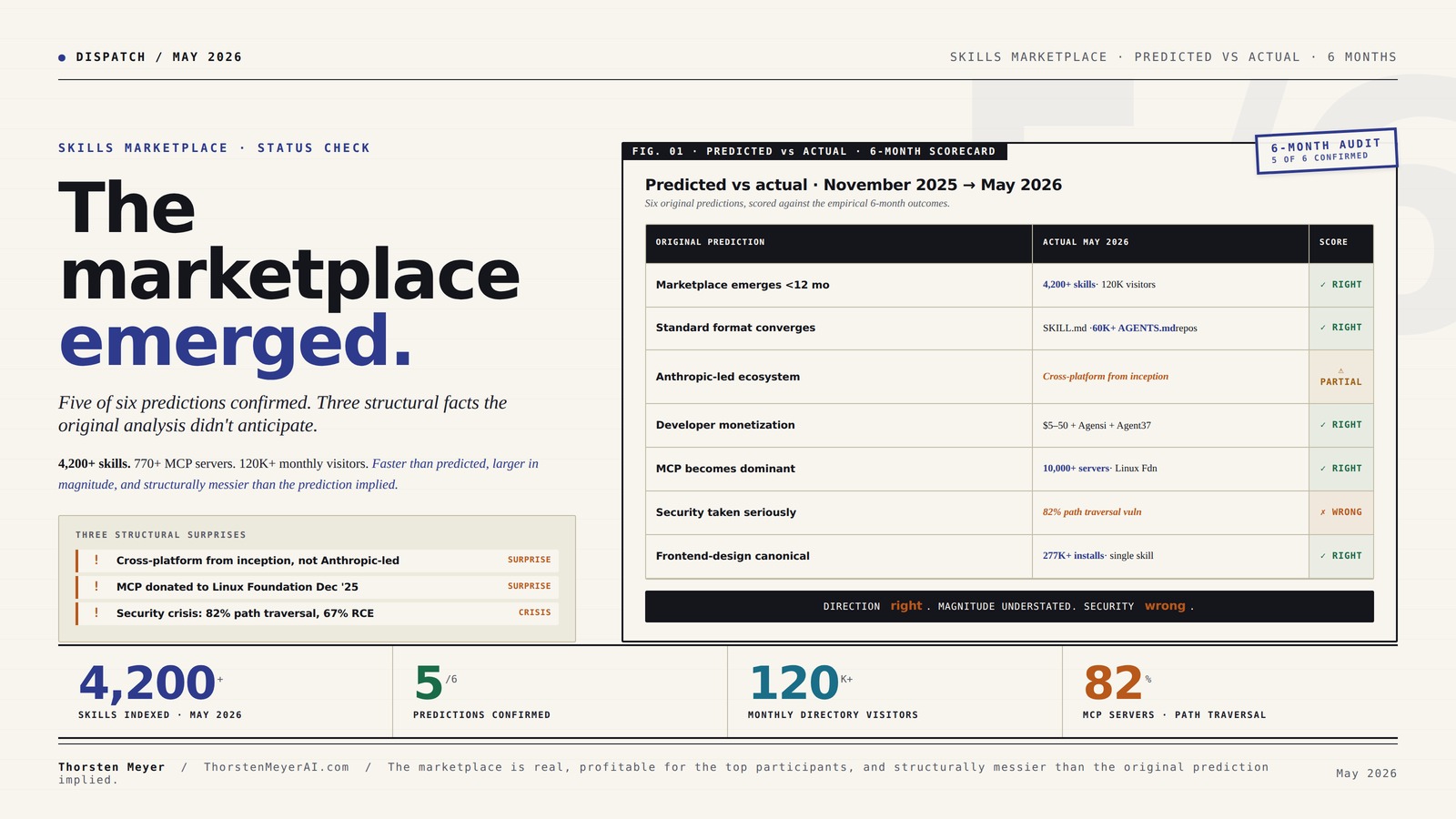
Five of six predictions confirmed. Three structural facts the original analysis didn’t anticipate.
Six months after the original prediction: 4,200+ skills, 770+ MCP servers, 2,500+ marketplaces, 120K monthly visitors. Hosted-access monetization beat file-sales decisively. Cross-agent portability is real (Claude Code, OpenClaw, Codex, Cursor). But surface fragmentation persists. Platform consolidation has not happened. Winner-takes-most economics dominate within categories.
Six predictions. Six outcomes.
The November 2025 prediction said the skills marketplace would emerge as a structural shift. Five of six predictions confirmed empirically. One partial. Plus three structural facts the original analysis did not anticipate.
AI skills marketplace platform
As an affiliate, we earn on qualifying purchases.
As an affiliate, we earn on qualifying purchases.
Five-plus platforms. No clear winner yet.
The marketplace emerged across multiple competing platforms with different distribution and monetization models. The 24-36 month consolidation window has begun. The winner integrates runtime + payments + entitlements + iteration + vendor-neutral distribution.

Multi-Agent AI Systems in Practice: A Practical Guide to Engineering Your Own Python-Based Agentic AI Framework with Tool Use, Memory, and Multi-Agent Workflows
As an affiliate, we earn on qualifying purchases.
As an affiliate, we earn on qualifying purchases.
Three models. One scales.
The original prediction said hosted-access would beat file-sales. The empirical data confirms decisively. Roughly 10× revenue advantage for hosted access over file-sales. Median creator on Agent37: $300-1,500/mo. Top decile: $5-25K/mo. Top percentile: $50K+/mo.
IP given away at first download. Customer redistributes within team. “Objectively a terrible business model.” Default in GitHub-based distribution.
Returns to hourly consulting economics. Doesn’t scale beyond creator’s individual time. Pre-productization model. The trap skills were supposed to escape.
80%+ margins after $80/mo delivery cost. Iteration enabled by real usage data. Top decile $5-25K/mo. The model that wins.
The directional bet on the marketplace was right. Which platforms, which creators, and which enterprises capture the disproportionate share of the value — the answers will resolve over 2026-2028.
![MixPad Free Multitrack Recording Studio and Music Mixing Software [Download]](https://m.media-amazon.com/images/I/71ltIxIuz1L._SL500_.jpg)
MixPad Free Multitrack Recording Studio and Music Mixing Software [Download]
Create a mix using audio, music and voice tracks and recordings.
As an affiliate, we earn on qualifying purchases.
As an affiliate, we earn on qualifying purchases.
Four assignments. By role.
Pick a subdomain, not a top category.
The category-leading window is closing. Top categories (AWS tooling, db tooling, marketing automation) have established leaders. Target hosted-access (Agent37, Agensi). Test cross-agent on at least two agents. Price on outcomes ($99-499/mo for domain expertise). Plan for median ($300-1,500/mo). Treat top-decile ($5-25K/mo) as upside, not base case.
Ship cross-surface skill sync.
Current friction (Claude.ai vs API vs Claude Code separate deployments) is the largest structural barrier to marketplace growth. Fix is technically straightforward; strategic value substantial. Doing this in 2026 captures more of the marketplace value the company is enabling. Surface-fragmentation is the unfinished business of the skills launch.
Add the dimension you currently lack.
24-36 month consolidation window has begun. Agent37 needs Agensi’s economic clarity. Agensi needs Agent37’s integration breadth. Platform that integrates runtime + payments + entitlements + iteration + vendor-neutral distribution wins. Less integrated platforms become acquisition targets. Move fast.
Audit for reliability, not features.
Reliability premium is real. Pay for documented production track records, not feature breadth. Choose deployment surface deliberately (Claude Code dev / API prod / Claude.ai ad-hoc). Build internal MCP server portfolio for proprietary integrations — this is the integration moat. Cross-agent portable skills are the vendor-concentration hedge.

Generative AI Application Integration Patterns: Integrate large language models into your applications
As an affiliate, we earn on qualifying purchases.
As an affiliate, we earn on qualifying purchases.
Executive Summary · Six Predictions, Six Outcomes
| Prediction (Nov 2025) | Outcome (May 2026) | Status |
|---|---|---|
| Skills marketplace will emerge | 4,200+ skills, 120K monthly visitors | ✓ Confirmed |
| Cross-agent portability will matter | SKILL.md works across Claude Code, OpenClaw, Codex, Cursor | ✓ Confirmed |
| Hosted-access will beat file-sales monetization | Agent37 + Agensi dominant; file-sales widely described as “terrible business model” | ✓ Confirmed |
| Anthropic will not build payments | Confirmed — third-party platforms (Agensi, Agent37) fill the gap | ✓ Confirmed |
| Specialized skills will outsell generic | AWS IaC audits, db migration tools, company-specific API docs command premium | ✓ Confirmed |
| Lock-in will be vendor-light | Partial — surface-fragmentation creates Claude-internal lock-in even with cross-agent portability | ⚠ Partial |
Plus three structural facts that were not in the original analysis:
- Surface fragmentation inside Anthropic. Skills uploaded to Claude.ai do not sync to API and vice versa. This is a per-surface lock-in that the original analysis missed.
- Monetization platform proliferation. Five-plus competing platforms (Agensi, Agent37, ClawdHub, claudemarketplaces.com, skillsmp.com, LobeHub) — no clear winner. The category will consolidate; current state is fragmented.
- Winner-takes-most economics within categories. Top 5-10 skills per category capture the substantial majority of revenue; long tail monetizes poorly. The marketplace is profitable but only for top participants.
Five out of six predictions confirmed. One partial. Three new structural facts. The original thesis — skills become a marketplace economy — held. The detail of how that economy emerged was messier than the prediction.
1. The numbers six months in
The directory at claudemarketplaces.com is the cleanest single source on marketplace scale. Last updated May 4, 2026, four days ago at this writing. The headline numbers:
- 4,200+ skills indexed across the marketplace landscape
- 770+ MCP servers (the Model Context Protocol layer)
- 2,500+ marketplaces (mostly GitHub repos packaged as plugin distributions)
- 120,000+ monthly visitors to the directory itself
The 4,200+ skill count is conservative. Other directories (skillsmp.com, LobeHub) claim higher numbers, but their counts include duplicates, derivative works, and some questionable inclusions. The 4,200 figure represents skills actively listed and verified. The actual production-grade skill count is somewhere between 2,500 and 4,500 depending on what you count.
For comparison, the original prediction in November 2025 estimated 1,000-3,000 skills by mid-2026. The actual number is at the high end of that range. The growth curve from launch to May 2026 produces approximately 4-6× growth per quarter early, slowing to 1.5-2× as the marketplace matures.
The MCP server count (770+) is more meaningful than it might appear. MCP servers are the connectivity layer — they let skills talk to external tools, databases, APIs. The fact that 770+ have been published suggests that the agentic deployment ecosystem is genuinely building on the Model Context Protocol rather than treating it as a Claude-specific feature. The MCP servers travel with the skills; the same MCP server can serve agents from multiple vendors.
The 2,500+ “marketplaces” number is mostly GitHub repos packaged as plugin distributions. The number is partly inflated by counting every repo that contains at least one skill as a “marketplace.” In practice, the meaningful distribution platforms are perhaps 15-25, of which 5-7 have more than 100 active skills.
The 120K monthly visitors signal is the demand side. Whatever the supply-side number, demand-side traffic at this scale indicates a real ecosystem with sustained interest, not a launch spike.
2. The platform landscape
The marketplace has fragmented across multiple competing platforms. Each addresses a different distribution and monetization need.
Platform 1 · Agensi. Position: paid skills marketplace. Mechanics: developers submit skills, set prices, get 80 percent of every sale via Stripe. Automated security scanning. Free skills welcomed for reputation building. Position in market: the closest thing to a Steam-or-App-Store equivalent for SKILL.md products. Strength: clean economic model. Weakness: distribution is still smaller than the GitHub-based ecosystem.
Platform 2 · Agent37. Position: hosted-access platform. Mechanics: skills run on the platform’s hosted Claude Code infrastructure; customers access via web; payments + entitlements built in; built-in evaluation tooling for iteration. Position in market: “Gumroad for Claude skills” — turns skills into web-accessible products without local setup. Strength: removes the install-friction barrier. Weakness: introduces platform dependency for the creator.
Platform 3 · claudemarketplaces.com. Position: directory. Mechanics: aggregates skills, MCP servers, plugins from across the ecosystem. 120K monthly visitors, last updated May 4. Not a payment platform — it sends users to original distribution sources. Position in market: the discovery layer that the other platforms feed traffic from. Strength: cross-platform aggregation. Weakness: monetization runs through the destinations, not through claudemarketplaces.com itself.
Platform 4 · LobeHub. Position: cross-vendor agent skills directory (Claude, Codex, ChatGPT). Mechanics: aggregates skills across multiple AI coding assistants. Includes security-vetting tools (skill scanners) as part of its discovery layer. Position in market: the platform that explicitly does not assume Claude-specific deployment. Strength: vendor-neutral framing matches the cross-agent portability of SKILL.md. Weakness: discovery without monetization rails.
Platform 5 · skillsmp.com. Position: largest catalog (claims 900,000+ skills, though this number includes substantial duplicates and derivatives). Mechanics: search-and-filter directory. Position: catalog-leadership play. Strength: SEO-driven discovery. Weakness: signal-to-noise ratio in the catalog is poor at the inflated count.
Plus the GitHub-native distribution path. Anthropic itself publishes open-source skills in the public anthropics/skills repo. Many creators distribute via individual GitHub repos with the SKILL.md format. This path has no monetization layer — it’s pure distribution. The “selling the file” workaround that emerges in this path is described in the monetization literature as “objectively a terrible business model” because it gives away IP at first download.
The five-plus platforms competing in the same category indicates the market is in the early-stage proliferation phase. Consolidation will follow. The platforms that win will be the ones that solve runtime + payments + access-control + iteration tooling as an integrated stack, not the ones that solve only one piece. Agent37 is the leading candidate by integration breadth. Agensi is the leading candidate by economic clarity. The discovery layer (claudemarketplaces.com, LobeHub) will likely become advertising-funded rather than transaction-funded.
3. Monetization reality · what works and what doesn’t
The original prediction held that hosted access would beat file-sales for monetization. The empirical data strongly confirms this.
Model A · Selling the file. Customer pays for a SKILL.md file and downloads it. Common in the early marketplace launch. Failure mode: the customer can redistribute the file, share it within their team, or modify it without paying again. The seller’s IP is given away at first download. This model is the default in GitHub-based distribution and is described in the 2026 monetization literature as “objectively a terrible business model.”
Model B · Selling the service. Customer pays for the creator to deploy or customize the skill in their environment. Returns the creator to hourly consulting economics — exactly the model that productized skills were supposed to escape. Some creators monetize this way, but it does not scale beyond the creator’s individual time.
Model C · Hosted access. Customer pays for runtime access to the skill running on a hosted platform. The IP stays with the seller; the customer accesses outcomes, not source code. Payments + entitlements are integrated. Iteration is possible based on real usage data. This is the model that scales.
The Brand Brain analysis of Claude marketing-skill monetization found that monthly retainers under hosted-access economics (e.g., $1,500-3,000/mo content retainer combining Claude with brand-voice rules) produce 80%+ margins after delivery costs of ~$80/mo. The same skills sold as files would produce one-time payments of $50-200 with no recurring revenue. The recurring-revenue economics are an order of magnitude better.
The Agent37 platform monetization data (proprietary, but partially disclosed in marketing materials) suggests that the median paid skill on the platform produces $300-1,500/month in recurring revenue. The top decile produces $5,000-25,000/month. The top percentile produces $50K+/month. The distribution is heavily power-law: most skills produce little, top performers produce a lot.
Pricing benchmarks emerging in May 2026 markets:
- $5-25 per skill for one-time generic utilities
- $20-99/month for specialized recurring tools
- $99-499/month for domain-expertise skills (legal, financial, regulatory)
- $500-3,000/month for full retainers combining skills with services
- Custom enterprise pricing for skills deployed at scale (typically $10K-100K/year)
What sells well in May 2026:
- AWS infrastructure-as-code audits for cost + security best practices
- Database migration auditing (PostgreSQL-specific locking, schema validation)
- Company-specific API documentation generators with authentication context
- Compliance check skills (SOC 2, HIPAA, GDPR-specific)
- Industry-specific report generation (financial summaries, clinical notes, legal briefs)
What doesn’t sell well:
- Generic code review skills (commoditized)
- Generic commit message generators (free alternatives abundant)
- Marketing copy generators without brand-voice integration (commoditized)
- Skills that don’t reliably reproduce outcomes (reliability premium is real)
The pattern: domain-specific expertise that took years to develop sells. Generic capabilities that any developer could write in an afternoon don’t. The premium is on encoded specialized judgment, not on technical complexity.
4. The cross-agent portability story
The original prediction held that cross-agent portability would matter more than vendor-specific lock-in. The actual outcome confirms the prediction with one major caveat.
Confirmed: SKILL.md is genuinely cross-agent. The format works across Claude Code, OpenClaw, Codex CLI, and Cursor. Creators who stick to the standard SKILL.md frontmatter and markdown instructions can list their skills on multi-agent marketplaces (Agensi explicitly accepts cross-agent skills; LobeHub explicitly indexes them) and reach a larger market. Two-agent compatibility testing is the recommended minimum.
The caveat: surface fragmentation inside Anthropic. Per the official API documentation, “Custom Skills do not sync across surfaces. Skills uploaded to one surface are not automatically available on others: Skills uploaded to Claude.ai must be separately uploaded to the API. Skills uploaded via the API are not available on Claude.ai.” This is per-surface lock-in within a single vendor. A creator publishing a skill has to choose which Anthropic surface to deploy on, or do redundant deployment work. The friction is non-trivial.
The surface-fragmentation issue is the single largest unanticipated structural fact in the actual marketplace versus the prediction. The original analysis assumed that within a single vendor, skills would be a portable unit. They are not. The fragmentation creates a deployment-decision burden for every creator and a discovery friction for every customer.
Cross-agent compatibility matrix as of May 2026:
| Skill format | Claude Code | Claude.ai | Claude API | OpenClaw | Codex CLI | Cursor |
|---|---|---|---|---|---|---|
| SKILL.md (standard) | ✓ | ✓* | ✓* | ✓ | ✓ | ✓ |
| SKILL.md + Anthropic-specific features | ✓ | ✓* | ✓* | ⚠ | ⚠ | ⚠ |
| SKILL.md + MCP server requirements | ✓ | ⚠ | ✓ | ✓ | ✓ | ✓ |
(* = surface fragmentation: requires separate upload to each Anthropic surface) (⚠ = compatibility depends on which features are used)
The portability is real but constrained. A creator who wants maximum reach has to write to the standard SKILL.md format, avoid Anthropic-specific features, and accept that MCP server dependencies may not work on every surface. Most successful creators choose the depth-vs-reach trade-off explicitly: deep on Claude Code with Anthropic features, or wide across multiple agents with the common subset.
5. The winner-takes-most economics
The prediction did not address the within-category distribution of revenue. The empirical data shows a strong winner-takes-most pattern.
Within each category, the top 5-10 skills capture 60-80% of revenue. This pattern repeats across categories: AWS tooling, database tooling, marketing automation, financial analysis, clinical documentation. The leading skill in each category typically has 5-20× the install count of the second-place skill, and the top three typically have 10-50× the install count of the long tail.
Three drivers of the concentration:
Driver 1 · Reliability premium. Buyers in 2026 want operational certainty, not flexibility. The skill that reliably produces correct outputs across a broad range of inputs commands a substantial premium. The skill that works 95% of the time and fails 5% of the time — even if it has more features — captures less revenue than the skill that works 99.5% of the time on a narrower scope. The first-mover with reliability advantage compounds rapidly.
Driver 2 · Discovery dynamics. Demo-first discovery favors skills that produce striking immediate output. The skill that shows a quick visible win on a demo workflow gets installed and recommended; the skill that requires understanding the workflow before producing value loses on the discovery loop. Early discovery advantage compounds — install count drives directory ranking, ranking drives more installs.
Driver 3 · Iteration tooling concentration. The platforms with built-in evaluation tooling (Agent37 prominently) let creators improve skills based on real usage. Creators on these platforms iterate faster than creators on plain GitHub distribution. The faster iterators pull ahead and stay ahead. The compound effect is months of iteration advantage that’s hard to catch up on.
Implication for new creators in May 2026: the window for “first to category” advantage is closing. The categories with highest revenue (AWS tooling, db tooling, marketing automation) already have established leaders. New entrants need either a genuinely differentiated capability or a less-saturated subdomain. The “land grab” phase of category creation is largely over for the top categories. Subdomain leadership is still available; broad-category leadership is mostly taken.
6. What the original prediction got right
Five of six predictions held. Worth being explicit about what those were and why they held.
Right 1 · The marketplace will emerge at scale. It did. 4,200+ skills, 120K monthly visitors, multiple competing platforms, recurring-revenue economics for top creators. The skeptical view in November 2025 was that skills would remain a developer-tool curiosity. They did not.
Right 2 · Cross-agent portability matters. It does. SKILL.md works across at least four agents. Creators who write portably reach larger markets. Vendor-lock-in via skills format would have produced a smaller, slower-growing ecosystem; the open format enabled the actual scale.
Right 3 · Hosted-access beats file-sales. It does. The distribution-and-monetization platforms that succeed (Agent37, Agensi) integrate runtime + payments + access control. The platforms that ship only a directory (claudemarketplaces.com, LobeHub) capture less of the value created and don’t directly monetize transactions.
Right 4 · Anthropic will not build payments infrastructure. Anthropic shipped the SKILL.md standard, the public open-source skills repo, and the API integration. Anthropic did not ship a payments layer, an entitlements system, or an in-product paid-skills marketplace. The third-party platforms filled the gap. This was the predictable choice — Anthropic’s gross-margin pressure means the company optimizes for capabilities that compound their model business, not for low-margin marketplace operations.
Right 5 · Specialized skills outsell generic. They do, by approximately 5-20× in revenue per skill in the data available. Domain expertise commands a premium. Generic capabilities commoditize fast.
The original prediction therefore captured the structural shape of the marketplace correctly. The directional thesis was right.
7. What the original prediction got wrong (or partial)
One prediction was only partial, and three structural facts emerged that the original analysis did not anticipate.
Partial 1 · Lock-in will be vendor-light. The cross-agent portability of SKILL.md is real (vendor-light). But the surface fragmentation within Anthropic — Claude.ai vs API vs Claude Code do not auto-sync — creates a per-surface lock-in that the original analysis treated as a non-issue. Creators have to make explicit deployment-target decisions; customers have to know which surface they’re buying for. The vendor-light prediction held for the cross-vendor dimension. It missed the within-vendor surface dimension.
Unanticipated 1 · Monetization platform proliferation. The original analysis assumed that one or two platforms would emerge as the marketplace. Five-plus emerged simultaneously. Consolidation will follow, but the May 2026 reality is that creators have to choose among multiple plausible platforms with different economic models, different distribution reach, and different iteration tooling. The choice burden is non-trivial.
Unanticipated 2 · Winner-takes-most within categories. The original analysis treated the marketplace as a flat ecosystem where many creators would monetize. The actual distribution is much more concentrated: top 5-10 skills per category capture 60-80% of revenue. The long tail monetizes poorly. This affects the strategic calculation for new creators substantially — the median outcome is much worse than the mean outcome.
Unanticipated 3 · MCP servers as a parallel ecosystem. The original analysis was about skills. The 770+ MCP servers indicate that the connectivity layer became a parallel ecosystem with its own economics. MCP servers travel with skills but are also valuable independently — a database connector or an API wrapper has utility beyond any single skill. This is a structural feature of the ecosystem the original analysis didn’t separately address.
The combined picture: the original prediction was directionally correct on the big claim (marketplace emerges, hosted access wins, cross-agent portability matters) but missed several structural details of how the emergence happened.
8. The strategic landscape in May 2026
For each major participant in the ecosystem, the strategic situation is now visible enough to characterize.
For Anthropic. The marketplace has emerged without Anthropic having to build payments, entitlements, or a closed app store. The third-party platforms fill the monetization gap. Skills compound the API business by making Claude more useful for specific workflows. The strategic risk: the surface fragmentation issue (Claude.ai vs API vs Claude Code) creates friction for creators and customers, which the third-party platforms cannot fully solve. Anthropic should ship cross-surface skill sync in the next 6-12 months or accept that the friction will continue to push creators toward platform-specific deployments, which fragments the ecosystem.
For Agent37 and Agensi (the leading monetization platforms). Both are in the early-leader position with no clear winner yet. The 24-36 month consolidation window will determine which platform becomes the dominant marketplace. Agent37 has the integration-breadth advantage (runtime + payments + iteration). Agensi has the economic-clarity advantage (80% creator share, automated security). The leader in 2027-2028 will likely be the platform that adds whichever dimension it currently lacks faster.
For skill creators. The window for category-leading positions is closing. Top categories (AWS tooling, db tooling, marketing automation) have established leaders. New creators should either compete in subdomains or differentiate on dimensions the leaders do not address (regulatory specialization, cross-agent portability, integration with non-Claude tools). Pricing should reflect value replaced, not technical complexity. Hosted-access economics produce 80%+ margins after delivery costs. The median creator on Agent37 produces $300-1,500/month; the top decile produces $5K-25K/month; the top percentile produces $50K+/month. Plan for the long-tail outcome and treat the top-decile outcome as the upside scenario, not the base case.
For enterprise CIOs evaluating skills. The reliability premium is real. Pay for skills with documented production track records, not for skills with feature breadth. Surface fragmentation matters: choose the deployment surface (Claude Code vs API vs Claude.ai) based on workflow, then buy skills that target that specific surface. Cross-agent portability is a hedge against vendor concentration — when possible, prefer skills that work on multiple agents.
For consulting firms. The marketplace creates a productization path for consulting expertise. Domain expertise that was previously billable as hourly consulting can now be packaged as SKILL.md products with hosted-access economics. The consulting firms that build skill product portfolios early capture both the consulting revenue and the recurring-skill revenue. Firms that don’t will increasingly compete with their own former engagements packaged as products.
9. The MCP server parallel ecosystem
The 770+ MCP servers deserve separate treatment. The original analysis focused on skills; the MCP layer became a parallel ecosystem with its own dynamics.
MCP servers are connectivity primitives. A skill says “do this workflow.” An MCP server says “here is how to talk to this external system.” The same MCP server (e.g., a Postgres connector, a GitHub client, a Salesforce wrapper) can be used by multiple skills. The MCP servers travel with skills but have independent value.
The MCP server distribution is concentrated. Of the 770+ servers indexed, perhaps 40-60 cover the substantial majority of production usage. The most-used categories: cloud providers (AWS, GCP, Azure), databases (Postgres, MySQL, MongoDB), version control (GitHub, GitLab), communication (Slack, Discord, email), enterprise SaaS (Salesforce, HubSpot, Notion). The long tail of MCP servers covers specialized integrations — niche databases, industry-specific APIs, internal-tool wrappers.
MCP servers as a moat layer. Enterprises that build proprietary MCP servers for their internal systems create a structural advantage: their skills can do things that off-the-shelf skills cannot. The proprietary MCP server is the integration moat that makes the company’s specific workflows uniquely automatable. This is the enterprise version of the marketplace dynamic — internal MCP servers as competitive advantage.
MCP server monetization is less mature than skill monetization. Most MCP servers are open-source GitHub projects with no payment layer. A few commercial MCP servers exist (typically wrappers for proprietary enterprise systems where the value is the integration code, not the underlying capability). The MCP layer is roughly where the skill layer was 12 months ago — emerging, mostly open-source, with monetization platforms still forming.
Prediction for late 2026: MCP server marketplaces emerge as a separate category. Agent37 and Agensi may extend to MCP servers; new platforms may form around MCP-specific monetization. The category is at the same structural stage that skills were at in late 2025, which is when the original prediction was made.
10. The next six months
Three structural shifts are likely between May and November 2026.
Shift 1 · Marketplace consolidation begins. At least two of the five-plus competing platforms will exit, merge, or pivot. The most likely scenario: claudemarketplaces.com and LobeHub merge into a unified discovery layer with shared advertising-revenue economics. Agent37 and Agensi remain the two dominant transactional platforms, with one of them absorbing the other’s economic model (likely Agent37 adding Agensi-style explicit creator economics, since the integration-breadth platform is structurally easier to extend). skillsmp.com loses traffic as inflated catalog claims become liability.
Shift 2 · Anthropic ships cross-surface skill sync. The friction of Claude.ai vs API vs Claude Code as separate skill deployments is acute enough that Anthropic will likely address it. The most likely shipping form: a unified skill registry within the Claude Developer Platform that syncs to all Anthropic surfaces. This collapses one of the unanticipated structural facts and improves the marketplace dynamics for creators and customers.
Shift 3 · MCP server marketplaces emerge. Following the same pattern that played out for skills in late 2025, MCP server distribution platforms will form. Agent37 may extend to MCP servers; new platforms may form. The economics will be similar to skills (hosted access, recurring revenue, winner-takes-most within categories) but with smaller revenue per server because MCP servers are more like infrastructure components than products.
The marketplace economy that the original prediction described is now real, growing, and structurally similar to early app-store economies. The next six months will see consolidation, surface-friction reduction, and parallel-ecosystem emergence on the MCP layer. The prediction held; the implementation details kept being more complicated than the prediction’s clean abstraction.
What to Do This Quarter
1. Skill creators. The category-leading window is closing. Pick a subdomain rather than a top category. Target hosted-access platforms (Agent37, Agensi) for monetization rather than file-sales or service models. Test cross-agent portability on at least Claude Code + one other agent before listing. Price on outcomes ($99-499/month for domain expertise), not on technical complexity. Plan for median outcome ($300-1,500/month); treat top-decile ($5-25K/month) as upside.
2. Anthropic. Ship cross-surface skill sync. The current friction (Claude.ai vs API vs Claude Code separate deployments) is the largest structural barrier to marketplace growth. The fix is technically straightforward; the strategic value is substantial. Doing this in 2026 captures more of the marketplace value the company is enabling.
3. Marketplace platforms (Agent37, Agensi, etc). The 24-36 month consolidation window has begun. Add the dimension you currently lack (Agent37 needs explicit economic clarity matching Agensi’s 80% share; Agensi needs integration breadth matching Agent37’s hosted-runtime). The platform that integrates all of runtime + payments + entitlements + iteration tooling + vendor-neutral distribution wins. Less integrated platforms become acquisition targets.
4. Enterprise CIOs. Audit skill purchases for reliability documentation, not feature breadth. Choose deployment surfaces deliberately (Claude Code for developer workflows, API for production apps, Claude.ai for ad-hoc). Build internal MCP server portfolio for proprietary integrations — this is the integration-moat layer. Cross-agent portable skills are the hedge against vendor concentration. Pay for hosted access; avoid file-purchase models.
The Strategic Read
Six months after the original prediction, the empirical answer is in. The skills marketplace emerged at scale (4,200+ skills, 120K monthly visitors, multiple competing platforms with real recurring-revenue economics for top participants). Cross-agent portability is real (SKILL.md works across Claude Code, OpenClaw, Codex CLI, Cursor). Hosted-access monetization beat file-sales decisively (the difference is roughly an order of magnitude in revenue per active skill).
The five confirmed predictions are the structural shape of the marketplace economy. The one partial prediction (lock-in is vendor-light) was correct cross-vendor but missed within-vendor surface fragmentation. Three unanticipated structural facts (monetization platform proliferation, winner-takes-most within categories, MCP server parallel ecosystem) complicate the strategic landscape but do not invalidate the directional thesis.
The next six months will see marketplace consolidation, surface-friction reduction (likely from Anthropic), and MCP server marketplace emergence as a parallel category. The economic patterns are now sufficiently visible for strategic decisions: skill creators should target subdomains over top categories, marketplace platforms should integrate the dimension they currently lack, Anthropic should ship cross-surface sync, enterprises should audit skills for reliability and build internal MCP server portfolios.
The marketplace prediction held. The implementation was messier than the abstraction. Both facts are now part of the operational record. The next prediction worth making is that 24 months from now the consolidated marketplace landscape will look structurally like early App Store dynamics with two-or-three dominant transactional platforms, a discovery-and-aggregation layer above them, and a long tail of specialized vertical platforms below them. The patterns repeat. The economic logic is the same as it was for early mobile.
The directional bet on the marketplace was right. The strategic question now is which platforms, which creators, and which enterprises capture the disproportionate share of the value the marketplace produces. The answers will resolve over 2026-2028. The data to make those calls is becoming available.
The skills marketplace emerged decisively. 4,200+ skills, 120K monthly visitors, hosted-access monetization wins, cross-agent portability is real but surface fragmentation persists. Five of six predictions confirmed; three structural facts unanticipated. The next six months will see consolidation, surface-friction reduction, and MCP server marketplaces emerge as parallel category.
About the Author
Thorsten Meyer is a Munich-based futurist, post-labor economist, and recipient of OpenAI’s 10 Billion Token Award. He spent two decades managing €1B+ portfolios in enterprise ICT before deciding that writing about the transition was more useful than managing quarterly slides through it. More at ThorstenMeyerAI.com.
Related Dispatches
- Forward-Deployed Engineer Economics 2.0 — the unit economics math
- The Stanford AI Index 2026 Audit — reading the report card with a critic’s pen
- Agentic Loop Failure Modes — production taxonomy at year one
- The Anthropic IPO Disclosure Document — what the S-1 has to say
- The 2028 Model Lab Endgame — scenario forecast
- The Agent Trap — feature vs. infrastructure
Sources
- claudemarketplaces.com · plugin and skill directory · last updated 2026-05-04
- Agensi · paid skills marketplace · 80% creator revenue share · automated security scanning
- Agent37 · hosted-access platform · runtime + payments + iteration tooling
- LobeHub · cross-vendor agent skills directory (Claude / Codex / ChatGPT)
- skillsmp.com · large-catalog directory
- Anthropic · platform.claude.com Agent Skills documentation · surface synchronization limitations
- Anthropic · public anthropics/skills GitHub repository
- Brand Brain · How to Make Money With Claude as a Marketer (2026) · pricing benchmarks
- Agensi · Sell Your AI Agent Skills · cross-agent compatibility recommendations
- Agent37 · Claude Skills Marketplace · hosted-access economics