

By Thorsten Meyer | November 22, 2026 | ThorstenMeyerAI.com

Get business pricing on tech for your team
- Business-only prices and quantity discounts
- Tax-exempt purchasing
- Multiple users, one account, clear invoices
Here is a puzzle in two numbers. According to the International Energy Agency (IEA), the energy used per AI task has dropped “by at least an order of magnitude annually in recent years”, a pace it calls “unprecedented in energy history”. In the same report, the IEA counts the electricity used by the world’s data centres: up 17% in 2025, and up 50% in the data centres built for AI.
Each answer gets cheaper and cleaner to produce. The total keeps climbing. An English economist described this pattern in 1865, for coal. Today it is called the Jevons paradox, and it is the most useful single idea for understanding why AI budgets and AI power demand keep rising while the price of a token keeps falling.
This explainer goes back to what William Stanley Jevons actually wrote, shows the mechanism in plain terms, sets out when it happens and when it does not, and then checks the AI case against the data.
Key takeaways
- The paradox in one line: making a resource more efficient lowers the effective price of what it produces, people and firms use more of it, and total use can rise instead of fall. Jevons: “It is wholly a confusion of ideas to suppose that the economical use of fuel is equivalent to a diminished consumption. The very contrary is the truth.”
- It is a possibility, not a law. A large 2007 review for the UK Energy Research Centre found that efficiency gains usually still save energy overall, just less than engineers expect. Total use rising (“backfire”) is most likely with general-purpose technologies adopted by producers early on, like steam engines and electric motors.
- AI looks like the backfire case so far. The cost of a given level of AI performance has fallen about 13 times per year since 2023, according to Epoch AI. Google’s monthly token count rose from 9.7 trillion in May 2024 to over 3.2 quadrillion in May 2026. Data centres used 485 TWh of electricity in 2025, and the IEA projects about 950 TWh in 2030.
- The IEA names the paradox itself. Efficiency gains “are also fuelling broader adoption of AI services, a dynamic known as the Jevons paradox”, so total electricity use from AI “is set to increase in the near term”.
- For businesses: the unit price falls, the bill grows. Budget per finished task, not per token, and watch the token-hungry uses such as reasoning and agents.
- For users and the grid: a single simple text prompt is small; the totals, and the heavier uses like video and agents, are what matter for power demand.
Jevons paradox · the mechanism
Cheaper per task, bigger in total
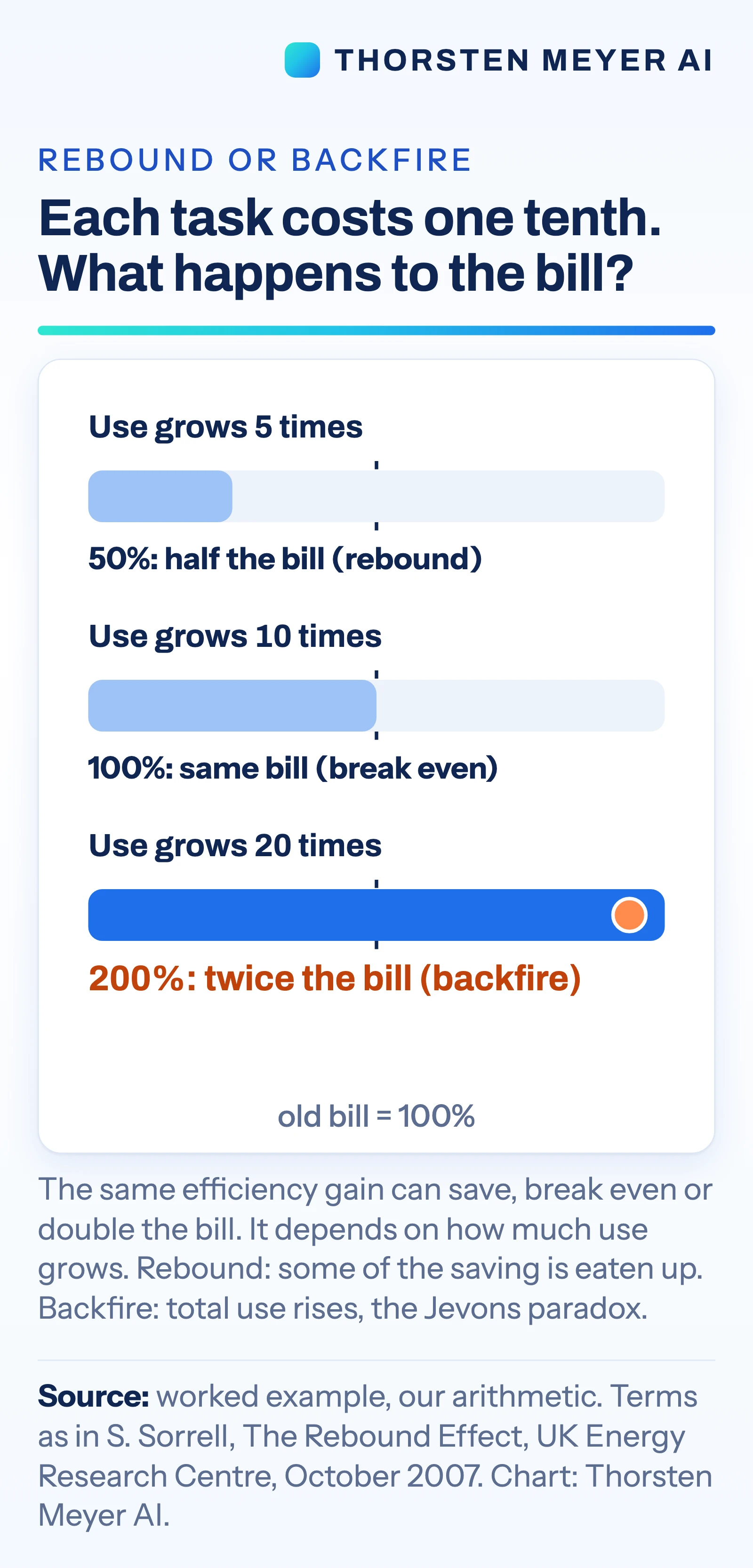
Efficiency cuts the price of each task. Whether the total falls or rises depends on how much more gets used. The numbers below are an illustration.
- 1 · EfficiencyA better engine, chip or model does the same task with less input. Here each task costs one tenth of what it did.
- 2 · DemandCheaper tasks get used more, and new uses become worth it. In this example, use grows 20 times.
- 3 · TotalOne tenth of the cost times 20 times the use is twice the old bill: backfire, the Jevons paradox. With only 5 times the use, the bill would have halved: a rebound, but still a saving.
Source: illustrative numbers from our worked example (our arithmetic). Concept: W. S. Jevons, The Coal Question (1865), Chapter VII; terms rebound and backfire as used by S. Sorrell, The Rebound Effect, UK Energy Research Centre (2007).
Graphic: Powered by Thorsten Meyer AI
Products Worth Considering

LG UltraGear 34G600A-B 34-Inch Curved WQHD Gaming Monitor, 160Hz, FreeSync Premium, HDR10

Samsung 27-inch Odyssey G5 G51F QHD Gaming Monitor

Apple AirPods Pro 3 Wireless Earbuds with Active Noise Cancellation
As an affiliate, we earn on qualifying purchases.
What Jevons actually wrote in 1865
William Stanley Jevons was a British economist. In 1865 he published The Coal Question, a book about whether Britain’s industrial lead could last once its cheapest coal ran out. A common reply at the time was that better engines would make the coal go further. Jevons summed it up this way: “The amount of useful work got out of coal may be made to increase manifold, while the amount of coal consumed is stationary or diminishing.”
In Chapter VII, “Of the Economy of Fuel”, he rejected that hope for industry: “It is wholly a confusion of ideas to suppose that the economical use of fuel is equivalent to a diminished consumption. The very contrary is the truth.” And: “As a rule, new modes of economy will lead to an increase of consumption, according to a principle recognised in many parallel instances.”
He also explained how it works, using a blast furnace for iron. If a furnace needs less coal for the same output, “the profits of the trade will increase, new capital will be attracted, the price of pig-iron will fall, but the demand for it increase”. In the end, “the greater number of furnaces will more than make up for the diminished consumption of each.”
His evidence came from the history of the steam engine and of iron. Early steam engines used so much coal that they were barely worth running; each step of economy, from Smeaton to Watt, made them worth using in more places. Jevons concluded that “it may be said that the whole history of the steam-engine is one of economy”. For Scottish iron, he reported that cutting the coal needed per ton of iron “to less than one-third of its former amount, has been followed, in Scotland, by a tenfold total consumption”.
Two details matter for today. Jevons was writing about industry, not households: he thought home coal use could simply be cut. And he was not arguing against efficiency. He thought the very economy of coal “makes our industry what it is”. His point was that efficiency does not, by itself, save the resource.
The mechanism in three steps
- Efficiency lowers the effective price. A more efficient engine, chip or model delivers the same service with less input, so each unit of service costs less.
- Cheaper service, more demand. People use more of it, and new uses become worth it that were too expensive before.
- The total depends on the size of that response. If use grows more slowly than the efficiency gain, total input still falls, only by less than planned. Economists call that gap the rebound effect. If use grows faster than the efficiency gain, total input rises. That is called backfire, and it is the Jevons paradox in the strict sense.
A simple worked example, our own arithmetic: say the cost per AI task falls to one tenth. If usage rises five times, the total bill halves. If usage rises ten times, the bill stays the same. If usage rises 20 times, the bill doubles. That is 50%, 100% or 200% of the old bill. Same efficiency gain, three different outcomes; all depends on the demand response.
When it happens, and when it does not
The best-known evidence review is The Rebound Effect, written by Steve Sorrell for the UK Energy Research Centre in October 2007. Its findings are a useful check on anyone who uses the paradox as a slogan.
- Usually, efficiency still saves. The review found that the evidence “does not suggest that improvements in energy efficiency routinely lead to economy-wide increases in energy consumption”. It also found that economy-wide rebound effects “will be at least 10% and often higher”.
- Mature household uses rebound little. For household heating, household cooling and personal car travel in developed countries, the direct rebound effect “is likely to be less than 30% and may be closer to 10% for transport”. It is likely to shrink further “as demand saturates”: you only heat a room to a comfortable temperature once.
- Small cost shares rebound little. Direct rebound is likely to be smaller where energy is a small share of total costs; the review names electricity in electronic appliances as an example.
- Backfire is most likely with general-purpose technologies. The review says the backfire claim seems more likely to hold for pervasive general-purpose technologies, “particularly when these are adopted by producers rather than final consumers and when the improvements occur at an early stage of development and diffusion”. Its examples: steam engines in the nineteenth century and electric motors in the early twentieth century.
- Dedicated savings technologies rarely backfire. For something like thermal insulation, used by consumers, “economy-wide energy consumption is likely to be reduced”.
There is also a recent counterexample from computing itself. Over the past 20 years, the IEA writes, efficiency kept data centre electricity in check: despite the “massive growth” in internet users and data traffic, data centres’ share of global electricity demand “only increased from 1% in 2005 to 1.5% in 2024”. Efficiency can win, when demand grows at a pace it can match.
The AI case: cheaper per task, more in total
AI fits the backfire profile on paper: a general-purpose technology, used mostly by businesses, at an early stage. Here is what the data show.
The price per result is falling fast. The Stanford AI Index 2025 reported that “the inference cost for a system performing at the level of GPT-3.5 dropped over 280-fold between November 2022 and October 2024”. Epoch AI, an independent research group, found in March 2025 that the price to reach a given benchmark score fell between 9x and 900x per year, with a median of 50x, depending on the task. Its September 22, 2026 report, The plunging price of thought, estimates that the cost of a given level of AI performance “has fallen about 47% per quarter since 2023, or 13× per year”. Its example: a score that cost about 30 cents per question with OpenAI’s o3 in January 2025 cost $0.0004 with GPT-5.6 Luna just under 18 months later, a 725-fold drop. Epoch’s earlier analysis cautioned that the fastest drops were recent, “so it’s less clear that those will persist”.
The energy per task is falling too. In August 2025, Google reported that the median text prompt in its Gemini app used 0.24 watt-hours, and that over a recent 12-month period the energy per median prompt “dropped by 33x”. The Stanford AI Index 2026 notes that the cost of GPU computation has fallen by more than 99% since 2006.
Use is rising much faster. At its developer conference on May 19, 2026, Google said it was processing 9.7 trillion tokens a month two years earlier, roughly 480 trillion a year earlier, and “over 3.2 quadrillion per month” now. That is more than 300 times in two years (our arithmetic; the figures are company-reported and not independently audited). The IEA reports that major model providers saw a threefold increase in active users and a fivefold increase in revenue over the past year.
Heavier uses are arriving. Video generation, reasoning and agentic tasks “can consume hundreds or thousands of times more energy per query than simple text generation”, the IEA writes. AI agents that plan and act in several steps “can consume orders of magnitude more tokens per interaction than a simple query”.
And the totals are rising. The IEA estimated that data centres used about 415 TWh of electricity in 2024, around 1.5% of the world’s total. In its April 2026 update, it put 2025 at 485 TWh, up 17%, with AI-focused data centres up 50%. It projects about 950 TWh in 2030, around 3% of global electricity demand, with consumption by AI-focused data centres tripling. Its 2025 report set out a range of cases: a “Lift-Off” case in which data centre use tripled by 2030, and a “Headwinds” case in which, as in the early 2010s, efficiency offsets most of the growth and demand plateaus at around 700 TWh.
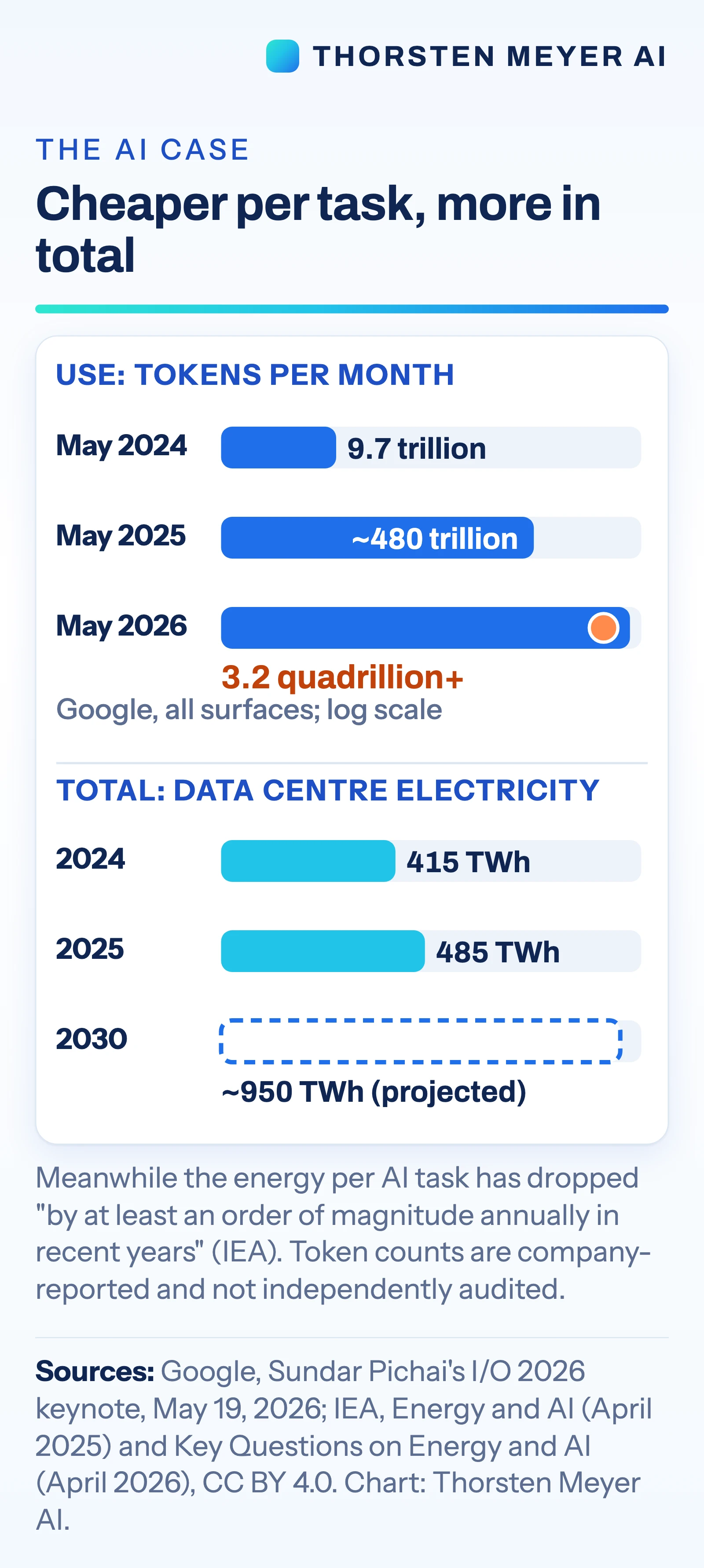
The IEA draws the link in plain words. By lowering costs and making AI more capable and accessible, “efficiency gains are also fuelling broader adoption of AI services, a dynamic known as the Jevons paradox. As a result, even with continued rapid improvement in energy efficiency, total electricity consumption from AI is set to increase in the near term.”
The famous remark: “Jevons paradox strikes again!”
The idea went mainstream in AI in January 2025. Late on Sunday, January 26, 2025, US time, Microsoft CEO Satya Nadella posted on X: “Jevons paradox strikes again! As AI gets more efficient and accessible, we will see its use skyrocket, turning it into a commodity we just can’t get enough of.” According to GeekWire, he shared it on LinkedIn too, linking to a Wikipedia page on the concept, amid the attention on DeepSeek’s R1, a Chinese model that GeekWire reported needed far less computing capacity.
GeekWire also noted that the view “would presumably benefit Microsoft”, which sells AI computing. Both things can be true: the remark is an interested party’s forecast, and the IEA’s later data point the same way.
Is it really Jevons, or just a boom?
Strictly, the Jevons paradox is about demand that rises because efficiency made the service cheaper. In AI, other forces push at the same time: the models got more capable, which opens uses that did not exist at any price, and far more people use AI: major model providers reported a threefold increase in active users over the past year, according to the IEA. The IEA lists three trends side by side: “improvements in efficiency, surging uptake, and changing model capabilities”. Nobody has measured how much of the rise is price alone.
That is why the honest phrasing is: the data are consistent with backfire, and the people who study energy see it at work, but the strict share caused by cheaper prices is unknown.
What it means for businesses
- Unit costs fall, budgets grow. At the same May 2026 event, Google’s CEO said in a pitch for a cheaper model: “We’ve heard that many companies are already blowing through their annual token budgets, and it’s only May.” A cheaper token is an invitation to use more of them.
- Measure cost per finished task. A reasoning model or an agent may cost less per token and still more per task, because it uses many more tokens. Track what one completed job costs, not what one token costs.
- Plan for the new uses, not only the old ones. The savings on today’s tasks get spent on tasks that were not worth automating before. That is the paradox working as intended, and it should show up in the plan.
- Expect energy questions from customers and regulators. The IEA calls for “more systematic energy consumption disclosures”. Knowing the energy behind your AI use is becoming part of the job.
What it means for users and for energy
- Your single prompt is small. The IEA writes that simple text queries now typically use less electricity than running a television for the same time. Google’s figure for a median Gemini text prompt is 0.24 watt-hours.
- The totals are not. The growth is in volume and in heavy uses: video, long reasoning, agents running for minutes. Those decide how many new power plants and grid connections data centres need.
- The local impact is real. The IEA reports that communities are pushing back against data centre projects, amid concerns about affordability and environmental impacts.
- Efficiency still matters. Without it, the same growth in use would need far more power. The paradox says efficiency alone will not cap the total; it does not say efficiency is pointless.
What is not known
- How sensitive AI demand is to price. That number decides whether the next tenfold cost cut means more or less total electricity, and nobody has measured it for AI.
- How long the price fall continues. Epoch warns against assuming today’s pace lasts; the fastest declines are the newest.
- Which IEA case comes true. The range runs from a plateau around 700 TWh to a tripling of data centre use; the IEA says bottlenecks make the most aggressive near-term paths less likely, with possible upside after 2030.
- The real energy per task across the industry. Few companies publish per-prompt figures, and Google’s are self-reported.
Part of a series
This is part five of our seven-part explainer series: how AI works, how language models learn from sliding context windows, how PyTorch works, how large language models work end to end, the Jevons paradox, David Friedberg on Jensen Huang, and self-improving agents without training.
I’m Thorsten Meyer. The sources are below, and more reality checks are at thorstenmeyerai.com.
Sources
- Jevons, W. S.: The Coal Question; An Enquiry Concerning the Progress of the Nation, and the Probable Exhaustion of Our Coal-Mines, London: Macmillan, 1865, Chapter VII “Of the Economy of Fuel”, pp. 102 to 107 and 113 to 114, scan of the 1865 edition (New York Public Library copy, digitised by Google, public domain), retrieved November 22, 2026
- Nadella, S.: post on X, January 2025, retrieved November 22, 2026
- GeekWire: Microsoft CEO says AI use will ‘skyrocket’ with more efficiency amid craze over DeepSeek, January 2025 (context of the post)
- International Energy Agency: Energy and AI, World Energy Outlook Special Report, April 2025, pp. 14, 49, 63 and 68 (CC BY 4.0)
- International Energy Agency: Key Questions on Energy and AI, World Energy Outlook Special Report, April 2026, Executive Summary pp. 9 to 10 and p. 16 and Chapter 2 p. 28 (CC BY 4.0)
- Stanford HAI: AI Index Report 2025, top takeaways
- Stanford HAI: AI Index Report 2026, Chapter 1: Research and Development, Section 1.4, p. 40
- Epoch AI (Cottier, B. et al.): LLM inference prices have fallen rapidly but unequally across tasks, March 12, 2025
- Epoch AI (Emberson, L. and Roodman, D.): The plunging price of thought, September 22, 2026
- Google: Sundar Pichai’s opening keynote at I/O 2026, May 19, 2026
- Google Cloud: Measuring the environmental impact of AI inference, August 21, 2025
- Sorrell, S.: The Rebound Effect: an assessment of the evidence for economy-wide energy savings from improved energy efficiency, UK Energy Research Centre, October 2007, Executive Summary
- Our calculations: the worked example and the growth multiple of Google’s token counts
Further reading on ThorstenMeyerAI.com
- AI Demand and the Energy Bottleneck
- Trump Wants to Stop US Firms Building AI Data Centres Abroad. A Threat Is Not a Rule
- Scenario 2027: A Year of AI Progress in Two Months, Until Compute Runs Out?
- ATMs and Bank Tellers: The Paradox
This explainer describes published research and data; it is not investment, legal or energy-policy advice. Researched and drafted with AI assistance, including Anthropic’s Claude. No company or organisation named here reviewed or sponsored this article. Company figures (Google’s token counts and per-prompt energy) are self-reported. Our own text and graphics contain no affiliate links; offer and product boxes added by the site may contain Amazon affiliate links. Sources checked on November 22, 2026. Images: AI-generated illustration (Runware), animation and charts by Thorsten Meyer AI from the published numbers; our own images show no real people or logos. Boxes added by the site may show product photos or people.